

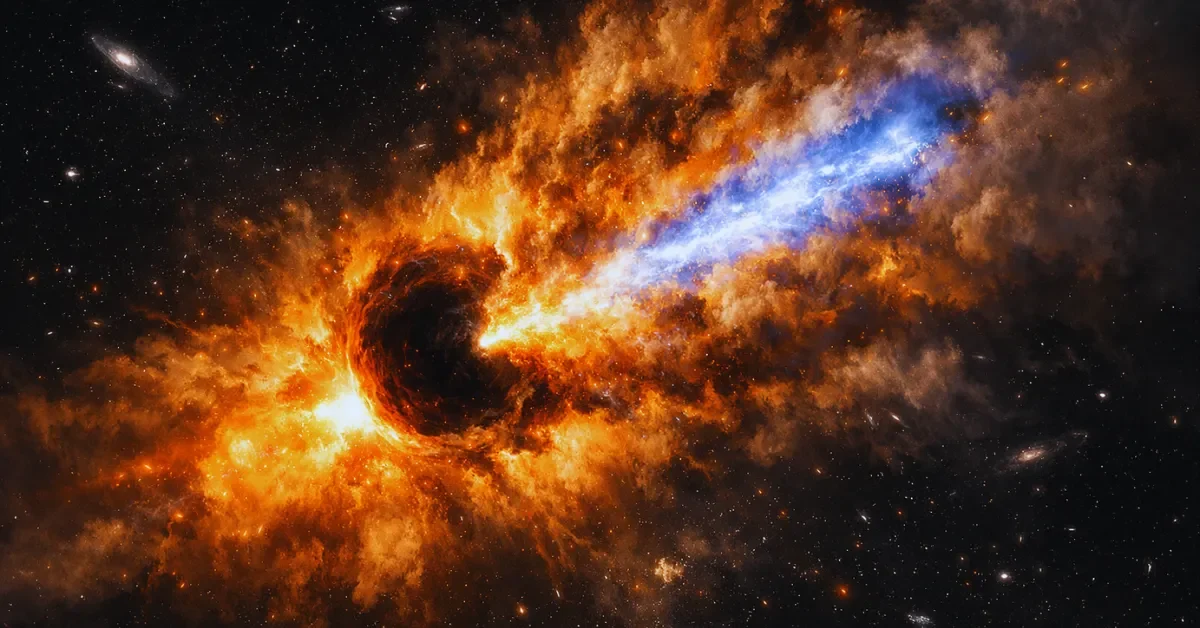
The recently launched Einstein Probe space telescope has captured a series of unprecedented cosmic explosions, fundamentally challenging our understanding of how massive stars end their lives. Among these groundbreaking observations are the first potential sighting of a “dirty fireball” star explosion and other exotic gamma-ray bursts that defy standard astrophysical models. These new astronomical discoveries reveal that the dramatic stellar deaths observed for the past six decades may only represent a fraction of a much more complex phenomenon.
The First Evidence of a Dirty Fireball
For over thirty years, physicists have theorized that when a massive star collapses into a black hole, the resulting explosion might not always produce a standard gamma-ray burst. Typically, these stellar collapses shoot an incredibly powerful beam of high-energy radiation through the star, unleashing as much energy in a single pulse as the Sun produces over its entire lifetime.
However, scientists hypothesized that if this relativistic jet became contaminated with heavier stellar material, such as protons and neutrons, the particles would act like a cosmic sponge. This heavy contamination would drag on the jet, slowing it down and forcing it to emit lower-energy X-rays instead of traditional gamma rays. Until recently, this theoretical dirty fireball scenario remained entirely unobserved in the universe.
A research team led by Xiang Yu Wang at Nanjing University in China believes they have finally captured this elusive event. Using the Einstein Probe, the team detected EP241113a, a powerful X-ray flash originating from a galaxy approximately nine billion light-years away. The explosion released energy comparable to a standard gamma-ray burst but entirely at X-ray frequencies. The initial flash transitioned into a glow that persisted for several hours before fading away, perfectly matching the predicted behavior of a dirty fireball.
Reactions from the Astronomical Community
Experts are highlighting the significance of this potential breakthrough. Rhaana Starling of the University of Leicester notes that while these events have been theorized since the 1990s, the astronomical community has never possessed conclusive evidence of their existence. Starling explains that whatever is driving this specific burst is likely interacting with the jet in unique physical ways, potentially offering astronomers a more complete picture of black hole formation.
Gavin Lamb from Liverpool John Moores University suggests that the traditional gamma-ray bursts we usually detect might actually be observational anomalies. He proposes that there could be a vast continuum of stellar explosions, ranging from powerful gamma-ray jets down to events with no jets at all.
However, some researchers remain cautious. Om Sharan Salafia of the Brera Astronomical Observatory emphasizes the need to definitively confirm the explosion’s extreme distance before drawing final conclusions about the transient phenomenon.
Ancient Explosions and Delayed Gamma Rays
The dirty fireball candidate is not the only exotic gamma-ray burst detected by the new observatory. On March 15, 2024, the Einstein Probe’s Wide-field X-ray Telescope recorded another deeply puzzling cosmic blast, designated EP240315a.
Follow-up observations traced this event to a galaxy 12.5 billion light-years away, meaning the explosion began its journey when the universe was only ten percent of its current age. The probe recorded soft X-rays fluctuating in brightness across six separate epochs over a span of 17 minutes. While NASA’s Swift observatory eventually detected an accompanying gamma-ray component, confirming the event as a gamma-ray burst, the timing baffled scientists.
In every previously recorded event, gamma rays dominate the early stages of the explosion when the jet is at its most energetic. In the March 15 event, the gamma-ray emission started long after the onset of the X-ray flash. This unprecedented delay contradicts standard emission models, leading researchers to suggest that the early X-rays might have originated from shockwaves within the supernova itself, or from weaker precursor jets that cleared a path for the primary blast.
Bridging the Gap Between Supernovae and Bursts
Just weeks later, on April 14, 2024, the telescope captured another unusual event. This occurrence featured a bright X-ray flash lasting roughly two and a half minutes. Ground-based optical and radio telescopes quickly pivoted to observe the location, detecting a weak afterglow alongside signatures typical of a standard core-collapse supernova.
Crucially, the spectral data showed the emission peaking at much softer energy levels than typical gamma-ray bursts, and no gamma-ray component was ever found. Astronomers believe this explosion produced a relativistic jet that simply lacked the energy necessary to generate gamma rays. This specific star appears to serve as a missing link, bridging the gap between standard supernova explosions and the extreme stellar deaths that trigger massive gamma-ray bursts.
A New Era of X-Ray Astronomy
The Einstein Probe, developed by the Chinese Academy of Sciences in collaboration with the European Space Agency and the Max Planck Institute for Extraterrestrial Physics, is rapidly transforming our view of the cosmos. Equipped with complex optics, the probe can observe an impressive one-eleventh of the sky at any given moment.
As older observatories age, the Einstein Probe is stepping into a vital role. By detecting these exotic, lower-energy X-ray bursts, the satellite is opening an entirely new window into the distant universe, proving that the deaths of massive stars are far more diverse and mysterious than scientists ever imagined.
