

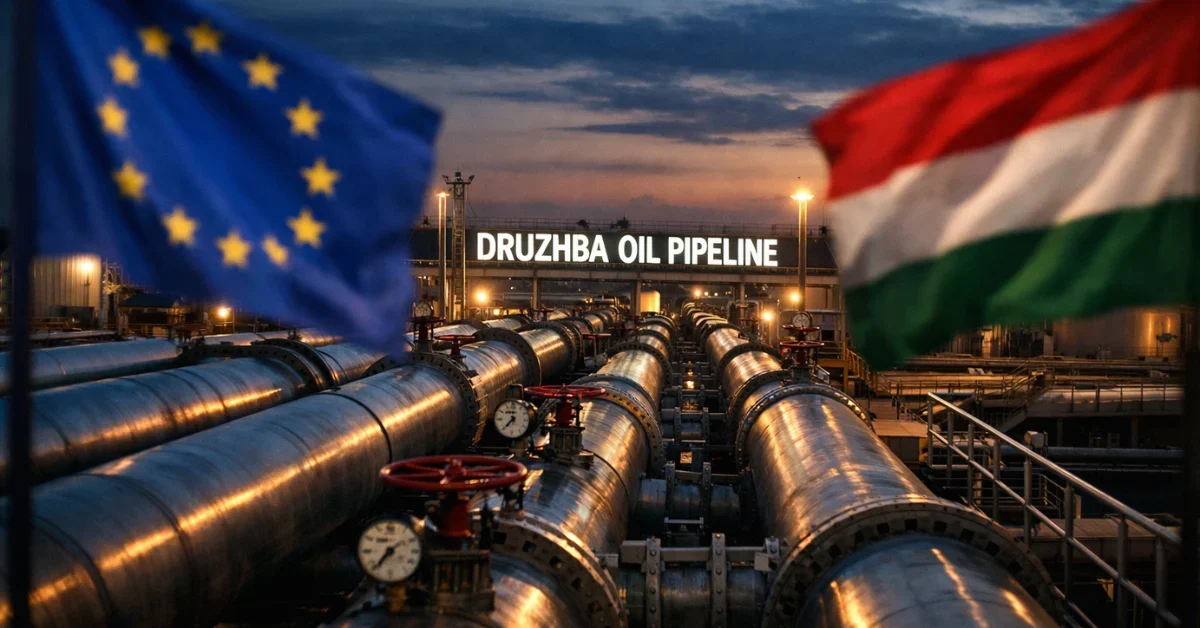
Hungary has announced it will block a €90 billion ($106 billion) European Union financial loan intended for Ukraine until Russian oil shipments through the Druzhba pipeline resume. Hungarian Foreign Minister Peter Szijjarto and Prime Minister Viktor Orbán confirmed the government’s intention to veto the emergency aid package, accusing the Ukrainian government of intentionally halting the vital energy transit. The standoff has escalated regional tensions just days before the anniversary of the ongoing war, creating a significant hurdle for European efforts to provide continued financial backing to Kyiv.
Disruption of the Druzhba Pipeline
The diplomatic dispute centers on the Soviet-era Druzhba pipeline, which transports Russian crude oil across Ukrainian territory to refineries in Hungary and Slovakia. Oil flows through the pipeline were halted following structural damage to the network.
Ukrainian officials state the pipeline was damaged by a Russian drone strike on January 27. The Hungarian government disputes this, accusing Ukraine of deliberately delaying repairs to restrict energy supplies. The Ukrainian government firmly denies these allegations. Because the sources present conflicting accounts, the exact cause of the stoppage remains a clear point of disagreement between Budapest and Kyiv.
To resolve the logistical challenges, Ukraine proposed that the European Union utilize alternative segments of its transport network. Kyiv suggested routing crude oil to Hungary and Slovakia through the Odesa-Brody pipeline to bypass the damaged sections.
Political Accusations and Election Tensions
The energy conflict arrives during a charged political season in Hungary, where Prime Minister Orbán faces a challenging parliamentary election on April 12. Recent polls show Orbán trailing opposition forces by double digits.
Hungarian officials have framed the pipeline disruption as a coordinated political attack. Foreign Minister Szijjarto claimed that the Ukrainian government, European Union officials in Brussels, and Hungarian opposition politicians are working together to disrupt energy supplies. Szijjarto argued that the goal of this alleged coordination is to create supply shortages and drive up domestic fuel prices right before the April elections.
Orbán stated on Facebook that Hungary will obstruct the war loan as long as Ukraine obstructs the pipeline, adding that his country will not be intimidated. Szijjarto posted on X that Ukraine’s actions violate the EU-Ukraine Association Agreement. He characterized the halted transit as “blackmail” and insisted Hungary would not succumb to coercion.
Orbán has historically maintained a critical stance toward Ukraine’s leadership. On the campaign trail, he has frequently portrayed Ukrainian President Volodymyr Zelenskyy as begging for funds and has suggested that admitting Ukraine into the EU would lead to a broader international conflict. Conversely, Kyiv has consistently urged European nations to stop purchasing Russian energy, arguing that the revenue directly finances Moscow’s ongoing invasion.
Strategic Reserves and Regional Responses
To mitigate the supply halt, the Hungarian government authorized the release of approximately one million barrels of crude oil from its strategic reserves. The Hungarian energy company MOL has priority access to this released crude oil until April 15, with a mandate to return the borrowed volume by August 24.
Despite the government’s move, alternative transit options remain available. Croatia’s JANAF pipeline operator noted that Hungary did not necessarily need to tap into its emergency reserves. The operator stated that MOL could simply permit the transit of Russian seaborne oil through the JANAF network while the Druzhba pipeline remains out of commission. Additionally, the Hungarian Hydrocarbon Stockpiling Association reported that as of late January, the country still possessed sufficient oil and petroleum product reserves to last for 96 days.
The energy disruption has also heavily impacted neighboring Slovakia. The Slovak government declared an oil emergency and committed to releasing one million barrels of oil for the Slovnaft refinery, which is owned by MOL. Slovak Prime Minister Robert Fico announced the state of emergency and warned of potential repercussions against Ukraine if the pipeline is not restored. Furthermore, Slovak Economy Minister Denisa Sakova noted that Ukraine had delayed the restart of oil deliveries until February 24.
Obstacles to European Union Aid
The blocked €90 billion financial package is designed to support Ukraine over a two-year period. European Union leaders agreed to the substantial loan in December, and the European Parliament ratified the measure recently.
Releasing the funds requires unanimous consent among member states because the legislation amends EU budget rules to allow borrowing for a non-EU member. The loan is financed by common debt backed by the broader EU budget. Notably, during the initial negotiations, Hungary, Slovakia, and the Czech Republic secured specific exemptions that relieve them from financially contributing to the borrowing expenses of the loan.
Despite these exemptions, Hungarian representatives formally raised objections to the loan during a closed-door meeting of EU ambassadors. In response to the escalating crisis, the European Commission has convened an emergency meeting for next week. While Brussels does not currently see an immediate risk to Hungary’s overall oil reserves, the diplomatic deadlock threatens to significantly delay the distribution of critical financial aid to Ukraine.
