

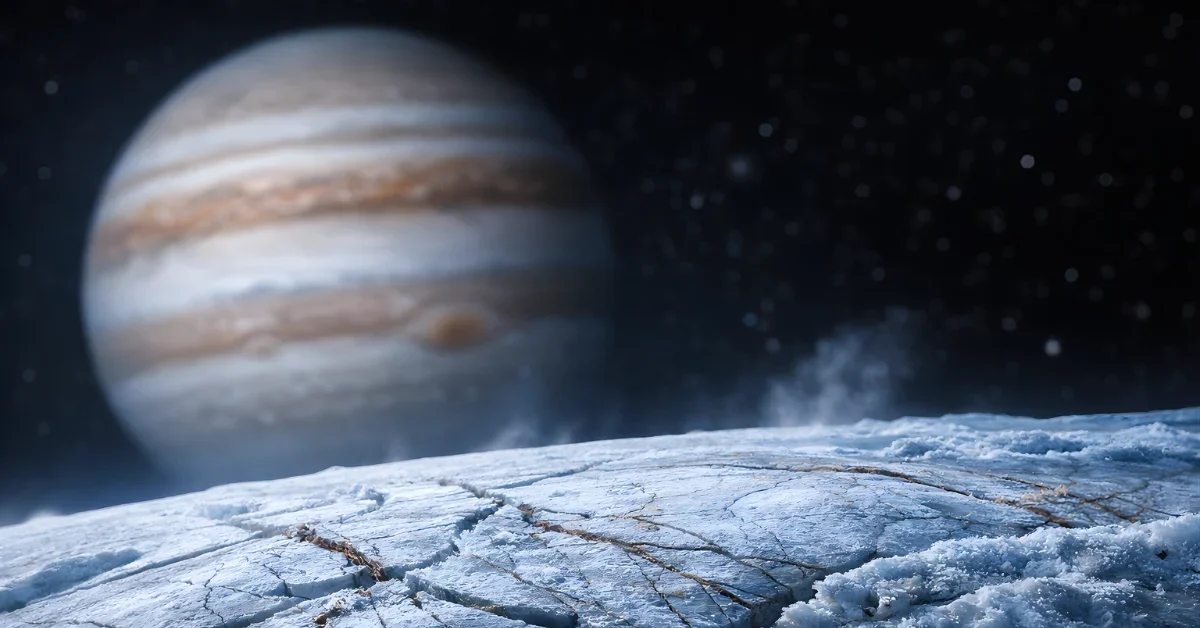
New research suggests Europa’s salty, nutrient-rich surface ice can become dense enough to break away and sink through the moon’s ice shell, delivering key ingredients to the ocean below. The study offers a potential answer to a long-running question about how Europa’s buried ocean could get the nutrients and energy sources needed for life in a place where sunlight cannot reach.
The work comes from geophysicists at Washington State University and is described as a new idea in planetary science inspired by a well-known Earth process called crustal delamination. The researchers used computer simulations to test whether heavier, salt-rich ice could separate from surrounding ice and slowly sink downward until it reaches the ocean beneath the shell.
A new route for ocean nutrients
Europa is considered one of the most promising places in the solar system to search for extraterrestrial life, partly because it has a global ocean hidden beneath ice. Scientists have struggled to explain how life-supporting materials could travel from the surface down to that ocean when a thick ice shell separates the two environments.
In the new modeling work, the team suggests that “dense ice packed with nutrients” can detach and descend, recycling surface material and delivering nutrients to the ocean. The researchers describe the process as fast on geological timescales, repeatable, and able to work under many conditions. Their simulations indicate the sinking can occur across a wide range of salt levels, as long as the surface ice is even modestly weakened.
Why Europa’s ice shell matters
Europa’s ocean sits under ice so thick that it blocks sunlight entirely, which means any potential life would need nutrient and energy sources that do not depend on the Sun. This creates what the researchers describe as a “habitability puzzle” because sunlight-driven ecosystems are not possible in an ocean sealed beneath ice.
At the same time, Europa is exposed to intense radiation from Jupiter, and that radiation can react with salts and other materials on the surface to produce compounds that could serve as nutrients for microbes. While scientists know these nutrient-related compounds can exist on the surface, it has been unclear how they could move down through the ice to the ocean. The sources also note that Europa’s surface is geologically active due to Jupiter’s gravitational forces, but much of the movement is described as sideways rather than the downward motion needed for regular surface-to-ocean exchange.
Earth geology, adapted to Europa
To tackle the transport problem, the researchers drew from crustal delamination, a process on Earth in which part of the crust becomes compressed, chemically altered, and dense enough to detach and sink into the mantle. The team’s idea is that a comparable mechanism could happen in Europa’s ice shell if parts of the surface ice become salty enough to increase density and weak enough to detach.
The sources describe how some areas of Europa’s ice shell may contain high concentrations of salt, making the ice denser than surrounding, purer ice. They also cite past findings that impurities can weaken ice crystal structure, making impure ice less stable than pure ice. In the proposed scenario, this combination—greater density plus structural weakening—allows salt-rich ice to break away and sink deeper, potentially reaching the ocean at the base of the ice shell.
Austin Green, the lead author and a postdoctoral researcher at Virginia Tech, described the work as an Earth-inspired approach that speaks to Europa’s habitability question. “This is a novel idea in planetary science, inspired by a well-understood idea in Earth science,” Green said. “Most excitingly, this new idea addresses one of the longstanding habitability problems on Europa and is a good sign for the prospects of extraterrestrial life in its ocean.”
What the study says next
The research was published in The Planetary Science Journal and is authored by Green and Catherine Cooper, an associate professor of geophysics at Washington State University and an associate dean in the College of Arts and Sciences. The ScienceDaily release says the work used computer simulations and was supported in part by a NASA grant, with computing resources provided by Washington State University’s Center for Institutional Research Computing.
The findings are also framed as relevant to NASA’s Europa Clipper mission, which launched in 2024 and is designed to study Europa’s ice shell, subsurface ocean, and habitability using scientific instruments. In that context, the study’s central claim is straightforward: if salty, nutrient-rich surface ice can repeatedly sink through the shell, Europa’s ocean may have an ongoing supply route for important chemicals that could support life.
