

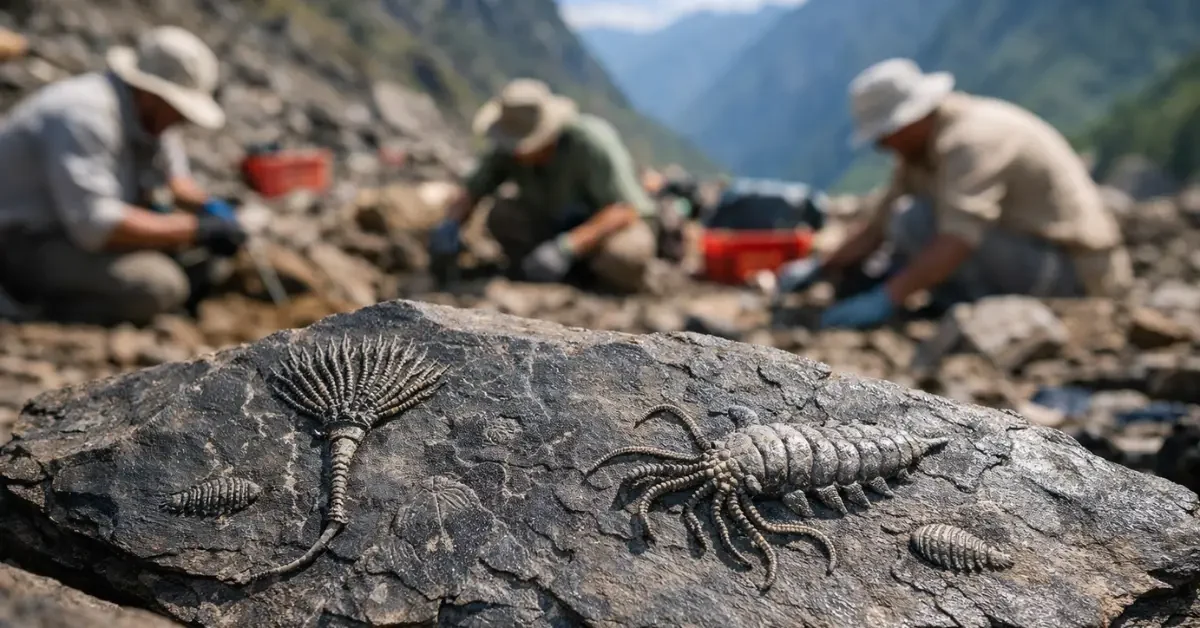
A newly discovered fossil site in southwest China is fundamentally transforming our understanding of how complex animal life emerged on Earth . This unprecedented fossil discovery in China, located in Yunnan Province, includes an extraordinary treasure trove of more than 700 specimens that pushes back the origins of complex animals by at least 4 million years . The study, published on April 2 in the journal Science, reveals that many major animal lineages had already evolved and diversified well before the famous Cambrian explosion .
Previously, scientists widely believed that the rapid diversification of complex animal life began at the start of the Cambrian Period, approximately 535 million years ago . Fossils from the preceding Ediacaran Period, spanning from 575 million to 539 million years ago, traditionally lacked the detailed anatomical evidence needed to prove that complex animals existed earlier . However, the newfound Jiangchuan Biota in China closes this evolutionary gap, demonstrating that physically complex creatures were thriving between 554 and 539 million years ago .
Unearthing the Jiangchuan Biota
The discovery unfolded over several years of dedicated fieldwork . In 2022, paleontologist Gaorong Li and his colleagues at Yunnan University were initially collecting Ediacaran algae fossils when they spotted strange, unidentifiable fragments . The breakthrough came in 2023 when the researchers uncovered preserved cylindrical animals . These unusual creatures, dubbed “bugle worms,” featured a flat pad on one end and an extendable, flag-shaped proboscis near their mouths . Following this initial success, researchers from the University of Oxford joined the expedition in 2024, helping to recover roughly 700 late Ediacaran fossils in total .
Among the most remarkable finds are the oldest known relatives of deuterostomes, a broad biological group that includes modern vertebrates such as humans and fish . Researchers identified ancestors of modern starfish and acorn worms, known as Ambulacraria . These ancient marine animals had U-shaped bodies, attached themselves to the seafloor using a stalk, and used a pair of tentacles on their heads to catch food . According to Frankie Dunn, a co-author from the Museum of Natural History at Oxford University, the presence of these fossils implies that chordates—animals with a backbone—must have also existed during this ancient timeframe .
Bizarre Anatomies and Bilateral Symmetry
The fossil site also revealed a bizarre array of anatomical features that do not match any previously known Ediacaran or Cambrian species . Researchers discovered rare fossils interpreted as early comb jellies, alongside radially symmetrical animals resembling a living martini glass with rim tentacles, similar to the previously discovered Haootia . Other specimens looked like “sausages on skewers” equipped with feathery feeding appendages . The diversity of shapes and structures was so astonishing that Dunn noted one particular specimen closely resembled the fictional sand worms from the novel Dune .
A particularly crucial aspect of the discovery is the abundance of bilaterian animals, which possess symmetrical right and left sides . Prior to this find, only four species of bilaterians were known from the Ediacaran Period . The Yunnan University and Oxford team uncovered more than 180 bugle worm fossils alone, proving that bilateral symmetry was far more common than previously thought . Emmy Smith, a paleontologist at Johns Hopkins University, emphasized that the specialized feeding structures on these bilaterians indicate a high level of physical complexity, strengthening the view that major animal groups were diversifying well before the Cambrian .
A Rare Window Through Carbonaceous Films
The extraordinary quality of these fossils is largely due to their unique preservation method . Unlike most Ediacaran fossils, which are typically preserved as rough impressions on sandstone, the Jiangchuan Biota fossils were preserved as carbonaceous films . This style of preservation, more commonly associated with famous Cambrian sites like Canada’s Burgess Shale, captures incredible anatomical details, including guts, locomotory organs, and delicate feeding structures . Ross Anderson, an associate professor at Oxford University, explained that the apparent absence of these complex animals in other Ediacaran sites might simply be due to differing preservation conditions rather than the animals not existing .
This newly uncovered fossil record helps resolve a long-standing mystery in evolutionary biology . Molecular studies and trace fossils had long suggested that animal lineages diversified earlier than the Cambrian explosion, but the physical fossil evidence had been missing . Lead author Gaorong Li stated that this gradual buildup of complex life proves the Cambrian explosion did not simply appear out of nowhere . Instead, it was the continuation of an evolutionary process that was already well underway .
The Jiangchuan Biota represents a crucial transitional community . According to Luke Parry, an associate professor at Oxford University, the site beautifully captures the weird, alien-like world of the Ediacaran giving way to the more familiar animal groups of the Cambrian Period . Moving forward, researchers aim to determine exactly how these complex Ediacaran animals are related to their Cambrian descendants, offering a clearer picture of where familiar animal groups got their evolutionary start .
