

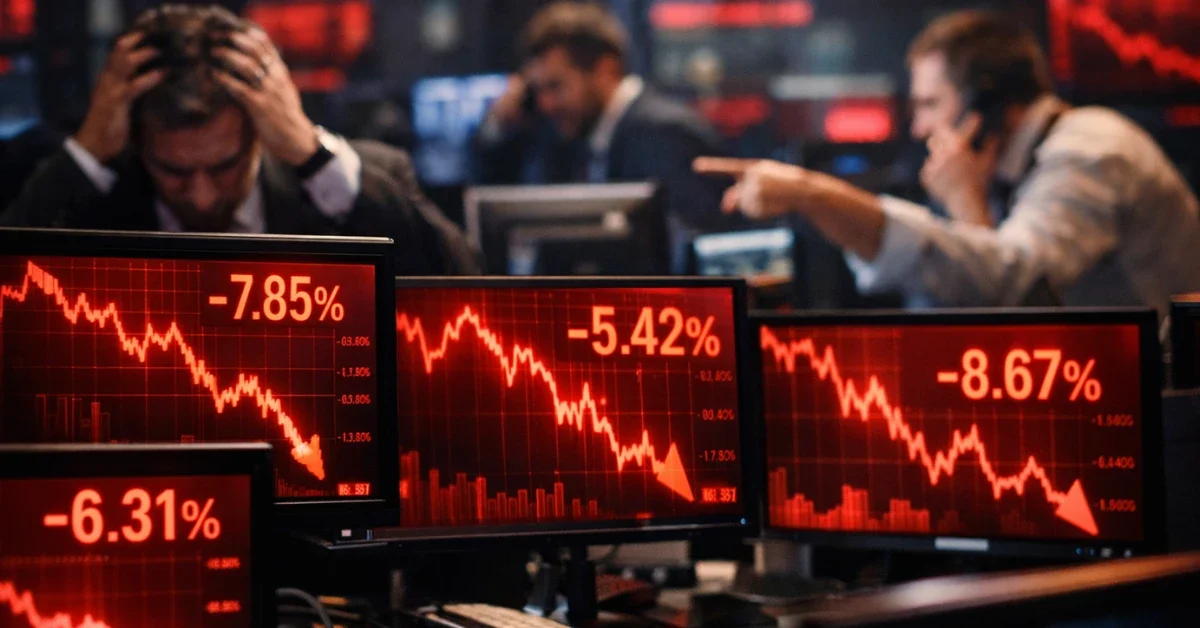
The escalating conflict in the Middle East is sending shockwaves through the global economy, causing a severe global markets slide. Investors are rapidly selling off equities and repricing risk following a combined United States and Israel attack on Iran, followed by Iranian drone strikes on the US Embassy in Riyadh, Saudi Arabia. The geopolitical turmoil has triggered a massive spike in oil prices, renewed inflation fears, and a broad selloff across major international stock exchanges.
As tensions rise, the US ordered emergency evacuations for personnel in Bahrain, Iraq, and Jordan, while Hezbollah launched missiles toward Tel Aviv. Market anxiety intensified further when President Donald Trump indicated the conflict could extend beyond four weeks, telling reporters that the US would commit to “whatever it takes.” These developments have left traders scrambling to adjust to a crisis with no immediate exit date, driving severe volatility across equities, commodities, and digital assets.
US Markets Face Steep Declines Amid Tech Selloff
Wall Street experienced significant losses as traders reacted to the widening conflict. Reports on the exact market drops vary among financial news outlets. According to The Economic Times, the Nasdaq Composite plunged 519.74 points, or 2.28%, to 22,229.11, and the S&P 500 fell 2.2%. In contrast, NDTV Profit and The Washington Times reported that the Nasdaq declined between 1.7% and 1.8%, while the S&P 500 dropped 1.6%. The Dow Jones Industrial Average sank between 840 and 880 points, representing a decline of roughly 1.7% to 1.8%.
Technology stocks, which carry heavy weight in major indices, absorbed some of the hardest hits. Intel dropped 6.42%, Nokia lost over 5%, and Bitcoin miner TeraWulf slid 7.41%. Reports conflict on Nvidia’s performance; The Economic Times and The Washington Times state the chipmaker slipped between 1.7% and 2% to $178.87, whereas The Federal noted that Nvidia shares rose 2.9%. The broader risk-off sentiment also dragged down cryptocurrency markets, with Bitcoin falling nearly 2% to $67,564 and Ethereum dropping 3.38%.
Crude Oil Surges as Middle East Tensions Escalate
Energy markets are signaling severe supply chain fears as targets expand to areas critical to worldwide oil and natural gas production. Much of the anxiety centers on the Strait of Hormuz, a critical passageway for a fifth of global oil. Iranian Brigadier General Ebrahim Jabbari declared the strait closed, warning that passing ships would be set on fire.
This threat caused immediate spikes in crude prices, though exact figures differ across reports. The Economic Times and The Washington Times reported that WTI Crude jumped nearly 8% to around $76.63 to $76.92 per barrel, while Brent Crude climbed over 5.75% to between $80.54 and $83.79. Alternatively, The Federal reported a milder increase, with US crude rising 77 cents to $72.00 and Brent adding $1.10 to $78.84. The surging energy costs quickly reached consumers, with the average US gasoline price jumping 11 cents overnight to $3.11 per gallon. Heating oil also surged more than 13%, and natural gas gained over 6%.
Asian and European Exchanges Suffer Heavy Losses
The market rout extended deep into Asia. In India, the BSE Sensex closed 1,048 points, or 1.3%, lower at 80,239, while the Nifty 50 dropped 313 points to 24,866. This selloff left Indian investors poorer by Rs 6.6 lakh crore, driven heavily by foreign fund outflows totaling Rs 3,300 crore and major declines in companies like Reliance Industries and L&T. The NSE volatility index, a key fear gauge, jumped 25%.
Across the rest of Asia, indices plummeted, though sources disagree on the severity. The Washington Times reported that Japan’s Nikkei 225 dropped 3.1% and South Korea’s Kospi plunged 7.2%. Meanwhile, The Federal stated the Nikkei sank 2.1% to 56,853.48 and South Korean shares sank 4.8% to 5,946.06. A third report from The Times of India noted the Nikkei fell 1.4%. Discrepancies also appeared regarding Chinese markets; The Times of India reported the Hang Seng down 2.1% and Shanghai up 0.5%, while The Federal stated the Hang Seng shed 0.1% and Shanghai lost 0.3%. European markets mirrored the downward trend, with Germany’s DAX falling between 2.6% and 3.6% and the UK’s FTSE down 1.3%.
Inflation Concerns and Mixed Asset Reactions
Rising energy costs are renewing fears that inflation will re-accelerate, potentially forcing the Federal Reserve to delay expected interest rate cuts. In response, bond markets signaled tighter financial conditions. The 10-year Treasury yield rose from 3.97% to above 4.04%, peaking near 4.10% before settling around 4.06% to 4.07%.
Higher fuel costs also hammered the aviation sector, with American Airlines falling 3.1%, United Airlines dropping 2.4%, and Korean Air plunging 8.9%. Conversely, defense contractors like Northrop Grumman and RTX rallied as military spending expectations grew.
Meanwhile, traditional safe-haven assets showed conflicting movements. According to The Economic Times, gold dropped 4.61% to $5,067 due to liquidity-driven selling and a stronger US dollar. However, The Federal reported that gold climbed 1.2% as investors sought safety amid the widening conflict.
