

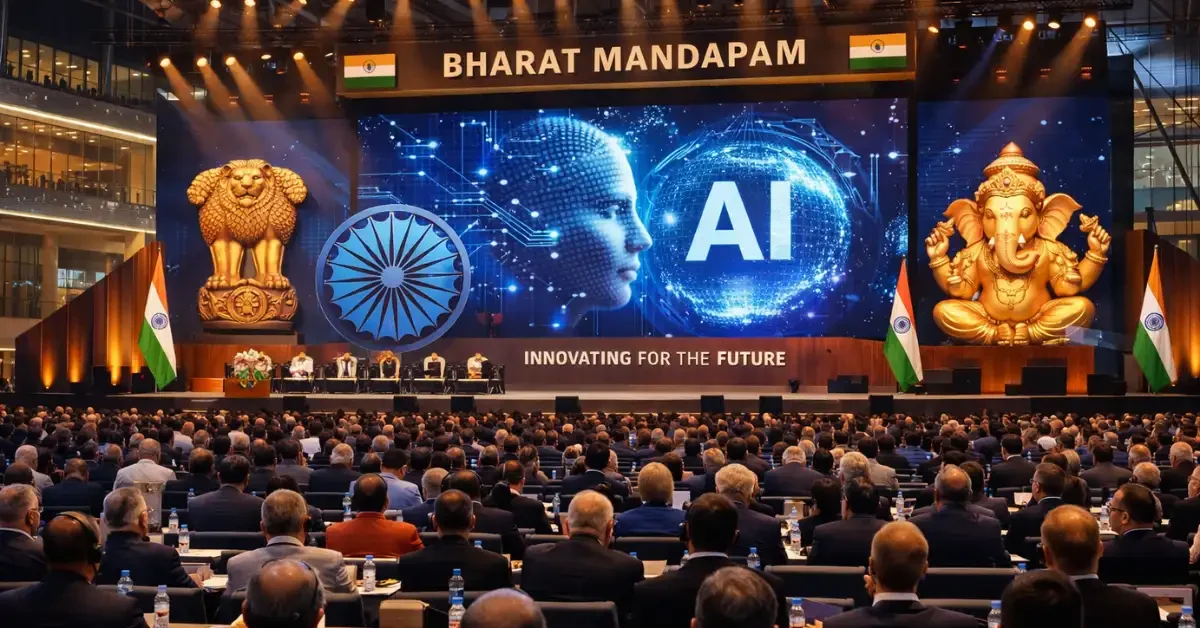
The India AI Impact Summit 2026 has commenced at Bharat Mandapam in New Delhi, marking the first global artificial intelligence gathering of this magnitude to be hosted in the Global South. Prime Minister Narendra Modi will deliver the inaugural address on February 19, setting the stage for international cooperation and outlining India’s vision for inclusive and responsible artificial intelligence.
The five-day summit, running from February 16 to 20, has drawn remarkable global participation. Over 100 government representatives are attending, including more than 20 heads of state and government alongside 60 ministers and vice ministers. The event brings together more than 500 global AI leaders, comprising CEOs, founders, academicians, researchers, chief technology officers, and philanthropic organizations.
Three Pillars Guide Summit Framework
The summit operates under the theme “सर्वजन हिताय, सर्वजन सुखाय,” which translates to “welfare for all, happiness of all.” This vision rests on three foundational pillars known as Sutras: People, Planet, and Progress. These principles aim to position India as a leader in artificial intelligence while envisioning a future where AI advances humanity, fosters inclusive growth, and safeguards the shared planet.
Building upon these three Sutras, the summit has structured its deliberations around seven Chakras representing key areas of multilateral cooperation. These working groups focus on AI for economic growth and social good, democratization of AI resources, inclusion for social empowerment, safe and trusted AI, human capital development, scientific advancement, and resilience, innovation, and efficiency.
Major Events and Knowledge Outputs
On February 19, Prime Minister Modi will participate in multiple high-profile engagements. The Opening Ceremony, scheduled for approximately 9:40 AM, will also feature addresses from the President of France, the Secretary-General of the United Nations, and various top industry leaders from around the world. Following this, around 11 AM, Modi and other leaders will visit the India AI Impact Expo 2026 to tour various country pavilions.
The Leaders’ Plenary will convene around noon, bringing together heads of state, ministers, and senior representatives from multilateral institutions to outline national and global priorities on AI, including governance, infrastructure, and international cooperation. Later that evening, starting at 5:30 PM, Modi will participate in a CEO roundtable where senior executives from global technology and industry firms will meet with government leadership to discuss investment, research collaboration, supply chains, and deployment of AI systems.
The summit features the release of Knowledge Compendiums on AI applications in health, energy, education, agriculture, gender empowerment, and accessibility. These casebooks, released on February 17, document real-world applications of artificial intelligence across priority sectors and will serve as reference resources for practitioners and stakeholders.
Global Impact Challenges Showcase Innovation
A major highlight of the summit is the three flagship Global Impact Challenges: AI for ALL, AI by HER, and YUVAi. These challenges were designed to identify scalable, development-oriented AI solutions aligned with national priorities. Together, they received over 4,650 applications from more than 60 countries, reflecting strong global participation and innovation interest.
Following a rigorous multi-stage evaluation by domain experts, policymakers, and industry leaders, 70 finalists have been selected to showcase their solutions at the Grand Finale and Awards Ceremony. The finalists presented their innovations on February 16 and 17 at Bharat Mandapam and Sushma Swaraj Bhawan in New Delhi, engaging with policymakers, industry leaders, investors, and academia while gaining recognition and ecosystem support to scale their innovations nationally and globally.
Research and Regional Preparedness
The Research Symposium on AI and Its Impact, organized in partnership with Indian Institute of Technology Hyderabad on February 18, serves as the principal academic platform of the summit. The symposium received around 250 research submissions from Africa, Asia, and Latin America. It was graced by the President of the Republic of Estonia, Alar Karis, along with Union Minister for Electronics and Information Technology Ashwini Vaishnaw and Union Minister of State for Electronics and Information Technology Jitin Prasada.
As preparation for the summit, eight regional AI conferences were held between October 2025 and January 2026 across Meghalaya, Gujarat, Odisha, Madhya Pradesh, Uttar Pradesh, Rajasthan, Kerala, and Telangana. These conferences, partnered with state governments, identified region-specific AI use cases, policy inputs, and capacity gaps to inform the summit’s agenda and outcomes.
Institutional Framework and Expected Outcomes
The summit is supported by core government institutions, with the Ministry of Electronics and Information Technology providing overall policy direction. The IndiaAI Mission, a flagship mission supporting AI development in India, shapes the core themes including AI compute infrastructure, datasets, indigenous AI models, skilling, and startup support. Software Technology Parks of India supports the innovation and participation of startups, small and medium enterprises, and innovators, while the Digital India framework provides the foundation for large-scale AI adoption.
On February 20, high-level Global Partnership on AI Council Meetings will convene member countries to review progress, align priorities, and strengthen multilateral cooperation on responsible and inclusive AI. The Leaders’ Declaration will be adopted, affirming collective commitments and outlining a shared roadmap for global AI governance and collaboration.
The summit is expected to deliver focused, outcome-driven results aligned with national priorities. It aims to strengthen governance and regulatory frameworks, assess regional preparedness for AI-led industrial growth, and promote skill development and workforce transition. The event also seeks to expand awareness and understanding of AI applications while fostering sustained partnerships among government, academia, startups, and industry to enable responsible and inclusive growth of the AI ecosystem.
