

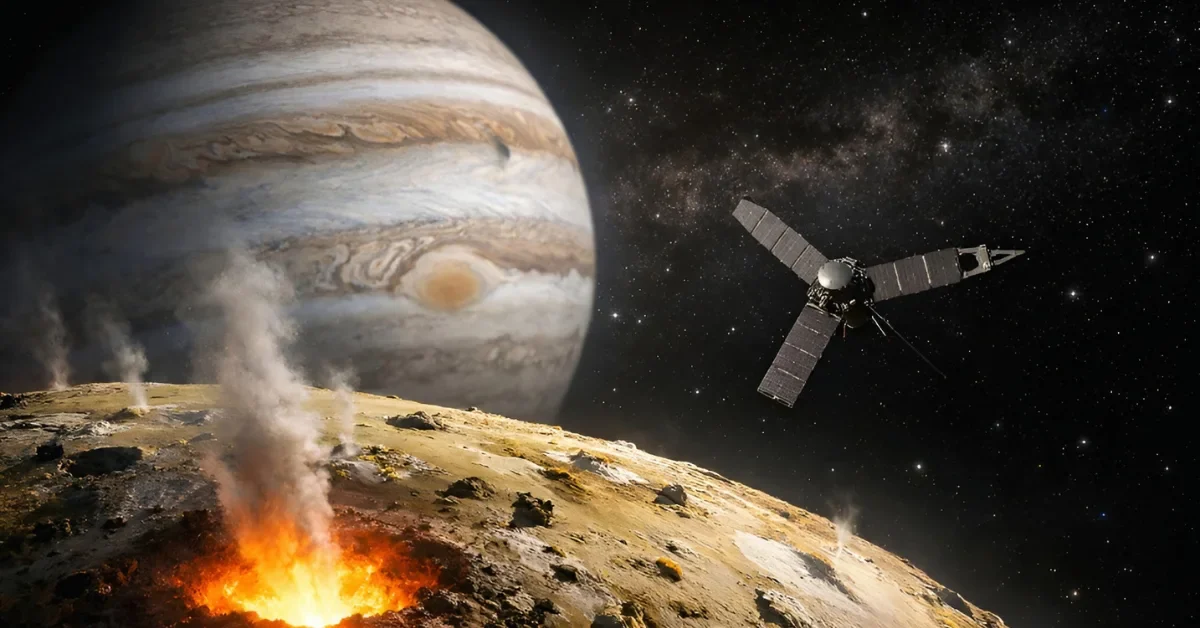
NASA’s Juno spacecraft has captured a record-breaking Io volcanic eruption, revealing the most powerful volcanic event ever observed on Jupiter’s moon and anywhere in the solar system beyond Earth. The giant hotspot, detected in Io’s southern hemisphere, stretches across roughly 40,000 square miles and dwarfs previous eruptions seen on this already hyperactive world.
The December 27, 2024 flyby showed that this Io volcanic eruption is releasing more energy than any eruption ever recorded on the moon, with estimates suggesting output several times greater than all of Earth’s power plants combined. NASA scientists say the feature is larger than Earth’s Lake Superior, underscoring the sheer scale of the activity on the most volcanic body in the solar system.
Most powerful eruption ever seen
Scientists describe the newly observed hotspot as the most intense volcanic eruption recorded on Io, and the most energetic eruption seen anywhere in the solar system beyond Earth. A NASA mission update reports that the total power of the hotspot’s radiance is well above 80 trillion watts, while an astronomy news report places the eruption’s energy in the range of 140 to 260 terawatts, far above earlier events.
For comparison, a famous eruption from Io’s volcano Surt in 2001 was estimated at about 80 terawatts, while the 1980 Mount St. Helens eruption on Earth had a power of about 52 terawatts. The newly detected hotspot also outclasses Loki Patera, a vast lava lake on Io that spans about 7,700 square miles, making this latest event the largest volcanic feature ever measured on the moon.
What Juno saw over Io
Juno has been orbiting Jupiter for nearly a decade, and its extended mission has brought it repeatedly past Io to study the moon’s extreme volcanism in greater detail. During earlier close flybys in December 2023 and February 2024, the spacecraft skimmed within about 930 miles of Io’s surface, setting the stage for the more distant but still revealing pass in December 2024.
On that latest flyby, Juno passed about 46,200 miles above Io’s surface with its Jovian Infrared Auroral Mapper (JIRAM) instrument focused on the southern hemisphere. JIRAM, originally designed to peer beneath Jupiter’s clouds and study its auroras, detected an event of such extreme infrared brightness that it saturated the detector, signaling a massive hotspot below.
Juno’s visible-light camera, JunoCam, also captured images of the region during this pass. By comparing these views with images from previous Io flybys in April and October 2024, the team saw clear changes in surface coloring around the hotspot, a known sign of recent volcanic deposits and activity on Io.
A tormented volcanic world
Io is roughly the size of Earth’s moon, but its environment is far more violent due to its close, fast, and elliptical orbit around Jupiter. The moon completes one orbit every 42.5 hours, and as its distance from the giant planet changes, Jupiter’s powerful gravity squeezes and flexes Io’s interior.
This relentless tidal tug-of-war, aided by gravitational pulls from neighboring moons Europa and Ganymede, generates intense internal friction and heat that melt large parts of Io’s interior. The result is a world covered by an estimated 400 active volcanoes, where molten rock constantly erupts to the surface, refilling impact craters and renewing the landscape with lava and ash.
According to NASA, the tidal forces can cause Io’s surface to bulge up and down by as much as about 330 feet, further highlighting how extreme these internal stresses are. Over time, this process has turned Io into the most volcanic object known in the solar system, with a surface repeatedly reshaped by eruptions like the newly observed blast.
Clues to a sponge-like interior
One of the most striking aspects of the December 2024 event is that it did not come from a single volcano, but from multiple hotspots that brightened at nearly the same moment. Scientists report that these active sources increased in brightness by more than a thousand times compared with typical levels, suggesting a coordinated, large-scale eruption.
Researchers interpret this synchrony as evidence of a vast system of interconnected magma reservoirs beneath Io’s crust. One team likens the moon’s subsurface and mantle to a sponge filled with magma, where linked pockets of molten rock can be triggered together, releasing energy across hundreds of kilometers.
Interestingly, not all known volcanoes in the region erupted during this event, which hints that different volcanic centers may tap into separate magma networks. The new data may help scientists map out how these networks are organized and how energy moves through Io’s interior during major eruptions.
What scientists hope to learn next
A volcanic outburst of this scale is expected to leave long-lasting marks on Io’s surface. Past large eruptions on the moon have produced features such as pyroclastic deposits made of rock fragments, small lava flows emerging from fissures, and broad plume deposits rich in sulfur and sulfur dioxide.
Mission teams plan to use Juno’s next, more distant flyby of Io on March 3 to revisit the hotspot and look for new lava flows, ash deposits, and color changes around the eruption site. Observatories on Earth may also be able to monitor the region, giving scientists multiple ways to track how Io’s surface evolves after this record-breaking event.
Researchers say this extraordinary eruption does more than rewrite the record books. By exposing the hidden plumbing of Io’s interior, the event could sharpen understanding of how volcanism works not only on this tortured moon, but also on other worlds where internal heat and tidal forces drive dramatic geological change.
