

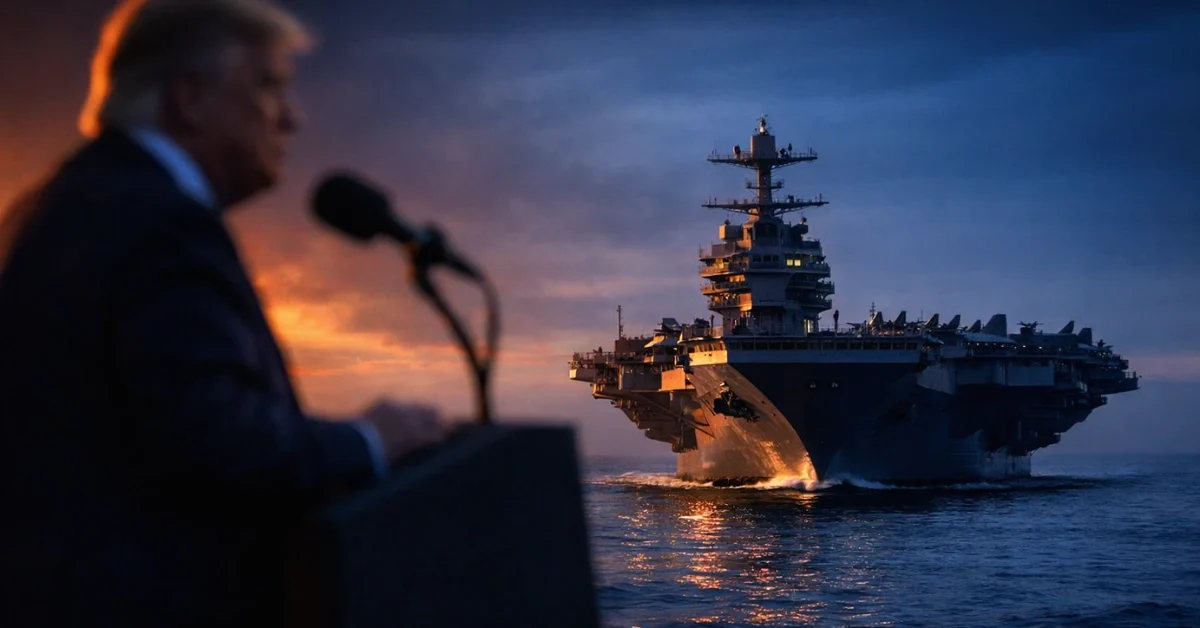
U.S. President Donald Trump has confirmed he is contemplating a limited military strike against Iran as diplomatic tensions intensify over the nation’s nuclear ambitions . When questioned by a journalist at a White House breakfast with U.S. governors on Friday, Trump acknowledged the possibility of military action, stating that he is actively considering it . This stark warning arrives just as officials in Tehran announce that a draft Iran nuclear deal is nearing completion . To exert maximum pressure on Tehran, Washington has orchestrated a substantial naval buildup in the Middle East, setting the stage for a high-stakes geopolitical standoff .
The Deadline and Ongoing Negotiations
The current escalation follows a strict timeline imposed by the U.S. administration . Trump initially issued a 10-day ultimatum for Iran to reach a nuclear agreement, a window he recently extended to 15 days . Speaking on Thursday at the inaugural session of his “Board of Peace”—an initiative aimed at the post-war Gaza Strip—the president cautioned that failure to secure a meaningful deal would result in severe consequences, warning that “bad things happen” otherwise .
Despite the looming threat of a limited military strike, Iranian officials have presented a more optimistic view of the diplomatic proceedings . Following discussions in Geneva with U.S. Special Envoy Steve Witkoff and presidential adviser Jared Kushner, Iranian Foreign Minister Abbas Araghchi characterized the meetings as constructive . Araghchi announced that both parties agreed to submit drafts of a potential accord as the next step .
According to Araghchi, the Iranian draft will be finalized within two to three days . Once confirmed by his superiors, the document will be handed to Witkoff, Trump’s chief negotiator for the Middle East . Araghchi dismissed the notion of an impending deadline, telling U.S. network MS NOW that “there is no ultimatum” . Instead, he emphasized that both nations are motivated to expedite a swift agreement . Iran has a pressing incentive to accelerate talks, as the country is eager to secure relief from crippling economic sanctions .
Conflicting Claims on Uranium Enrichment
While both sides express a desire for a resolution, significant discrepancies remain regarding the specific terms of the deal . A primary point of conflict is the future of Iran’s uranium enrichment capabilities . In his interview, Araghchi claimed that American negotiators did not demand a complete halt to enrichment activities . He stated that Iran has not offered any suspension and that the U.S. side has not requested “zero enrichment” . The foreign minister noted that current discussions focus exclusively on ensuring Iran’s nuclear program remains peaceful indefinitely .
This narrative sharply contradicts the official stance of the United States . Senior U.S. officials, including Trump, have consistently maintained that Iran should not be permitted to enrich uranium at any level . Western nations accuse the Islamic Republic of covertly attempting to develop nuclear weapons . Tehran firmly refutes these allegations, asserting its sovereign right to enrich uranium for civilian applications . Beyond the nuclear issue, Washington aims to address Iran’s advancing ballistic missile capabilities and its support for militant groups, topics that Israel advocates including in the negotiations .
Military Buildup and Regional Fallout
The diplomatic maneuvering is accompanied by a massive projection of military power . Trump has ordered a formidable naval fleet to the Middle East to reinforce the administration’s position . The U.S. previously deployed the USS Abraham Lincoln and accompanying ships to the Gulf . In a further show of force, the aircraft carrier USS Gerald Ford was observed navigating through the Strait of Gibraltar on February 20, heading toward the region .
Iran has responded with its own demonstrations of military readiness . This week, Iranian naval forces conducted military exercises in the Gulf and around the Strait of Hormuz . Furthermore, Iran’s ambassador to the United Nations, Amir Saeid Iravani, warned that U.S. bases, military facilities, and assets would become legitimate targets if Washington acts on its strike threats . Meanwhile, the Israeli military announced on Friday that its forces are on high alert regarding Iran, although public safety guidelines remain unchanged .
Background of the Crisis
The renewed diplomatic push began with an initial round of talks in Oman on February 6 . These discussions mark the first direct dialogue since previous negotiations collapsed during a 12-day conflict between Iran and Israel last June, which saw the U.S. launch strikes against Iranian nuclear sites .
The urgency for a deal is heavily driven by Iran’s internal crises . Economic hardships ignited public protests in December that escalated into a nationwide anti-government movement last month . This uprising led to a severe government crackdown, which reports indicate resulted in up to 30,000 fatalities, with rights groups suggesting the death toll could be even higher . As the U.S. weighs its military options, the region braces for the outcome of this delicate diplomatic gamble .
