

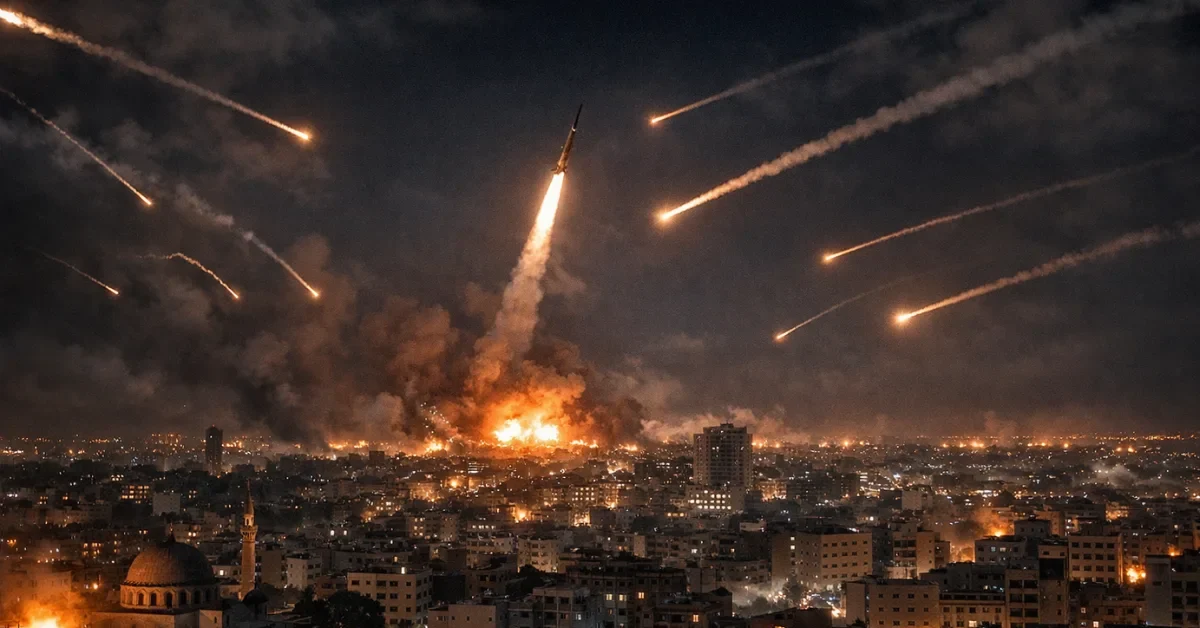
The rapidly expanding Middle East conflict entered a volatile new phase on Thursday as Iran launched a fresh wave of ballistic missiles at Israel and United States military installations. The latest attacks follow severe U.S. and Israeli airstrikes targeting Iran’s leadership, nuclear program, and missile capabilities. The hostilities, which commenced on Saturday, have triggered major regional instability, drawing in neighboring countries and prompting the U.S. State Department to begin evacuating American citizens from the region.
New Missile Attacks on Israel and US Targets
In response to the allied bombardment, Iran fired missiles at central Israel, Jerusalem, and the northern West Bank, forcing millions of residents into bomb shelters. The Israeli military reported that it actively worked to intercept the incoming fire, sounding sirens across multiple territories. Following Thursday’s strikes, the Magen David Adom ambulance service reported no injuries, and Israelis were given the all-clear to exit their shelters. This contrasts with earlier Iranian missile strikes on Tuesday. During those attacks, Israeli police reported several impact areas involving munition fragments in the Tel Aviv district, and Israel’s ambulance service treated three people for light injuries.
The violence has not been limited to Israel. Iranian state television announced that the country’s military strikes also targeted U.S. bases. The conflict has already resulted in American casualties, with U.S. troops killed during an Iranian attack on a military base in Kuwait. As the war spirals, Iran has fired on Bahrain and Kuwait. The conflict’s reach even extended toward Europe, with Turkish officials reporting that NATO defense systems successfully intercepted an Iranian ballistic missile before it could cross into Turkey’s airspace. At sea, the confrontation expanded further when a U.S. Navy submarine sank an Iranian warship off the coast of Sri Lanka.
Airstrikes Expand into Lebanon
The conflict has simultaneously expanded into Lebanon. The Israeli military initiated new targeted airstrikes against Hezbollah, an Iranian-backed militant group, in the southern suburbs of Beirut. Before the strikes, Arabic-language military spokesperson Col. Avichay Adraee issued explicit evacuation warnings for specific buildings in the Hezbollah stronghold. Sharing a map of the targeted areas, he warned residents to immediately move at least 300 meters away for their safety.
According to Lebanon’s Health Ministry and the state news agency, at least eight people were killed from late Wednesday into Thursday. Meanwhile, Hezbollah has fired dozens of rockets and several drones at northern and central Israel, triggering alerts for suspected drone infiltrations in border communities like the Upper Galilee and the Galilee Panhandle.
Iranian Leadership Losses and Allied Objectives
U.S. and Israeli operations have inflicted significant structural and leadership losses on Iran. The initial strikes killed Iran’s Supreme Leader, Ayatollah Ali Khamenei, along with several senior figures in Tehran. The intensity of the allied bombardment was so severe that Iranian state television announced the postponement of a planned memorial ceremony for Khamenei on Wednesday. By comparison, millions attended the funeral of his predecessor, Ayatollah Ruhollah Khomeini, in 1989.
U.S. and Israeli objectives appear to include destabilizing or toppling the Iranian government, though shifting timelines suggest an open-ended war. According to the semi-official ISNA news agency, an Iranian military official threatened that Iran will target Israel’s Dimona nuclear facility if the U.S. and Israel actively pursue regime change.
Evacuations and Internal Pressures
Due to the escalating danger across multiple borders, the U.S. State Department organized a chartered flight to evacuate American citizens from the Middle East, marking the first such flight since the war began. Additional evacuation flights are planned to surge across the region for Americans in the United Arab Emirates, Qatar, Saudi Arabia, and Israel. The department advised citizens to complete a crisis intake form or contact its task force for assistance.
Inside Iran, the government is facing unprecedented pressure from ongoing protests. Prior to the war, President Donald Trump had threatened military action in response to the Iranian government’s crackdown on protesters before the administration shifted its primary focus to the country’s disputed nuclear program.
US Senate Defeats War Powers Resolution
In Washington, the U.S. Senate voted to allow President Trump to continue the military campaign without explicit congressional approval. A bipartisan measure proposed by Democrat Tim Kaine and Republican Rand Paul aimed to compel the withdrawal of American troops from hostilities with Iran, pending official congressional authorization. However, the resolution was defeated in a 53-47 vote, matching the Republican majority in the chamber. Democratic lawmakers argued that the president bypassed Congress unconstitutionally and provided shifting justifications for the war.
President Trump praised the armed forces, stating they were “doing very well on the war front, to put it mildly.” White House press secretary Karoline Leavitt explained that the operations were launched partly out of concern that Iran might strike U.S. personnel and assets first. Leavitt also noted that a phone call between Trump and Israeli Prime Minister Benjamin Netanyahu before the airstrikes was significant in determining the attack’s timeline.
