

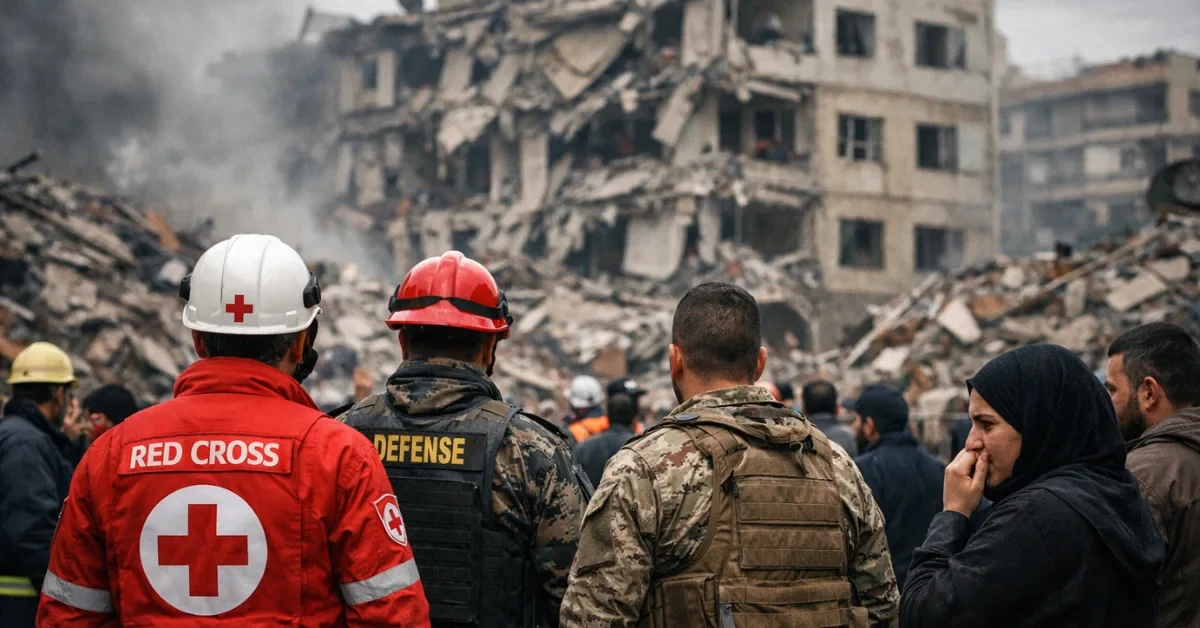
Israeli strikes in Lebanon targeted multiple regions on Friday, resulting in at least 12 fatalities and dozens of injuries across the eastern and southern parts of the country. The military operations hit an apartment building, a densely populated refugee camp, and alleged militant infrastructure, marking a significant and deadly escalation in ongoing regional hostilities.
These recent Israeli strikes in Lebanon represent some of the most lethal incidents recorded in the nation in recent weeks. The attacks pose a severe threat to the fragile ceasefire agreement brokered by the United States between Israel and the Shiite militant group Hezbollah, which has already been strained by ongoing allegations of violations.
Conflicting Casualty Reports in the Bekaa Valley
The airstrikes heavily impacted the Bekaa Valley in eastern Lebanon, though official sources disagree on the exact number of casualties. Two security sources told Reuters that at least 10 individuals lost their lives and approximately 50 sustained injuries in the region.
According to the Lebanese health ministry, the Friday attacks killed 10 people and wounded 24 others, a toll that tragically included three children among the injured. Meanwhile, Lebanon’s state-run National News Agency initially reported a minimum of six fatalities and over 25 injuries in the Bekaa Valley, noting that the victims were transported to various hospitals across the area.
Footage broadcasted by local television stations captured the immediate aftermath of one of the strikes in the Bekaa region. The targeted location was identified as an apartment building, where emergency responders were seen battling flames and searching through the rubble for potential survivors.
Hezbollah Command Posts Targeted in Baalbek
The Israel Defense Forces issued a public statement confirming that their forces targeted Hezbollah command centers situated in the Baalbek area of the Bekaa Valley. Security officials and a Hezbollah representative informed news agencies that a high-ranking military leader from the group was among the deceased.
The prominent Hezbollah figure was identified as Hussein Yaghi, the son of former Hezbollah member of parliament Mohamed Yaghi. Hezbollah media outlets announced that his funeral is scheduled to take place on Saturday. Aside from confirming the loss of their military leader, Hezbollah has not issued an immediate, comprehensive response regarding the Baalbek strikes.
Drone Assault on Ein el-Hilweh Refugee Camp
Earlier on Friday, a separate Israeli attack struck the Ein el-Hilweh Palestinian refugee camp, located on the outskirts of the southern coastal city of Sidon. The Lebanese Ministry of Public Health reported that two individuals were killed in this specific strike.
The National News Agency specified that an Israeli drone targeted the Hittin neighborhood within the densely populated settlement, which is the largest Palestinian refugee camp in Lebanon. In a subsequent statement, the Israeli military claimed that it had targeted a Hamas command center utilized by militants to plan operations. The Israel Defense Forces cited repeated breaches of the ceasefire terms as the primary reason for launching the assault on the camp.
Hamas Rejects Israeli Military Claims
Hamas strongly condemned the airstrike in Ein el-Hilweh, asserting that the attack resulted in civilian casualties. While the group confirmed the deaths of two of its members, it completely dismissed the Israeli military’s claims regarding the targeted site, labeling the command center allegation as a weak justification.
According to Hamas, the destroyed location actually belonged to the camp’s Joint Security Force, a body composed of various Palestinian factions responsible for maintaining order within the settlement. The National News Agency provided additional details, noting that the strike inflicted considerable damage on a building that was previously used by the joint security force. The agency reported that the damaged structure was currently being leased by an individual to operate a kitchen dedicated to distributing food aid.
Strains on the US-Brokered Ceasefire
The Friday attacks have intensified concerns over the durability of the 2024 ceasefire agreement. Following the pact, Israel has accused Hezbollah of actively attempting to re-establish its military capabilities. Consequently, Israel has conducted nearly daily strikes in Lebanon, maintaining that these operations strictly target militants and their infrastructure. In contrast, Hezbollah has reported carrying out only one attack against Israel since the ceasefire was enacted.
The high casualty toll from Friday’s airstrikes comes during a period of heightened regional tensions, particularly as the United States warns of potential conflicts involving Iran, which is a known ally of both Hezbollah and Hamas. United States and Israeli officials have continuously urged Lebanese authorities to step in and restrict Hezbollah’s military capabilities. Conversely, Lebanese leaders have strongly cautioned that extensive Israeli military operations could further destabilize a nation that is already struggling to navigate severe political and economic crises.
