

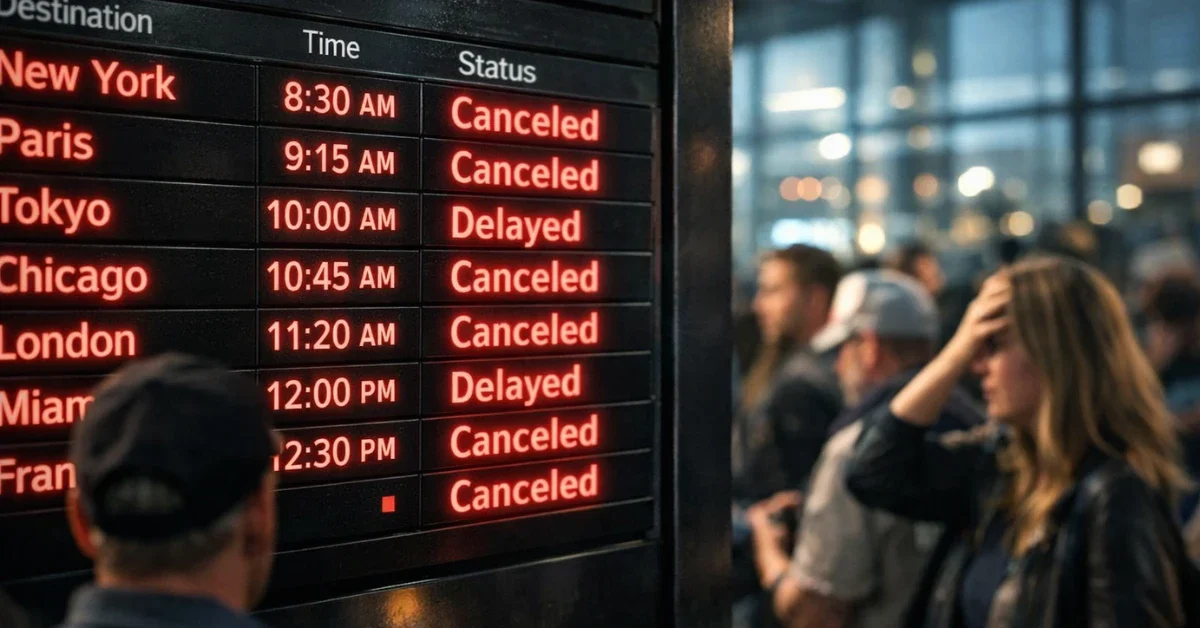
Sweeping airspace closures have sparked a massive wave of Middle East flight cancellations, leaving more than 1.5 million passengers stranded across the globe. Following intensified hostilities involving Israel, Iran, and the United States that began on February 28, the regional aviation network has faced near paralysis.
Airlines have canceled more than 12,300 scheduled flights into and out of the region, accounting for over 40 percent of regional air traffic. While some major carriers have cautiously resumed a handful of repatriation and cargo flights, the vast majority of commercial air travel remains suspended across key transit hubs, severing crucial global transit corridors.
Gulf Hubs Paralyzed by Airspace Closures
The disruption has heavily impacted major international transit points, including Dubai International, Abu Dhabi’s Zayed International, and Doha’s Hamad International Airport. The crisis deepened after drone strikes hit airport infrastructure. On February 28, a drone attack at Abu Dhabi’s airport resulted in one death and seven injuries, while a separate strike at Dubai’s airport terminal caused minor damage and injured four staff members. Since then, multiple inbound flights to Dubai and the Saudi Arabian capital of Riyadh have been diverted due to ongoing aerial threats.
Currently, seven countries in the region have fully closed their airspace. In Qatar, an airspace closure has stranded nearly 8,000 transit passengers, forcing the national flag carrier, Qatar Airways, to temporarily suspend all flight operations. Authorities in Dubai have urged passengers not to travel to airports unless they have received direct confirmation from their airline, as over 80 percent of flights to and from the city have been canceled.
Limited Repatriation Flights Resume
Despite the severe restrictions, a small number of flights have managed to depart the United Arab Emirates. Etihad Airways began operating select repositioning, cargo, and repatriation flights on Monday. At least 15 Etihad passenger jets departed Abu Dhabi for destinations including London, Paris, Islamabad, and Mumbai. However, the airline has suspended all other scheduled commercial services to and from Abu Dhabi until the afternoon of March 5.
Similarly, Emirates initiated a limited resumption of operations prioritized for passengers with earlier bookings. The carrier’s first international departure since the shutdown, a flight to Mumbai, took off on Monday evening. By Tuesday morning, five Emirates aircraft departed Dubai for major cities such as Jeddah, Manchester, Paris, London, and Frankfurt. Despite these limited movements, Emirates has suspended regular scheduled flights to and from Dubai through the late evening of March 4.
Budget carrier Flydubai also operated a small number of arriving and departing flights, though the airline stressed that the situation remains highly dynamic and subject to strict safety approvals.
Impact on International Airlines and Routes
The airspace closures have forced international airlines to scramble for alternative routes or halt regional services entirely. Regional carriers like Air Arabia, Oman Air, Gulf Air, and Saudia have all temporarily suspended operations to key destinations. Global carriers have followed suit. Lufthansa, British Airways, KLM, Air France, and Turkish Airlines have canceled flights to multiple Middle Eastern destinations, including Tel Aviv, Beirut, Amman, and Dubai. Cathay Pacific Airways canceled all of its flights to and from Dubai and Riyadh between February 28 and March 14.
British Airways announced that customers flying to impacted destinations through March 15 can change their travel dates free of charge, or request full refunds if traveling by March 8.
Indian airlines have been particularly hard hit, canceling 760 overseas flights in just two days. On Monday alone, Delhi’s Indira Gandhi International Airport saw 87 international flight cancellations, while airports in Kerala reported 65 canceled flights to the Gulf region. To maintain connectivity to North America and Europe, Air India is rerouting flights through Egyptian airspace, which adds up to 40 minutes of flying time and increases operational expenses. IndiGo and Air India Express have resumed select flights to Jeddah and Muscat, respectively, to help clear the backlog of stranded passengers.
Meanwhile, aviation authorities in Pakistan confirmed that their airspace remains fully open for commercial flights.
Travel Industry Faces Surge in Cancellations
The ongoing military conflict has drastically altered traveler sentiment. The Indian Association of Tour Operators reported a 20 to 25 percent spike in cancellations and rescheduling requests for routes linked to the Middle East. Travel booking aggregators like MakeMyTrip and EaseMyTrip noted that many customers are choosing to defer their travel plans due to concerns over flight diversions and airspace uncertainties.
To assist stranded passengers, EaseMyTrip announced plans to organize charter flights from Oman to India, pending regulatory approvals. While international travel through the Gulf corridor faces short-term headwinds, industry experts note that domestic tourism demand remains stable as travelers shift their focus away from the conflict zones.
