

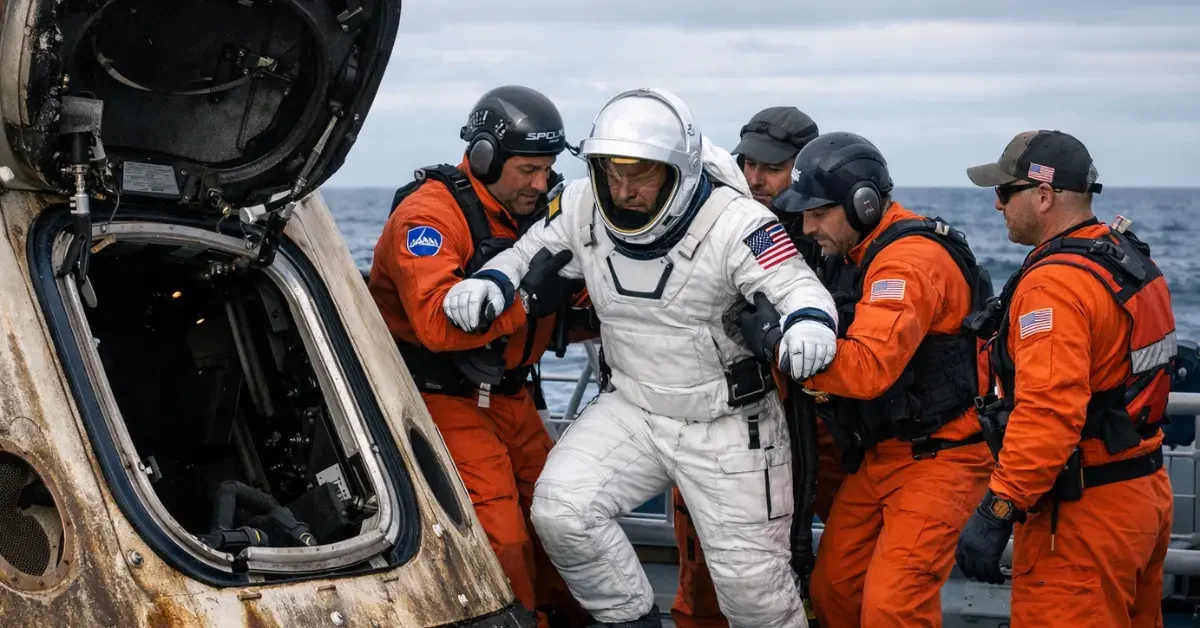
NASA veteran astronaut Mike Fincke has publicly identified himself as the crew member whose health emergency prompted the first-ever medical evacuation in the 25-year history of the International Space Station. The disclosure came on February 26, when NASA released a statement from Fincke explaining what happened during the Crew-11 mission — and why the entire four-person crew had to come home early.
Fincke said the incident occurred on January 7 while he was aboard the space station. His crewmates responded quickly, and NASA flight surgeons provided guidance from the ground to help stabilize his condition. Though he did not disclose the nature of his medical issue, Fincke was clear that the situation did not reach emergency levels. Instead, he described the early return as a deliberate and carefully planned decision, made to give him access to advanced medical imaging equipment that simply does not exist aboard the ISS.
The Evacuation That Made History
The four-member Crew-11 team — Fincke, fellow NASA astronaut Zena Cardman, Japan Aerospace Exploration Agency astronaut Kimiya Yui, and Roscosmos cosmonaut Oleg Platonov — splashed down in the Pacific Ocean off the coast of San Diego on January 15, roughly a month ahead of schedule. The crew had launched to the ISS on August 1, 2025, and had spent five and a half months on the station.
Their return was made in the same SpaceX Dragon capsule they had arrived in, as no other crew-ready capsules were docked at the station at the time. NASA’s priority was to avoid leaving astronauts in orbit without a reliable way home — making an early departure the most sensible option. Because Crew-11 was already nearing the end of its six-month mission, the decision to bring them back ahead of schedule was less disruptive than it might otherwise have been.
After splashing down, Fincke received care at Scripps Memorial Hospital La Jolla near San Diego. In his statement, he expressed gratitude to his crewmates, NASA and SpaceX teams, and the medical staff who supported his recovery. He said he is currently at NASA’s Johnson Space Center in Houston undergoing standard post-flight reconditioning.
“Spaceflight is an incredible privilege, and sometimes it reminds us just how human we are,” Fincke said.
A Minimal Crew Left Behind
When Crew-11 departed, only three people remained aboard the ISS — one American astronaut and two Russian cosmonauts. Their reduced numbers led NASA to pause spacewalks and scale back research activities on the station. The gap was eventually filled when Crew-12 arrived in mid-February, bringing the station back to full operational capacity.
NASA Administrator Jared Isaacman had described the situation as “serious” when the early return was first announced in January, but reassured the public that the affected crew member had been stable since the incident. He noted that Crew-11 had accomplished nearly all of its mission objectives before the early departure, and that Crew-12’s launch was already weeks away at that point.
Why This Matters for Space Medicine
NASA’s chief health and medical officer, James Polk, clarified that Fincke’s condition was not a workplace injury. It was a health issue that emerged within the microgravity environment of the space station — an important distinction that highlights the unpredictable physical toll spaceflight can take on the human body.
This event is the first time in NASA history that a mission ended early because of a medical problem. However, it is not without precedent in spaceflight history overall; the Soviet Union carried out two medical evacuations for cosmonauts during the 1980s. According to statistical models cited by Polk, a medical evacuation from the ISS should statistically occur about once every three years. The fact that 25 years passed without one is, in itself, remarkable.
Jordan Bimm, a historian specializing in U.S. space exploration at the University of Chicago, put it plainly: “While this may seem unusual now, it foreshadows what could become the norm if more people venture into space. Illnesses will occur, and sometimes contingency plans will need to be implemented.”
What Comes Next
The incident has thrown a spotlight on the growing importance of space medicine. Astronauts face serious physiological challenges in orbit, including accelerated bone density loss, muscle atrophy, fluid shifts toward the head, cardiovascular changes, and vision problems caused by a condition known as spaceflight-associated neuro-ocular syndrome. These risks increase with longer missions.
As NASA and private companies push deeper into space — with plans for lunar missions and eventually Mars — having reliable medical capabilities on board will become increasingly critical. Technologies like AI-assisted diagnostics and real-time telemedicine from Earth are already being explored to fill that gap.
For now, Fincke’s openness about his experience has given the public a rare and honest look at the real human risks of working in space — and the systems put in place to bring astronauts home safely when things go wrong.
