
By using this site, you agree to our Privacy Policy and Terms of Use.
Accept
VellaTimesVellaTimesVellaTimes
  • News
    NewsShow More
    A glowing quantum clock fragmenting into light particles against a dark cosmic background with swirling entangled atoms and spacetime waves, representing quantum physics breakthroughs in time and the universe.
    Quantum Physics Breakthroughs Reshaping How We Understand Time and the Universe
    May 3, 2026
    A sleek and modern stage at a corporate technology launch event with glowing digital displays.
    OpenAI GPT-5.5 Launch Party and the Goblin Problem
    May 3, 2026
    A glowing digital medical tablet displaying artificial intelligence graphics in a modern hospital emergency room.
    AI Outperforms Doctors in Harvard Trial of Emergency Triage Diagnoses
    May 3, 2026
    A glowing antimatter atom passing through a hexagonal graphene sheet and splitting into a quantum wave interference pattern in a high-tech laboratory setting.
    Scientists Observe Positronium Wave Behavior in Lab
    May 1, 2026
    Hyper-realistic news-style image of a modern AI data center with server racks and a digital display labeled DeepSeek V4, shown in cool blue lighting.
    DeepSeek V4 launch puts Huawei AI chips in spotlight
    May 1, 2026
  • Technology
    TechnologyShow More
    A glowing digital medical tablet displaying artificial intelligence graphics in a modern hospital emergency room.
    AI Outperforms Doctors in Harvard Trial of Emergency Triage Diagnoses
    May 3, 2026
    A modern smartphone displaying an app storefront positioned next to a wooden judge's gavel on a desk, representing the legal battle over digital marketplace policies.
    Apple Loses Bid to Pause App Store Fee Changes
    May 1, 2026
    A business professional using an AI assistant on a laptop in a modern office with a data center visible in the background.
    Microsoft Copilot Tops 20 Million Paid Enterprise Seats
    May 1, 2026
    A brightly lit modern semiconductor cleanroom featuring advanced silicon wafers and glowing blue server racks.
    Samsung Q1 Profit Surges Eightfold as AI Boom Fuels Record Chip Earnings
    April 30, 2026
    A person holding a smartphone displaying the Amazon Shopping app's AI audio chat interface in a modern living room.
    Amazon AI Audio Shopping Chat Enhanced With Real-Time Q&A
    April 29, 2026
  • AI
    AIShow More
    A sleek and modern stage at a corporate technology launch event with glowing digital displays.
    OpenAI GPT-5.5 Launch Party and the Goblin Problem
    May 3, 2026
    Hyper-realistic news-style image of a modern AI data center with server racks and a digital display labeled DeepSeek V4, shown in cool blue lighting.
    DeepSeek V4 launch puts Huawei AI chips in spotlight
    May 1, 2026
    News-style image of Elon Musk seated in a courtroom during a legal dispute involving OpenAI.
    Elon Musk OpenAI Trial Puts Nonprofit Mission on Trial
    May 1, 2026
    News-style image showing LG Electronics and Nvidia branding in a modern tech setting with AI server racks and a service robot.
    Nvidia-LG Talks Highlight Wider AI Expansion Strategy
    April 30, 2026
    A dramatic courtroom setting featuring an abstract artificial intelligence hologram on a wooden table, representing the high-stakes tech trial.
    Elon Musk vs Sam Altman OpenAI Trial Over AI Future
    April 29, 2026
  • Science
    ScienceShow More
    A glowing quantum clock fragmenting into light particles against a dark cosmic background with swirling entangled atoms and spacetime waves, representing quantum physics breakthroughs in time and the universe.
    Quantum Physics Breakthroughs Reshaping How We Understand Time and the Universe
    May 3, 2026
    A glowing antimatter atom passing through a hexagonal graphene sheet and splitting into a quantum wave interference pattern in a high-tech laboratory setting.
    Scientists Observe Positronium Wave Behavior in Lab
    May 1, 2026
    The NASA Curiosity rover is using its robotic arm to drill into a red sandstone rock on the dusty surface of Mars.
    Mars Organic Molecules: Curiosity Rover Makes Historic Find
    May 1, 2026
    Aerial view of the Pacific Ocean off a forested coastline with a glowing geological fault line beneath the water representing the Cascadia subduction zone.
    Earth Tearing Apart Under the Cascadia Subduction Zone
    May 1, 2026
    A young adult female patient and a doctor are looking at medical charts in a modern clinical office setting.
    Rising Cancer Rates in Young Adults: Is Obesity to Blame?
    April 29, 2026
  • World
    WorldShow More
    Allu Arjun Commitment to Ethical Brand Partnerships
    Exploring Allu Arjun’s Commitment to Ethical Brand Partnerships
    December 18, 2023
    Orry aka Orhan Awatramani
    Orhan Awatramani ‘Orry’ Biography, Lifestyle and Rise to Fame
    December 8, 2023
    Alia Bhatt Latest Deepake Video Victim
    Alia Bhatt becomes latest victim of Deepfake Videos, Obscene Video goes Viral
    November 28, 2023
    Napoleon Movie Review
    Napoleon Movie Review: A Historical Epic by Ridley Scott Reviewed
    November 25, 2023
  • Bookmarks
Search
Category
  • News
  • Technology
  • AI
  • Science
  • World
Company
  • About Us
  • Contact Us
  • Fact Checking Policy
  • Terms & Conditions
  • Privacy Policy
  • Copyright Policy
Resources
  • Home
  • Web Stories
  • Bookmarks
  • Interests
  • Disclaimer
  • Sitemap
© 2022 VellaTimes • All Rights Reserved.
Reading: Mike Fincke Reveals He Triggered NASA’s First-Ever ISS Medical Evacuation
Share
Notification Show More
Font ResizerAa
VellaTimesVellaTimes
Font ResizerAa
  • News
  • Technology
  • AI
  • Science
  • World
Search
  • Explore
    • News
    • Technology
    • AI
    • Science
    • World
  • Useful Links
    • About Us
    • Contact Us
    • Fact Checking Policy
    • Terms & Conditions
    • Privacy Policy
    • Copyright Policy
  • Home
  • Web Stories
  • Bookmarks
  • Interests
  • Disclaimer
  • Sitemap
© 2022 VellaTimes • All Rights Reserved.
News

Mike Fincke Reveals He Triggered NASA’s First-Ever ISS Medical Evacuation

Nisha Pradhan
Last updated: 27/02/2026
Nisha Pradhan
Share
7 Min Read
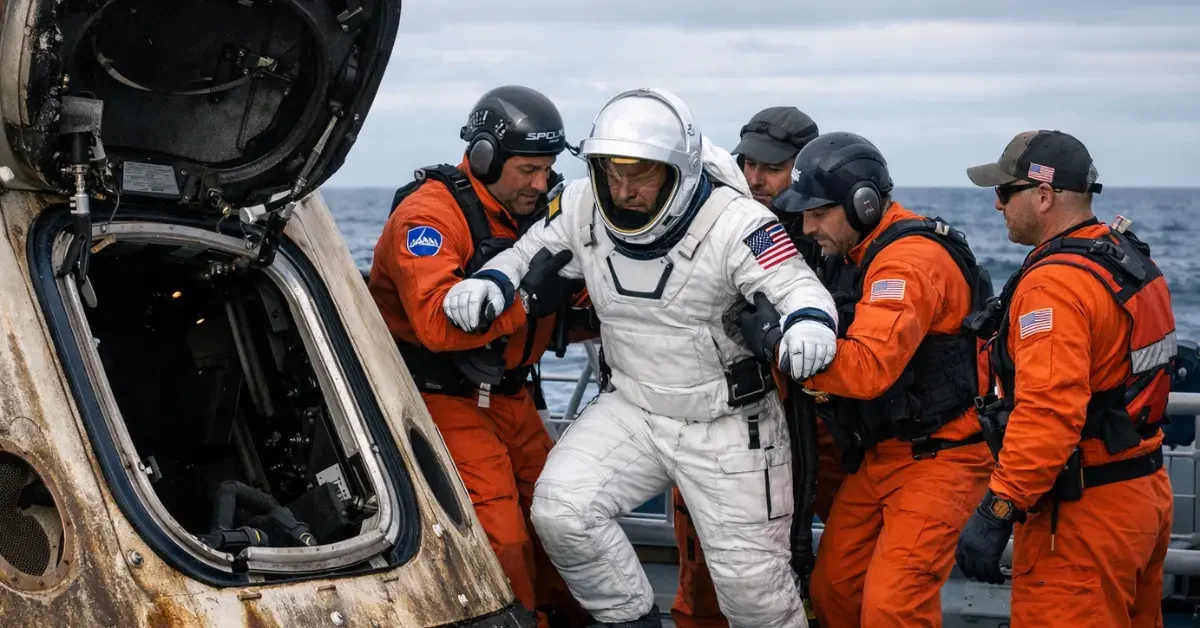
NASA astronaut Mike Fincke being assisted out of the SpaceX Dragon Endeavour capsule by recovery personnel on a ship in the Pacific Ocean after the Crew-11 early return on January 15, 2026.

NASA veteran astronaut Mike Fincke has publicly identified himself as the crew member whose health emergency prompted the first-ever medical evacuation in the 25-year history of the International Space Station. The disclosure came on February 26, when NASA released a statement from Fincke explaining what happened during the Crew-11 mission — and why the entire four-person crew had to come home early.

Contents
The Evacuation That Made HistoryA Minimal Crew Left BehindWhy This Matters for Space MedicineWhat Comes Next

Fincke said the incident occurred on January 7 while he was aboard the space station. His crewmates responded quickly, and NASA flight surgeons provided guidance from the ground to help stabilize his condition. Though he did not disclose the nature of his medical issue, Fincke was clear that the situation did not reach emergency levels. Instead, he described the early return as a deliberate and carefully planned decision, made to give him access to advanced medical imaging equipment that simply does not exist aboard the ISS.

The Evacuation That Made History

The four-member Crew-11 team — Fincke, fellow NASA astronaut Zena Cardman, Japan Aerospace Exploration Agency astronaut Kimiya Yui, and Roscosmos cosmonaut Oleg Platonov — splashed down in the Pacific Ocean off the coast of San Diego on January 15, roughly a month ahead of schedule. The crew had launched to the ISS on August 1, 2025, and had spent five and a half months on the station.

Their return was made in the same SpaceX Dragon capsule they had arrived in, as no other crew-ready capsules were docked at the station at the time. NASA’s priority was to avoid leaving astronauts in orbit without a reliable way home — making an early departure the most sensible option. Because Crew-11 was already nearing the end of its six-month mission, the decision to bring them back ahead of schedule was less disruptive than it might otherwise have been.

After splashing down, Fincke received care at Scripps Memorial Hospital La Jolla near San Diego. In his statement, he expressed gratitude to his crewmates, NASA and SpaceX teams, and the medical staff who supported his recovery. He said he is currently at NASA’s Johnson Space Center in Houston undergoing standard post-flight reconditioning.

“Spaceflight is an incredible privilege, and sometimes it reminds us just how human we are,” Fincke said.

A Minimal Crew Left Behind

When Crew-11 departed, only three people remained aboard the ISS — one American astronaut and two Russian cosmonauts. Their reduced numbers led NASA to pause spacewalks and scale back research activities on the station. The gap was eventually filled when Crew-12 arrived in mid-February, bringing the station back to full operational capacity.

NASA Administrator Jared Isaacman had described the situation as “serious” when the early return was first announced in January, but reassured the public that the affected crew member had been stable since the incident. He noted that Crew-11 had accomplished nearly all of its mission objectives before the early departure, and that Crew-12’s launch was already weeks away at that point.

Why This Matters for Space Medicine

NASA’s chief health and medical officer, James Polk, clarified that Fincke’s condition was not a workplace injury. It was a health issue that emerged within the microgravity environment of the space station — an important distinction that highlights the unpredictable physical toll spaceflight can take on the human body.

This event is the first time in NASA history that a mission ended early because of a medical problem. However, it is not without precedent in spaceflight history overall; the Soviet Union carried out two medical evacuations for cosmonauts during the 1980s. According to statistical models cited by Polk, a medical evacuation from the ISS should statistically occur about once every three years. The fact that 25 years passed without one is, in itself, remarkable.

Jordan Bimm, a historian specializing in U.S. space exploration at the University of Chicago, put it plainly: “While this may seem unusual now, it foreshadows what could become the norm if more people venture into space. Illnesses will occur, and sometimes contingency plans will need to be implemented.”

What Comes Next

The incident has thrown a spotlight on the growing importance of space medicine. Astronauts face serious physiological challenges in orbit, including accelerated bone density loss, muscle atrophy, fluid shifts toward the head, cardiovascular changes, and vision problems caused by a condition known as spaceflight-associated neuro-ocular syndrome. These risks increase with longer missions.

As NASA and private companies push deeper into space — with plans for lunar missions and eventually Mars — having reliable medical capabilities on board will become increasingly critical. Technologies like AI-assisted diagnostics and real-time telemedicine from Earth are already being explored to fill that gap.

For now, Fincke’s openness about his experience has given the public a rare and honest look at the real human risks of working in space — and the systems put in place to bring astronauts home safely when things go wrong.

TAGGED: Crew-11, International Space Station, ISS medical evacuation, Kimiya Yui, Mike Fincke, NASA, Oleg Platonov, space medicine, SpaceX Dragon, Zena Cardman
Share This Article
Facebook Twitter Whatsapp Whatsapp Telegram Copy Link
By Nisha Pradhan
I am a passionate content creator with a deep love for travel, music, and food. Using my unique blend of these interests, I genuinely enjoy crafting high-quality travel, lifestyle, and entertainment-related news content.
Leave a comment

Leave a Reply Cancel reply

Your email address will not be published. Required fields are marked *


Most Read

AI Funding Race: OpenAI Secures $122B as Rivals Advance

April 1, 2026

Nvidia CEO Rules Out $100 Billion OpenAI Investment

March 7, 2026

OpenAI Seeking AI Chip Alternatives as Inference Performance Lags

February 11, 2026

Google AI Chips: Strategic Funding Push to Rival Nvidia

February 24, 2026

Meta Shares Jump as Zuckerberg Weighs Major Layoffs to Offset AI Spending

March 18, 2026

Nvidia AI Chips: New Strategy Amid Export Controls

March 8, 2026

Related News

A glowing quantum clock fragmenting into light particles against a dark cosmic background with swirling entangled atoms and spacetime waves, representing quantum physics breakthroughs in time and the universe.
News

Quantum Physics Breakthroughs Reshaping How We Understand Time and the Universe

Nisha Pradhan Nisha Pradhan May 3, 2026
A sleek and modern stage at a corporate technology launch event with glowing digital displays.
News

OpenAI GPT-5.5 Launch Party and the Goblin Problem

Sameer Katoch Sameer Katoch May 3, 2026
A glowing digital medical tablet displaying artificial intelligence graphics in a modern hospital emergency room.
News

AI Outperforms Doctors in Harvard Trial of Emergency Triage Diagnoses

Rakesh Paul Rakesh Paul May 3, 2026

About Us

VellaTimesVellaTimesVellaTimes

VellaTimes is a leading news portal that covers the latest trending news in technology, lifestyle, entertainment, automobiles, travel, and sports.

Explore

  • News
  • Technology
  • AI
  • Science
  • World

Useful Links

  • About Us
  • Contact Us
  • Fact Checking Policy
  • Terms & Conditions
  • Privacy Policy
  • Copyright Policy

Subscribe Us

Subscribe to our newsletter for the Latest News and Top Stories!

© 2022 VellaTimes • All Rights Reserved.
  • Home
  • Web Stories
  • Bookmarks
  • Interests
  • Disclaimer
  • Sitemap
adbanner
AdBlocker Detected
Our site is an advertising supported site. Please whitelist us to support our work.
Okay, I'll Whitelist