
By using this site, you agree to our Privacy Policy and Terms of Use.
Accept
VellaTimesVellaTimesVellaTimes
  • News
    NewsShow More
    Stanford lab optical cavity array system interfacing light with atom qubits for quantum computing advancement.
    Stanford Optical Cavity Arrays Unlock Million-Qubit Quantum Computers
    February 3, 2026
    NVIDIA CEO Jensen Huang announces Rubin AI platform on CES 2026 stage with holographic rack-scale system display.
    NVIDIA Launches Rubin AI Platform at CES 2026
    February 3, 2026
    Microsoft headquarters building in Redmond, Washington, symbolizing strong Q2 2026 earnings driven by cloud and AI growth.
    Microsoft Q2 2026 Earnings Beat Expectations with Strong Cloud Growth
    February 3, 2026
    Iranian official announces US diplomacy updates at press conference with flags visible.
    Iran Examines US Diplomacy, Hopes for Results Soon
    February 3, 2026
    Deep-sea mining tracks on Clarion-Clipperton Zone seafloor with reduced animal abundance, including worms and crustaceans, illuminated by ROV lights.
    Deep-Sea Mining Trial Causes 37% Drop in Seabed Animals
    February 3, 2026
  • Technology
    TechnologyShow More
    Microsoft headquarters building in Redmond, Washington, symbolizing strong Q2 2026 earnings driven by cloud and AI growth.
    Microsoft Q2 2026 Earnings Beat Expectations with Strong Cloud Growth
    February 3, 2026
    Advanced AI chips representing OpenAI's exploration of Nvidia alternatives amid performance concerns in a professional news style.
    OpenAI Seeks Nvidia AI Chip Alternatives
    February 3, 2026
    MacBook screen showing OpenAI Codex app with multi-agent coding threads and project management interface.
    OpenAI Launches Codex App for Mac Multi-Agent Coding
    February 3, 2026
    A smartphone displaying the Snapchat app logo held by a teenager in an outdoor Australian park setting.
    Snapchat Blocks 415,000 Underage Accounts as Australia Social Media Ban Takes Effect
    February 2, 2026
    Hyper-realistic illustration of Nvidia H200 AI server racks in a Chinese data center, symbolising Beijing’s conditional approval for DeepSeek to buy the chips.
    Nvidia H200 China approval: DeepSeek gets conditional nod
    February 2, 2026
  • AI
    AIShow More
    NVIDIA CEO Jensen Huang announces Rubin AI platform on CES 2026 stage with holographic rack-scale system display.
    NVIDIA Launches Rubin AI Platform at CES 2026
    February 3, 2026
    A modern conference room with laptops and papers on a table, with a city skyline visible through glass windows.
    Meta hires OpenAI researchers as AI talent war heats up
    February 3, 2026
    MacBook screen running OpenAI Codex app with multi-agent coding threads and project management features.
    OpenAI Launches Codex App for macOS Developers
    February 3, 2026
    A Starlink satellite dish positioned outdoors at dusk with a starry night sky and satellite light trails in the background.
    Starlink Privacy Policy Update Allows AI Training on Customer Data
    February 2, 2026
    Traders watch large screens showing falling gaming stock prices next to a Google Genie 3 AI demo display on a busy trading floor.
    Google Genie 3 AI Triggers Sharp Sell-Off in Gaming Stocks
    February 2, 2026
  • Science
    ScienceShow More
    Stanford lab optical cavity array system interfacing light with atom qubits for quantum computing advancement.
    Stanford Optical Cavity Arrays Unlock Million-Qubit Quantum Computers
    February 3, 2026
    Deep-sea mining tracks on Clarion-Clipperton Zone seafloor with reduced animal abundance, including worms and crustaceans, illuminated by ROV lights.
    Deep-Sea Mining Trial Causes 37% Drop in Seabed Animals
    February 3, 2026
    Massive sunspot AR4366 on the sun's surface with bright solar flares erupting from its edges, shown in high-contrast hydrogen-alpha telescope view.
    Sun Unleashes 27 Solar Flares in 24 Hours as Monster Sunspot Races Toward Earth
    February 3, 2026
    Illustration of NASA’s Juno spacecraft observing a large bright volcanic hotspot near the south pole of Jupiter’s moon Io from space.
    Io volcanic eruption: Juno spots most powerful blast
    February 2, 2026
    Scientist in a modern genomics lab examining a large digital display of a DNA double helix with AI-generated data overlays, illustrating Google DeepMind’s AlphaGenome model.
    AlphaGenome: Google DeepMind Open-Sources Powerful DNA AI
    February 2, 2026
  • World
    WorldShow More
    Iranian official announces US diplomacy updates at press conference with flags visible.
    Iran Examines US Diplomacy, Hopes for Results Soon
    February 3, 2026
    Families and professionals protest outside New York federal courthouse against Trump administration's 75-country green card freeze.
    Lawsuit Challenges Trump’s 75-Country Green Card Freeze
    February 3, 2026
    US President Donald Trump announcing US-India trade deal with reduced tariffs at White House podium.
    Trump Cuts Tariffs to 18% in US-India Trade Deal
    February 3, 2026
    Starlink dish and terminal operating near a military command post with soldiers monitoring drone footage on screens.
    Starlink blocks Russia use after Ukraine drone alerts
    February 2, 2026
    Ukrainian, Russian, and American flags displayed in a conference room with the Abu Dhabi skyline visible through large windows, representing upcoming trilateral peace talks.
    Ukraine-Russia-US Peace Talks Delayed to February 4-5 in Abu Dhabi
    February 2, 2026
  • Bookmarks
Search
Category
  • News
  • Technology
  • AI
  • Science
  • World
Company
  • About Us
  • Contact Us
  • Fact Checking Policy
  • Terms & Conditions
  • Privacy Policy
  • Copyright Policy
Resources
  • Home
  • Web Stories
  • Bookmarks
  • Interests
  • Disclaimer
  • Sitemap
© 2022 VellaTimes • All Rights Reserved.
Reading: NASA’s Perseverance Rover Completes Historic First AI-Planned Drive on Mars
Share
Notification Show More
Font ResizerAa
VellaTimesVellaTimes
Font ResizerAa
  • News
  • Technology
  • AI
  • Science
  • World
Search
  • Explore
    • News
    • Technology
    • AI
    • Science
    • World
  • Useful Links
    • About Us
    • Contact Us
    • Fact Checking Policy
    • Terms & Conditions
    • Privacy Policy
    • Copyright Policy
  • Home
  • Web Stories
  • Bookmarks
  • Interests
  • Disclaimer
  • Sitemap
© 2022 VellaTimes • All Rights Reserved.
News

NASA’s Perseverance Rover Completes Historic First AI-Planned Drive on Mars

Nisha Pradhan
Last updated: 02/02/2026
Nisha Pradhan
Share
6 Min Read
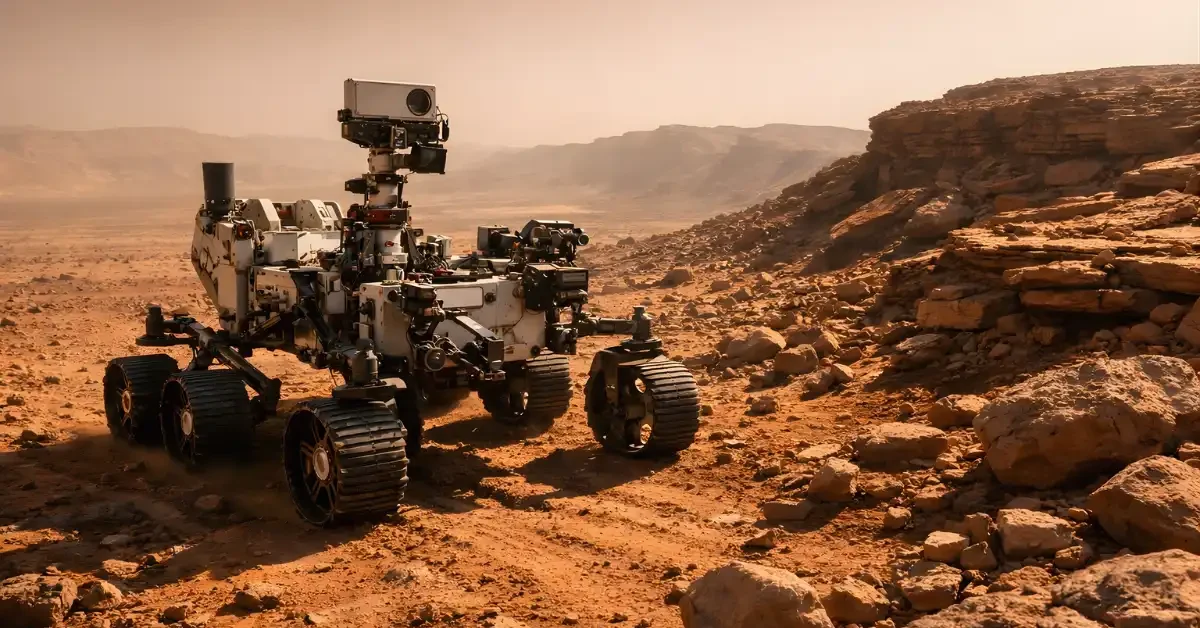
NASA's Perseverance rover driving along the rocky rim of Jezero Crater on Mars during its historic first AI-planned autonomous drive.

NASA’s Perseverance rover has achieved a groundbreaking milestone by completing the first drives on another world planned entirely by artificial intelligence. The historic demonstration took place on December 8 and 10, 2025, when the six-wheeled explorer traversed the Martian surface using waypoints generated by generative AI rather than human route planners.

Contents
How the AI-Planned Drives WorkedCollaboration with Anthropic’s Claude AIWhy Autonomous Navigation MattersLooking Toward Future Missions

The mission, led by NASA’s Jet Propulsion Laboratory in Southern California, marks a significant leap forward in autonomous space exploration. For the past 28 years, rover routes across multiple Mars missions have been carefully plotted by human drivers who analyze terrain and status data to create safe paths. This traditional approach requires waypoint spacing of no more than 330 feet to avoid potential hazards. The recent AI-planned drives demonstrate a new paradigm where machine intelligence can handle complex navigation tasks previously reserved for human operators.

How the AI-Planned Drives Worked

The Perseverance team leveraged vision-language models, a type of generative AI, to analyze high-resolution orbital imagery from the HiRISE camera aboard NASA’s Mars Reconnaissance Orbiter. The system also processed terrain-slope data from digital elevation models to identify critical features including bedrock, outcrops, hazardous boulder fields, and sand ripples. After analyzing this data, the AI generated a continuous path complete with waypoints where the rover could receive new instructions.

Before transmitting commands to Mars, the engineering team subjected the AI-generated instructions to rigorous verification. They processed the drive commands through JPL’s digital twin, a virtual replica of the rover, confirming compatibility with Perseverance’s flight software by checking over 500,000 telemetry variables. This careful validation ensured the AI’s route would work safely with the rover’s existing systems.

On December 8, Perseverance drove 689 feet using AI-generated waypoints stored in its memory. Two days later, on December 10, the rover completed a second AI-planned drive covering 807 feet along the rim of Jezero Crater. The second drive lasted approximately two hours and thirty minutes, with the rover’s navigation cameras capturing the journey for later reconstruction.

Collaboration with Anthropic’s Claude AI

The initiative emerged from JPL’s Rover Operations Center in partnership with Anthropic, the artificial intelligence company behind the Claude AI models. The collaboration allowed NASA to apply advanced generative AI capabilities to the challenges of interplanetary navigation.

NASA Administrator Jared Isaacman praised the demonstration as evidence of advancing capabilities that will reshape how humanity explores other worlds. He noted that autonomous technologies enable missions to operate more efficiently, respond to challenging terrain, and increase scientific returns as spacecraft travel farther from Earth. The administrator described the project as a careful and responsible application of new technology in real operations.

Why Autonomous Navigation Matters

The vast distance between Earth and Mars creates significant communication delays that make real-time remote control impossible. Mars sits approximately 140 million miles away on average, meaning radio signals take many minutes to travel between the planets. This time lag prevents mission controllers from directly steering rovers using joysticks or immediate commands.

Instead, traditional rover operations require human planners to analyze imagery and data, sketch routes, and upload complete instruction sets via NASA’s Deep Space Network. The rover then executes these plans autonomously while Earth awaits confirmation of success. AI-planned routes promise to streamline this process, reducing the workload on human operators while potentially enabling longer, more complex journeys.

Vandi Verma, a space roboticist at JPL and member of the Perseverance engineering team, explained that generative AI shows promise across the fundamental pillars of autonomous navigation. These include perception of terrain features, localization to determine position, and planning and control to select and execute safe paths. She envisions a future where smart tools help rovers handle kilometer-scale drives while automatically flagging scientifically interesting surface features hidden within massive image archives.

Looking Toward Future Missions

Matt Wallace, manager of JPL’s Exploration Systems Office, described the broader implications of integrating intelligent systems directly into space exploration hardware. He foresees AI applications not only in ground-based operations but also in edge computing aboard rovers, helicopters, drones, and other surface assets. These systems could be trained using the collective expertise of NASA engineers, scientists, and astronauts.

Wallace identified this integration as game-changing technology necessary for establishing permanent human presence on the Moon and advancing crewed missions to Mars. As exploration pushes deeper into the solar system, the ability to make real-time navigation decisions without waiting for Earth-based input becomes increasingly critical.

The Perseverance AI demonstration represents a crucial step toward that future, proving that generative AI can safely plan routes across alien terrain. With two successful drives completed, the mission team has opened new possibilities for how humanity’s robotic explorers will navigate the Red Planet and beyond.

TAGGED: Anthropic Claude, Artificial Intelligence, Jezero Crater, JPL, Mars 2020 mission, Mars exploration, NASA, Perseverance rover, space technology
Share This Article
Facebook Twitter Whatsapp Whatsapp Telegram Copy Link
By Nisha Pradhan
I am a passionate content creator with a deep love for travel, music, and food. Using my unique blend of these interests, I genuinely enjoy crafting high-quality travel, lifestyle, and entertainment-related news content.
Leave a comment

Leave a Reply Cancel reply

Your email address will not be published. Required fields are marked *


Most Read

Russian drone attack on Odesa kills 3, injures 35

January 29, 2026

Google AI Overviews shift to Gemini 3, add AI Mode chat

January 28, 2026

South Korea Seeks China Mediation Role to Restart North Talks

January 8, 2026

Iran protests: Khamenei blames Trump, US and Israel

January 18, 2026

Grok image editing restrictions tightened after backlash

January 19, 2026

NIST Cyber AI Profile sets new AI security focus for 2026

January 30, 2026

Related News

Stanford lab optical cavity array system interfacing light with atom qubits for quantum computing advancement.
News

Stanford Optical Cavity Arrays Unlock Million-Qubit Quantum Computers

Nisha Pradhan Nisha Pradhan February 3, 2026
NVIDIA CEO Jensen Huang announces Rubin AI platform on CES 2026 stage with holographic rack-scale system display.
News

NVIDIA Launches Rubin AI Platform at CES 2026

Sameer Katoch Sameer Katoch February 3, 2026
Microsoft headquarters building in Redmond, Washington, symbolizing strong Q2 2026 earnings driven by cloud and AI growth.
News

Microsoft Q2 2026 Earnings Beat Expectations with Strong Cloud Growth

Rakesh Paul Rakesh Paul February 3, 2026

About Us

VellaTimesVellaTimesVellaTimes

VellaTimes is a leading news portal that covers the latest trending news in technology, lifestyle, entertainment, automobiles, travel, and sports.

Explore

  • News
  • Technology
  • AI
  • Science
  • World

Useful Links

  • About Us
  • Contact Us
  • Fact Checking Policy
  • Terms & Conditions
  • Privacy Policy
  • Copyright Policy

Subscribe Us

Subscribe to our newsletter for the Latest News and Top Stories!

© 2022 VellaTimes • All Rights Reserved.
  • Home
  • Web Stories
  • Bookmarks
  • Interests
  • Disclaimer
  • Sitemap
adbanner
AdBlocker Detected
Our site is an advertising supported site. Please whitelist us to support our work.
Okay, I'll Whitelist