

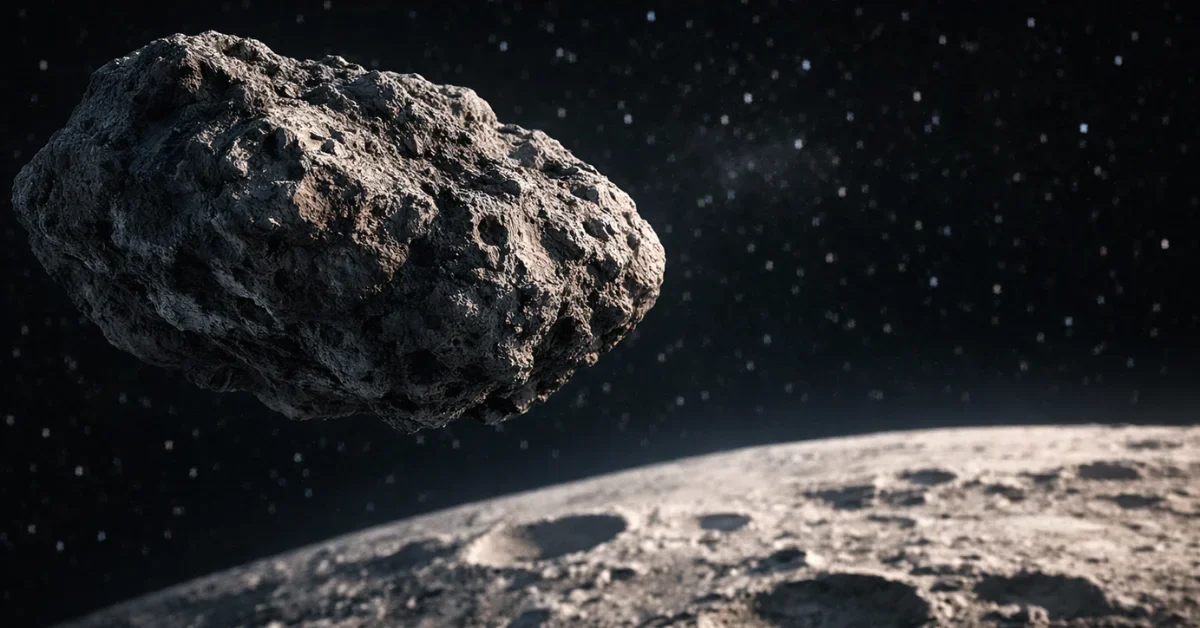
Recent observations utilizing the James Webb Space Telescope have officially eliminated the possibility that asteroid 2024 YR4 will collide with the moon . Previously, astronomers calculated a 4.3% chance that the space rock would strike the lunar surface on December 22, 2032 . However, precise new data gathered in February 2026 has refined the trajectory of the asteroid, confirming it will safely bypass the moon at an altitude of 13,200 miles, or 21,200 kilometers . This updated forecast represents an improvement in tracking precision rather than a physical change in the orbital path of the object .
The Discovery and Initial ‘City Killer’ Threat
The journey to understanding this near-Earth object began in late 2024 when it was first discovered by the Asteroid Terrestrial-impact Last Alert System station located in Chile . Following its initial detection, subsequent observations revealed that the space rock is substantial in scale, measuring between 174 and 220 feet in diameter . This size makes it comparable in height to the Leaning Tower of Pisa .
During the early stages of tracking in early 2025, preliminary trajectory models indicated a notable threat to our home planet . The likelihood of an Earth collision peaked at 3.1%, representing the highest odds ever recorded for a potential asteroid impact . If a space rock of this magnitude were to strike Earth, it could generate an explosive force equivalent to 500 Hiroshima bombs, earning 2024 YR4 the moniker of a “city killer” asteroid . While further global observatory data eventually brought the Earth impact odds down to zero for the next century, the risk of a lunar collision remained fixed at 4.3% until the latest developments .
Overcoming Observational Challenges with JWST
Confirming the exact path of the asteroid presented a significant astronomical challenge . Since the spring of 2025, the object had become completely unobservable from both ground-based and space-based telescopes . Astronomers initially believed they would have to wait until 2028 for their next opportunity to view the rock and refine its orbit .
Fortunately, researchers at the Johns Hopkins University Applied Physics Laboratory identified a narrow window of opportunity . Between February 18 and February 26, 2026, the James Webb Space Telescope was deployed to capture two critical observations . During this specific week, the asteroid drifted across a faint field of background stars . By leveraging precise stellar position data previously measured by the European Space Agency’s Gaia mission, astronomers could accurately track the movement of the asteroid against this cosmic backdrop .
The observational effort was highly complex . The asteroid ranks among the faintest targets ever monitored by the James Webb Space Telescope, and the Near-Infrared Camera used for the task possesses a narrow field of view of just 2.2 square arcminutes . The successful alignment and tracking required extensive collaboration among Johns Hopkins engineers, NASA’s Center for Near-Earth Object Studies, and the European Space Agency’s Near-Earth Object Coordination Centre .
The Averted Lunar Collision Scenario
Had the asteroid maintained a collision course with the near side of the moon, it would have presented scientists with an unprecedented opportunity to witness a large-scale impact event in real time . The high-velocity strike would have released energy equivalent to six million tons of TNT, comparable to a large nuclear detonation .
This massive explosion would have generated a brilliant flash visible to the naked eye from Earth . The impact would have carved out a brand-new lunar crater measuring approximately 0.62 miles, or one kilometer, across . While the majority of the displaced lunar material would have rained back down onto the surface of the moon, millions of pounds of ejected debris would have possessed enough velocity to escape lunar gravity .
This escaping material would have drifted toward Earth, potentially triggering a unique, multi-day meteor shower as the fragments entered the atmosphere . Furthermore, this lingering debris would have created a prolonged, long-lasting hazard for artificial satellites operating in Earth’s orbital space .
Future Tracking and Planetary Defense
With the moon officially safe from a 2032 collision, the focus now shifts toward utilizing this space rock for broader scientific applications . Asteroid 2024 YR4 remains an ideal subject for researchers aiming to test and refine planetary defense models . These exercises are crucial for preparing humanity for potential future encounters with hazardous near-Earth objects .
NASA plans to utilize the James Webb Space Telescope to observe the asteroid once again in 2028 when its orbit brings it back into a favorable viewing position . Until then, global astronomical organizations will maintain their vigilance, continuously scanning the skies for any new objects that might pose a genuine threat to Earth or its lunar companion .
