

Scientists have reached a major milestone in developing the world’s first practical nuclear clock. By discovering a simpler way to measure the tiny oscillations of the thorium-229 nucleus, an international research team has brought ultra-precise timekeeping closer to reality. This advancement, recently published in the journal Nature, promises to revolutionize navigation, communications, disaster prediction, and deep-space exploration.
For decades, researchers have pursued a nuclear clock because of its potential to vastly outperform current atomic clocks. While atomic clocks are highly accurate, they rely on measuring the energy jumps of electrons. Because electrons orbit the outside of an atom, they are vulnerable to environmental interference. A nuclear clock relies on energy transitions deep within the atom’s nucleus. The nucleus is naturally shielded from outside disturbances, making nuclear clocks inherently more stable.
A Simplified Approach to Timekeeping
Building a functional nuclear clock has historically been an expensive challenge. Last year, scientists achieved a breakthrough by using a laser to excite thorium-229 nuclei embedded inside specialized, transparent fluoride crystals. This achievement took fifteen years of dedicated research.
However, the crystal method presented significant practical hurdles. The specialized crystals were fragile, technically demanding, and time-consuming to fabricate. Furthermore, the process required at least one milligram of thorium-229 per crystal. Because this specific isotope is incredibly rare—with only an estimated 40 grams available worldwide from weapons-grade uranium—mass production was practically impossible.
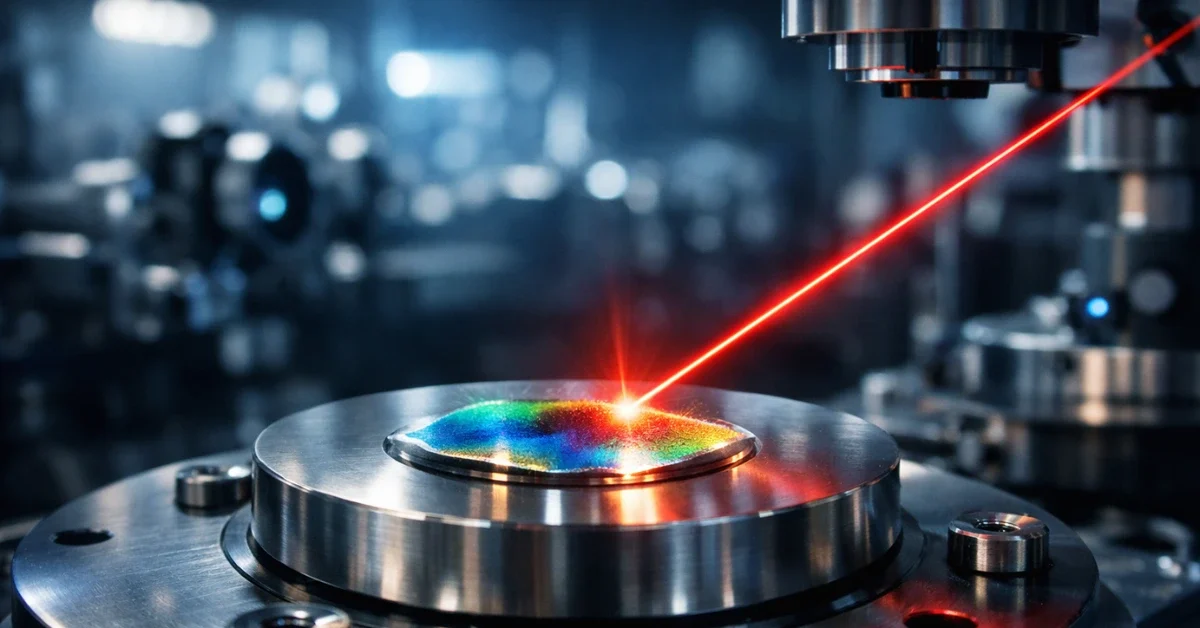
To overcome these limitations, a research team led by physicist Eric Hudson from the University of California, Los Angeles, alongside experts from the University of Manchester and other institutions, developed a simplified method. Instead of growing complex crystals, the researchers used a technique similar to electroplating jewelry. They deposited a microscopic thin film of thorium oxide onto a small stainless-steel disc.
This new approach is physically tougher than fragile crystals and uses one thousand times less thorium. Most importantly, it disproved a long-held scientific assumption.
Rethinking Light and Nuclei
Previously, scientists believed the thorium needed to be housed in a transparent material so laser light could reach the nuclei and emit measurable photons. The new research proves that an opaque material works just as well.
When the laser forces light into the opaque stainless-steel setup, it excites the thorium nuclei near the surface. After a few microseconds, these nuclei transfer their energy to nearby electrons, forcing the electrons to emit. This resulting electric current is then directly measured in a laboratory using a process known as conversion electron Mössbauer spectroscopy.
Dr. Harry Morgan, a researcher at the University of Manchester, noted that the previous need for costly crystals placed severe limits on practical applications. He explained that this electroplating approach removes a major obstacle, proving that a real-world device is highly feasible and closer to deployment than originally expected.
Transforming Navigation and Physics
The implications of an easily manufactured nuclear clock are vast. Current atomic clocks are critical for synchronizing power grids, cellular networks, and global positioning systems. However, a portable nuclear clock could function reliably in GPS-denied environments. Submarines navigating the deep ocean currently rely on atomic clocks that drift over time. A nuclear clock would allow them to maintain precise locations for much longer periods without surfacing.
Experts anticipate the technology could eventually be miniaturized to fit inside smartphones, wristwatches, or remote radar networks. As humanity looks toward deep space, highly resilient nuclear clocks will be necessary to establish a synchronized solar-system-wide time scale for future exploration.
Predicting Earthquakes and Volcanic Eruptions
Beyond navigation, nuclear clocks could serve as highly sensitive geological monitors. According to the theory of general relativity, time is influenced by gravity. Because nuclear clocks are incredibly precise, they can detect microscopic changes in the Earth’s gravitational field caused by the underground movement of rock and magma.
By placing these advanced clocks across active tectonic zones in places like Japan, Pakistan, or Indonesia, scientists could monitor underground shifts in real time. This network of sensors could ultimately allow researchers to predict earthquakes and volcanic eruptions before they happen.
Exploring the Universe
The transition to nuclear timekeeping opens a new frontier in fundamental physics. The energy binding a nucleus together involves three fundamental forces: electromagnetism, the strong nuclear force, and the weak nuclear force. In contrast, atomic clocks only rely on electromagnetism.
Because a nuclear clock measures the delicate balance of these forces, it could help scientists detect if any fundamental laws of physics change over time or space. This extreme precision provides a new tool to explore mysteries like dark matter and dark energy. Seeing the first signals of this transition was described by researchers as a dream come true, marking the beginning of a new era in science.
