

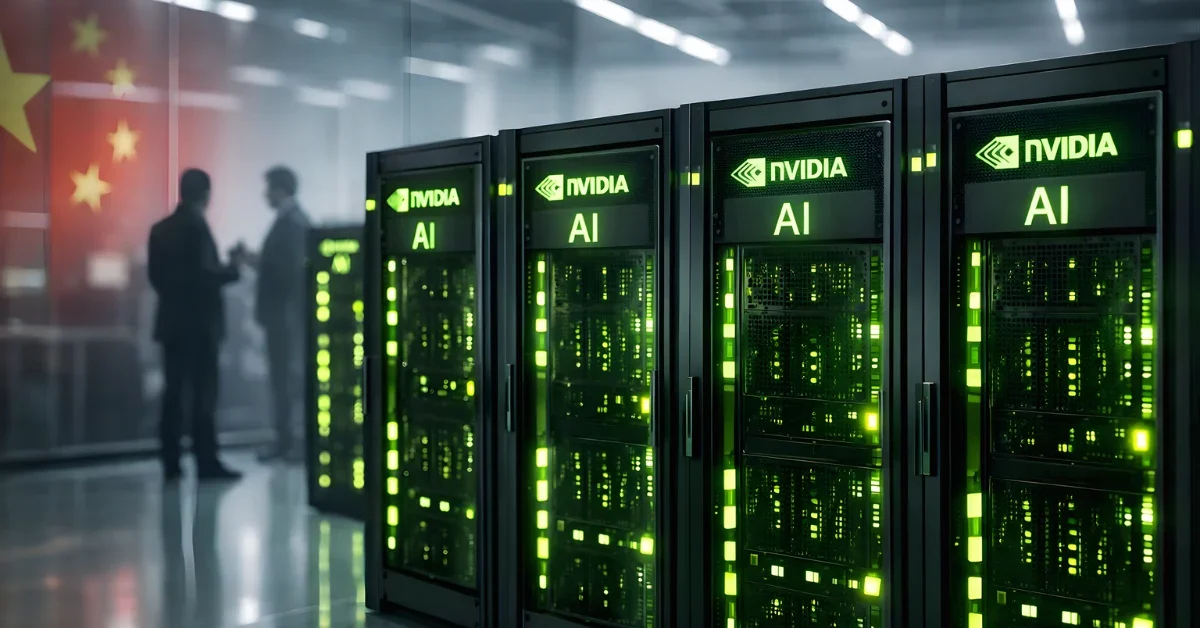
China has conditionally approved leading AI startup DeepSeek to purchase Nvidia’s high-end H200 artificial intelligence chips, according to reports citing people familiar with the decision. The move could reopen a key part of Nvidia’s China business, but strict conditions and final sign-offs from Beijing still stand between the company and large-scale chip shipments.
Regulators have also reportedly allowed Chinese tech giants ByteDance, Alibaba and Tencent to buy hundreds of thousands of H200 units, underscoring the strong demand for advanced AI hardware in the country. At the same time, Nvidia CEO Jensen Huang says the company has not yet been officially informed of any approvals, and he believes the licence for H200 sales into China is still being finalised.
Conditional approval for DeepSeek and big tech
According to reports, Chinese authorities have granted DeepSeek a green light to import H200 chips, but only under regulatory conditions that are still being worked out. The approvals were issued by government bodies responsible for industry and commerce, while the National Development and Reform Commission is said to be drafting the detailed terms that buyers must meet.
People familiar with the process say ByteDance, Alibaba and Tencent have been cleared in principle to buy more than 400,000 H200 chips combined, though the attached conditions may be demanding enough to limit actual orders. Reports describe these approvals as conditional rather than a blanket opening, suggesting Beijing wants to maintain tight oversight of how advanced AI processors are used inside the country.
DeepSeek has quickly become one of China’s most closely watched AI companies by releasing large language models that run at a fraction of the cost of rivals from U.S. players such as OpenAI. Almost a year ago, excitement around its technology helped trigger a market reaction that erased roughly 600 billion dollars from Nvidia’s stock market value, according to one account. Access to H200 chips could further strengthen DeepSeek’s position in the global AI race by giving it more computing power to train and run its models.
Nvidia says licence still not final
Despite reports of Chinese approvals, Jensen Huang has stressed that Nvidia is still waiting for clear, formal permission from Beijing before it can move ahead with H200 sales to Chinese customers. Speaking to reporters in Taipei after visiting clients, partners and officials on the Chinese mainland, he said the licence for the H200 is being finalised and that Chinese authorities must decide whether the chip can be sold in their market.
Huang has also said that the export licence on the U.S. side is close to complete, meaning Washington has largely signed off on Nvidia sending H200 chips to China under controlled conditions. He argued that the H200 supports American technology leadership while also serving strong demand in China, adding that local customers are eager to get access to the product.
At the same time, he cautioned that Nvidia cannot assume it will dominate the Chinese market. According to Huang, domestic chipmakers are growing quickly, and Nvidia still needs to win concrete purchase orders even if regulators ultimately approve H200 sales. He has said Nvidia already has supply available globally and would work closely with manufacturing partner TSMC to ramp up production if and when China fully clears the way for shipments.
A high-stakes chip at the centre of tensions
Nvidia’s H200 is one of the company’s most advanced AI accelerators and sits at the heart of current U.S.–China technology tensions. Reuters has described it as Nvidia’s most powerful chip, while another report has called it the firm’s second most powerful AI processor, highlighting some differences in how the hardware is characterised. Either way, the H200 is designed for training and running large AI models in data centres, making it highly attractive to firms like DeepSeek, ByteDance, Alibaba and Tencent.
The chip has become a political flashpoint as well as a commercial product. A senior U.S. lawmaker has accused Nvidia of helping DeepSeek improve AI models that were later used by the Chinese military, raising the possibility that any large H200 deal with the startup could draw further scrutiny in Washington. Even after the U.S. government signalled it would allow controlled exports of the H200 to vetted Chinese buyers, Beijing’s own controls remain a major barrier to actual deliveries.
Chinese regulators appear to be trying to balance their desire for cutting-edge AI capabilities with concerns about security, data control and dependence on foreign technology. By granting conditional, case-by-case approvals to a small number of influential companies, officials can channel scarce high-end chips toward firms they see as strategically important while still maintaining leverage over how those chips are deployed.
What comes next for DeepSeek and Nvidia
For DeepSeek, conditional approval to buy the H200 is a major symbolic win that could translate into a practical advantage if the final terms are manageable. High-performance chips would allow the company to train more complex models faster and deploy them more widely, potentially reinforcing its reputation for delivering powerful AI at lower cost.
For Nvidia, the outcome of China’s licensing process will shape how much of the country’s AI boom it can still tap under tightening export controls. Huang has signalled that, once the regulatory path is clear and customer orders are firm, Nvidia is ready to ramp up H200 shipments quickly to meet demand. However, strict conditions from Beijing, rising Chinese competitors and political pressure from U.S. lawmakers could all limit how far the company can go.
Details beyond what has been reported so far about the precise conditions on H200 purchases and the timing of final approvals were not available at the time of writing.
