

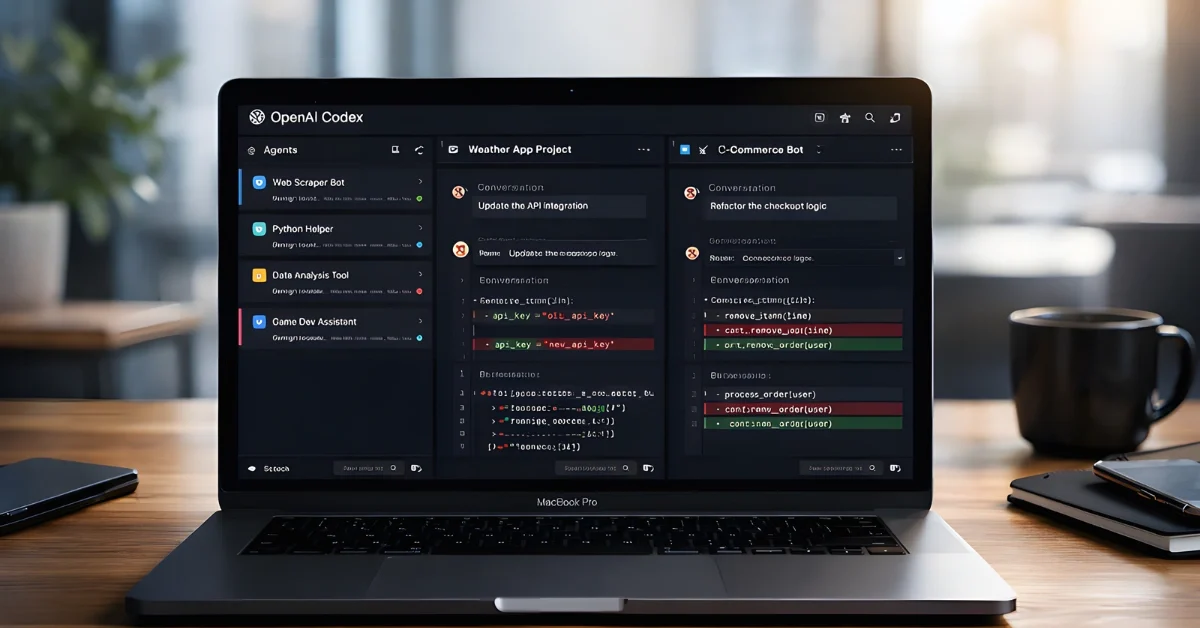
OpenAI has unveiled a new macOS application called the Codex app, aimed at revolutionizing how developers handle complex coding projects. Launched on February 2, 2026, this tool lets users oversee multiple AI agents simultaneously, running tasks in parallel and collaborating on extended work.
The app arrives as developers increasingly rely on AI to orchestrate teams of agents for building software from start to finish. It builds on Codex, which debuted as a command-line tool in April 2025 before gaining a web version.
Revolutionizing Agent Management
Developers now face the challenge of directing several agents across projects that last hours, days, or weeks. Traditional code editors and terminals fall short for this shift toward multi-agent coordination.
The Codex app acts as a central hub. It organizes agents into separate project threads, preserving context as users switch tasks. Workers can inspect code changes, add comments on differences, or load them into preferred editors for tweaks.
Handling Multiple Codebases Seamlessly
A standout feature involves worktrees, allowing various agents to operate on identical repositories without clashes. Each agent uses its own isolated code copy, letting users test ideas freely.
Users maintain their main git setup untouched while agents progress. The app seamlessly imports history and setups from the existing Codex command-line interface and IDE add-on.
Extending Capabilities with Skills
Codex now goes beyond pure code writing to tackle broader computer tasks. Skills package directives, materials, and scripts, helping agents link to utilities, execute processes, and align with team standards.
The interface simplifies crafting and handling these skills. Agents apply them on command or automatically match tasks. OpenAI shares a starter library covering popular tools.
Practical Examples in Action
One demo shows Codex creating a racing game like Mario Kart. It features various vehicles, eight tracks, and power-ups activated by spacebar. Using an image tool powered by GPT Image and a web game skill, it handled design, development, and testing independently over 7 million tokens.
Internal teams at OpenAI use skills for evaluations, training oversight, documentation, and experiment reports. Pre-built options include pulling Figma designs into UI code, managing Linear projects, deploying to Cloudflare or Vercel, generating visuals, API integration, and document handling.
Automations for Background Efficiency
Automations let agents tackle scheduled jobs unattended. Results queue for later review, fitting busy workflows.
OpenAI employs them for routine duties like sorting issues daily, summarizing test failures, preparing release notes, and scanning for bugs. Users combine prompts with skills for custom repeats.
Tailored Interaction Styles
Preferences vary among developers—some seek direct efficiency, others warmer exchanges. Codex offers two modes: a concise pragmatic one and a chatty empathetic style.
Switch via a simple command in the app, command line, or IDE tool. Capabilities stay identical across choices.
Strong Security Measures
Safety integrates deeply. The app employs open-source sandboxing, restricting edits to work folders or branches. Agents use stored web data first and seek approval for network needs.
Team rules can greenlight certain high-access commands automatically.
Benchmarks and Model Power
GPT-5.2-Codex, released mid-December 2025, leads TerminalBench for command-line tasks. It matches rivals like Gemini 3 and Claude Opus on SWE-bench for bug fixes, though real use varies.
OpenAI CEO Sam Altman highlighted its edge for intricate jobs. He noted past usability hurdles but praised the app’s flexible setup. Altman also touted rapid prototyping, limited only by typing speed for ideas.
Broad Access and Growth
The app rolls out immediately for macOS users with ChatGPT Plus, Pro, Business, Enterprise, or Edu plans—usage counts toward subscriptions, with extra credits available.
For now, Free and Go tiers get access too, alongside doubled limits for paid users everywhere Codex runs. Since GPT-5.2-Codex, activity doubled; over a million developers engaged last month.
OpenAI plans Windows support, speedier processing, refined workflows, and cloud-based automations.
