

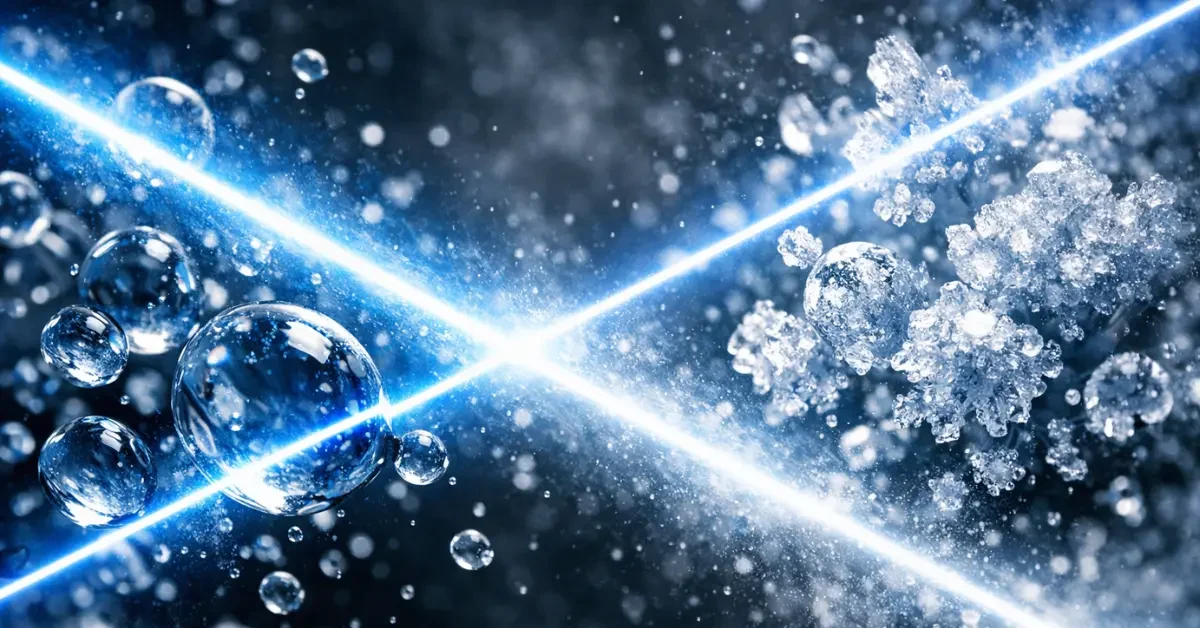
For decades, scientists have puzzled over why water behaves so differently from almost every other liquid on Earth. Now, a major breakthrough has provided the answer. Researchers from Stockholm University have finally identified a supercooled water critical point, solving a scientific mystery that has baffled experts for over a century. Published in the journal Science, this groundbreaking discovery explains how water’s strange characteristics originate from a hidden state that occurs right before it freezes.
By using ultra-fast X-ray lasers, the research team successfully observed water in a deeply supercooled state. They pinpointed the exact critical point at an extreme temperature of roughly -63 degrees Celsius and a pressure of 1,000 atmospheres. Even though these conditions are extreme, this hidden phase strongly influences how ordinary water behaves at normal temperatures and pressures.
Capturing the Liquid Before It Freezes
Observing water at such low temperatures without it turning into ice is extremely difficult. To achieve this, the scientists relied on powerful, incredibly fast X-ray pulses generated by advanced lasers at a facility in South Korea. These rapid flashes allowed the team to capture images of the liquid in the fleeting moments before crystallization occurred.
Anders Nilsson, a professor of chemical physics at Stockholm University, noted that the extraordinary speed of the X-rays allowed the team to watch a transition between two liquid states disappear as the new critical phase emerged. He explained that while scientists have theorized about this critical point for many years, they finally have concrete proof that it actually exists.
The Mystery of Water’s Unusual Behavior
Water is essential for life, yet it breaks the normal rules of physics and chemistry. For most substances, cooling causes the material to shrink and become denser. Because of this general rule, the solid form of a substance should be heavier than its liquid form. However, water does the exact opposite. Ice floats on top of liquid water, and liquid water reaches its maximum density at 4 degrees Celsius. This unique trait is why colder water settles at the bottom of oceans and lakes.
When pure water is cooled below 4 degrees Celsius, it begins to expand instead of shrinking. If the cooling process continues below 0 degrees Celsius, where crystallization typically happens slowly, this expansion actually speeds up. Other physical traits also act completely opposite to typical liquids as the temperature drops. For instance, the way water handles heat capacity, its internal thickness or viscosity, and its ability to be compressed all become increasingly unusual as the liquid gets colder.
Two Liquids Merging Into One
The newly discovered supercooled water critical point helps explain these backwards reactions. Under high pressure and freezing temperatures, water can actually exist as two separate liquid phases. These two distinct forms have completely different ways of bonding their molecules together.
As the temperature rises and the pressure drops, these two distinct liquids merge together at the critical point. At this specific juncture, the water becomes highly unstable. It constantly shifts back and forth between the two liquid forms, acting as if it cannot settle on a single state. These powerful fluctuations stretch all the way up to normal environmental conditions, giving everyday water its strange and unique qualities. In fact, ambient water exists in what scientists call a supercritical state, which occurs just beyond this critical point.
A Black Hole Effect on Molecules
As water gets closer to this critical state, its molecular movement slows down drastically. Robin Tyburski, a chemical physics researcher at the university, compared this phenomenon to a black hole, noting that once the water enters this critical phase, it appears almost impossible for the dynamics to escape.
Other members of the research team shared their excitement about the breakthrough and its implications for future scientific studies. Postdoctoral researcher Aigerim Karina highlighted how studying amorphous ices—a well-researched topic—unexpectedly opened the door to finding this hidden region. Meanwhile, PhD student Iason Andronis called the ability to measure unfrozen water at such low temperatures a dream come true. He credited the recent development of powerful new X-ray laser technology for finally making this long-sought measurement possible.
Future Implications for Science and Life
Associate professor Fivos Perakis pointed out a fascinating connection to biology. He questioned whether it is merely a coincidence that water is the only supercritical liquid at normal conditions where life can thrive, suggesting that this knowledge could lead to profound future discoveries.
This milestone marks the end of an intense, long-standing debate that started over a hundred years ago with the early research of physics pioneer Wolfgang Röntgen. With the critical point now definitively proven, the scientific community can move forward using this new model of supercooled water. The massive international research team—which included key collaborators from POSTECH University in South Korea, the Max Planck Society in Germany, and St. Francis Xavier University in Canada—now faces a new challenge. In the coming years, they will work tirelessly to understand how this hidden state deeply impacts biological, chemical, geological, and climate-related processes across the globe.
