

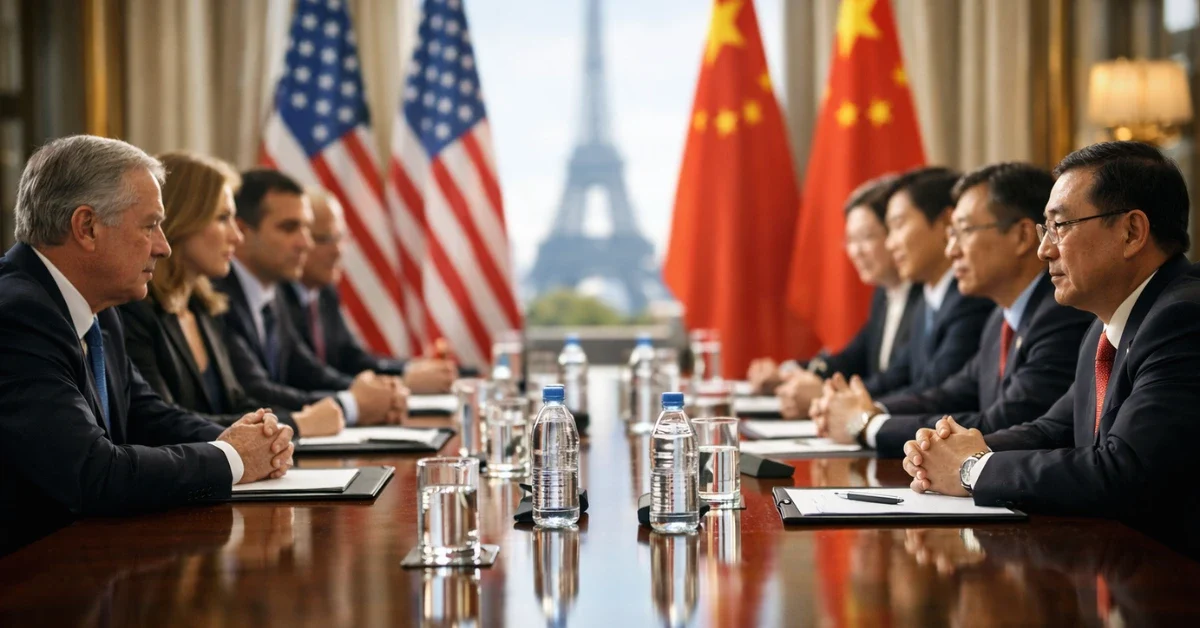
US and Chinese officials concluded two days of constructive US-China trade talks in Paris on Monday, laying the critical groundwork for President Donald Trump’s highly anticipated summit with Chinese President Xi Jinping in Beijing.
Led by US Treasury Secretary Scott Bessent and US Trade Representative Jamieson Greer, the American delegation met with Chinese Vice Premier He Lifeng and chief trade negotiator Li Chenggang. The meetings aimed to stabilize bilateral ties following recent economic disputes. Both sides characterized the dialogue as constructive, with Bessent calling the meetings “very good.” Chinese state media outlet Xinhua echoed this sentiment, reporting that the exchange would bring “greater certainty and stability” to bilateral trade and the global economy.
The Paris round is the latest in a series of international engagements between Bessent and He, who previously convened in Geneva, London, Stockholm, Madrid, and Kuala Lumpur. These ongoing discussions aim to manage disagreements following a one-year ceasefire in a major trade conflict, an agreement reached by Trump and Xi five months ago in Busan, South Korea.
Economic Demands and Agricultural Agreements
During the discussions, US officials pressed Beijing to expand its imports of Boeing jetliners, alongside American coal, oil, and natural gas. Furthermore, Washington sought to secure expanded access to yttrium, a rare-earth element vital for manufacturing jet engine turbines. Both sides identified potential ways to ease restrictions surrounding these critical minerals.
In response, the Chinese delegation expressed an openness to increasing US agricultural purchases, including poultry, beef, and non-soybean row crops. Additionally, Beijing reaffirmed its plans to purchase 25 million metric tonnes of American soybeans annually for the next three years.
To better manage future economic relations, the delegations explored creating formal institutional mechanisms, including a proposed joint US-China ‘Board of Trade’ and a ‘Board of Investment’. However, Bessent stressed that any concrete deliverables regarding aircraft, energy, and agriculture would ultimately be decided directly by Trump and Xi during the Beijing summit.
Geopolitical Tensions and the Iran War
The economic dialogue unfolded against the complex backdrop of the ongoing Iran War, which has effectively closed the Strait of Hormuz. This maritime chokepoint handles roughly 20 percent of the global oil trade and supplies the vast majority of China’s imported crude. The conflict has caused global oil prices to surge by 40 to 50 percent.
President Trump recently urged nations including China, France, Japan, South Korea, and the United Kingdom to deploy warships to ensure the vital waterway remains open. Trump previously suggested that his planned visit to Beijing—originally scheduled for March 31 to April 2—could be postponed if China does not support a proposed US naval mission to escort oil tankers through the strait.
However, Bessent clarified that any delay in the visit would be strictly for logistical reasons rather than a direct demand over policing the waterway. Bessent noted that as commander-in-chief, the president might need to remain at the White House while the war is being prosecuted. US officials confirmed on Monday that the trip would likely be delayed due to Washington’s involvement in the conflict.
Trade Probes and Diplomatic Hurdles
Despite the shared desire to prevent tensions from spiraling, significant diplomatic hurdles remain. Last week, the Trump administration announced fresh trade investigations into excess industrial capacity and forced labor spanning multiple economies, including China. These probes follow a recent Supreme Court decision that struck down Trump’s earlier global tariffs.
Addressing the inquiries, US Trade Representative Jamieson Greer noted that the American team provided the Chinese delegation with a preview of adjusting US trade policy, stating that while the president’s trade policy has not changed, the administration’s tools may change.
Beijing responded with a sharp rebuke. China’s Commerce Ministry labeled the investigations “extremely unilateral, arbitrary and discriminatory,” accusing Washington of attempting to erect new trade barriers. The ministry described the probe as “a mistake on top of a mistake” that severely undermines global supply chains. Beijing confirmed it lodged formal representations, urging the US to meet China halfway through dialogue.
Furthermore, US Secretary of State Marco Rubio is expected to accompany Trump on his first presidential visit to China since November 2017. China imposed sanctions on Rubio in 2020 over his positions on Hong Kong and Xinjiang. Despite this, China’s Foreign Ministry indicated the measures targeted his past actions as a senator and would not necessarily block his participation.
As preparations continue, Gary Ng, a researcher at the European Institute of Asian Studies, noted that the Paris meeting serves as the most critical bilateral engagement before the leaders meet. Chinese Foreign Minister Wang Yi recently indicated that the agenda for high-level exchanges is set, viewing 2026 as a significant year for US-China relations.
