

A deadly wave of Russian strikes in Ukraine has hit the northeastern city of Kharkiv, utilizing a suspected new type of missile, while the broader conflict continues to intensify across multiple eastern and southern fronts. Despite enduring severe bombardments and navigating diplomatic hurdles with Hungary over blocked European Union aid, Ukrainian forces report net territorial gains. Concurrently, Kyiv has secured new in-country defense maintenance facilities established by the United Kingdom to sustain its military operations.
Deadly Kharkiv Attacks and Infrastructure Damage
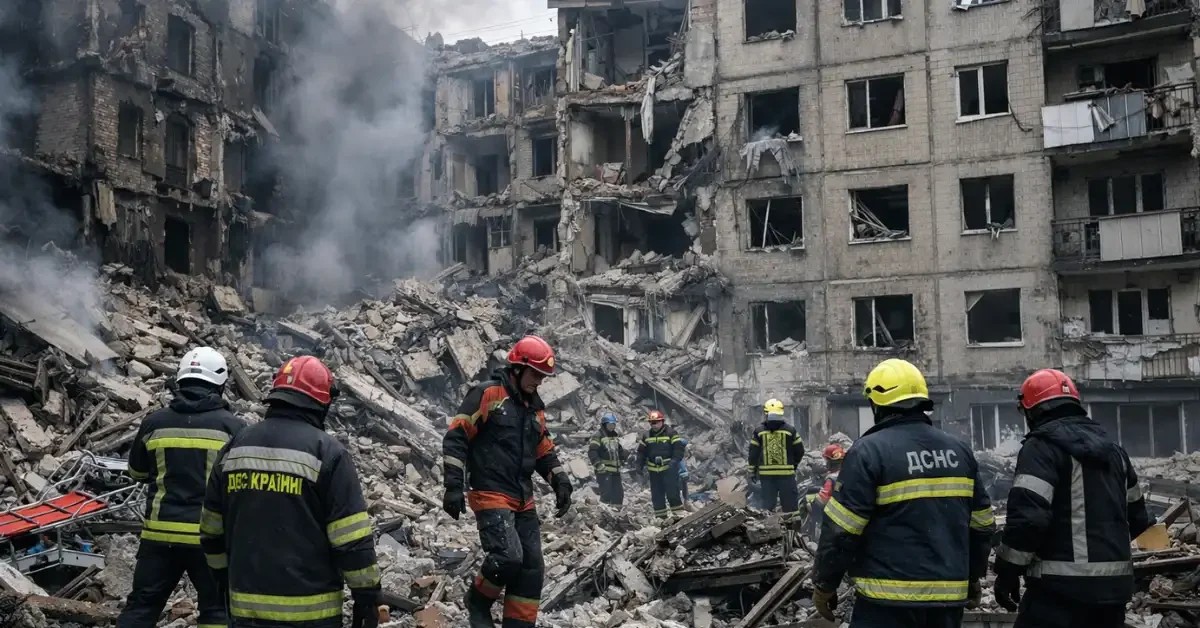
Overnight on Saturday, Russia launched an extensive barrage of 480 drones and 29 missiles primarily targeting Ukraine’s energy sector and railway infrastructure. A nationwide air alert was issued around 3 a.m. local time to warn citizens of the incoming projectiles. The city of Kharkiv suffered severe casualties when a Russian ballistic missile struck a five-story residential apartment building in the Kyivskyi district, causing heavy destruction and sparking fires across multiple floors.
According to the regional governor, Oleh Syniehubov, the attack killed at least seven people, including two children, and wounded 10 others. Rescue operations remain ongoing as emergency workers clear debris to locate residents believed to be trapped under the rubble. The assault caused widespread damage throughout Kharkiv, affecting seven residential apartment blocks, commercial and administrative buildings, electricity distribution lines, and vehicles. In the nearby city of Chuhuiv, an enemy drone attack injured two additional people.
Ukrainian prosecutors and regional officials suspect the residential building in Kharkiv was hit by an Izdeliye-30. This new Russian subsonic cruise missile reportedly has a range of 1,500 kilometers and is equipped with a highly advanced satellite navigation system designed to be more resistant to electronic jamming.
Beyond the Kharkiv region, Ukrainian officials reported that Russian forces attacked four railway stations and other transit infrastructure in central Ukraine. In the southern Odesa region, port infrastructure was also targeted, resulting in damage to a grain warehouse and igniting fires in containers filled with vegetable oil.
Frontline Escalations and Territorial Shifts
As the war progresses, combat has escalated in the eastern Donetsk region. Russian military forces recently intensified their offensive by shelling the outlying communities of Kramatorsk. Military analysts noted that this marked the first instance of Russian forces utilizing tube artillery on Kramatorsk or its surrounding areas. Kramatorsk, alongside Sloviansk, Druzhkivka, and Kostiantynivka, forms a heavily fortified north-to-south defensive line. Russian President Vladimir Putin has insisted that the surrender of this fortress belt is a prerequisite for any potential ceasefire.
Adding to the escalating threat, Ukrainian President Volodymyr Zelenskiy revealed that he had reviewed leaked documents outlining Russian war strategies. These plans allegedly detail an impending offensive aimed at capturing unoccupied regions of Donetsk and Luhansk, as well as the southern port city of Odesa and significant portions of the Zaporizhzhia and Dnipro regions.
Despite these looming threats, Ukraine’s military leadership reports positive battlefield momentum. Commander-in-Chief Oleksandr Syrskii, who orchestrated the unexpected counter-invasion into Russia’s Kursk region last August, stated that Ukrainian forces have reclaimed more territory than the enemy has seized since early February. Independent analysts have corroborated this assessment, estimating that Ukraine has achieved net territorial gains of 257 square kilometers this year, marking the most significant net gain since the 2023 counteroffensive.
UK Establishes In-Country Military Hubs
To support Ukraine’s ongoing frontline readiness, the United Kingdom has formally disclosed the operation of four in-country maintenance facilities, with a fifth location currently in the planning stages. These hubs, which were not previously announced, are staffed by a combination of British and Ukrainian personnel operating under contracts issued by the UK’s Ministry of Defence.
The facilities are dedicated to repairing and maintaining UK-donated military equipment, ensuring rapid turnaround times for combat-damaged hardware. The repair work currently focuses on CVR-T armored vehicles, Husky support vehicles, L119 light guns, and AS-90 artillery systems.
Luke Pollard, Britain’s Minister for Defence Readiness and Industry, emphasized the strategic importance of the hubs. He noted that the innovative facilities are essential for sustaining Ukraine’s armed forces while simultaneously boosting long-term industrial capabilities and mutual business collaboration between the two nations. Since the full-scale invasion began, the UK has committed more than 21.8 billion pounds in support to Kyiv.
Diplomatic Tensions Over Blocked European Aid
While battling on the frontlines, Kyiv is also navigating intense diplomatic friction with neighboring Hungary. Tensions flared recently when Ukrainian Foreign Minister Andrii Sybiha accused Hungary of detaining seven employees of Ukraine’s state savings bank.
The diplomatic rift centers largely on Hungary’s obstruction of international assistance. Zelenskiy sharply criticized Hungarian Prime Minister Viktor Orban for blocking a critical 90 billion euro European Union aid package. Ukraine heavily relies on this international financial assistance to meet its budgetary demands while directing its state resources toward national defense.
Orban, who maintains a strongly non-interventionist position and cordial relations with Moscow, stated that Budapest would use political and financial tools to compel Ukraine to reopen the Druzhba pipeline. This pipeline is crucial for transporting Russian oil to Hungarian refineries. While Budapest claims Ukraine intentionally halted the oil flow, Kyiv contends that the transportation ceased due to a Russian assault on the pipeline’s infrastructure in January, with repair efforts expected to take up to six weeks.
In a sarcastic public rebuke after an iftar meal with Muslim service members, Zelenskiy questioned whether Ukraine, which is enduring severe bombardment, should provide oil to ensure Orban’s electoral victory. He further quipped that if the unnamed European leader continued to obstruct the military aid package, Ukraine would provide its armed forces with the individual’s contact information so they could reach out directly.
