

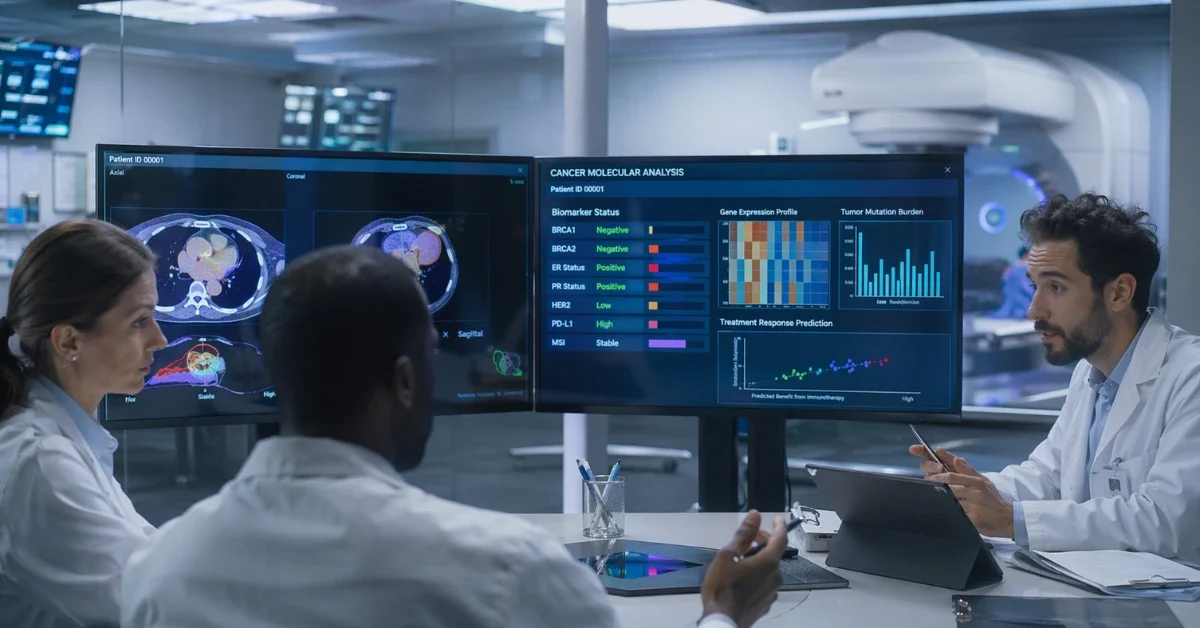
Precision medicine in cancer care is gaining momentum as new reports from England, Vietnam, Gujarat, and the United States highlight the growing use of artificial intelligence, digital diagnostics, and more targeted treatment strategies. The updates point to a common goal: matching treatment more closely to a patient’s tumor while reducing unnecessary side effects and improving care decisions.
One of the clearest examples comes from England, where scientists developed an AI-powered method that could help determine which patients with advanced bowel cancer are most likely to respond to bevacizumab, a targeted drug approved in December for NHS patients with advanced bowel cancer. The report says nearly 10,000 cases of advanced bowel cancer are diagnosed in England each year, and it notes that cases in young adults are rising. Researchers said the drug can slow cancer growth, but it works for only a small group of patients and can cause serious side effects including high blood pressure, gastrointestinal problems and blood clots.
AI and Bowel Cancer
The bowel cancer study was carried out by scientists at The Institute of Cancer Research in London and RCSI University of Medicine and Health Sciences in Dublin, who analyzed 117 European patients treated with bevacizumab and chemotherapy. They used an AI tool called PhenMap to combine tumor genetics with clinical details such as age, gender, and which side the tumor was on, then used a second AI system to create a risk score linked to survival after treatment. Patients were placed into high-, moderate-, and low-risk groups, and the researchers reported that none of the patients in the high-risk group responded to the treatment.
The same report said one of the patterns identified by the AI was that patients with a BRAF gene mutation were all in the high-risk group and had poor outcomes. Researchers said the next step is to validate the findings in more patient samples and develop the method into a test for a prospective clinical trial that could help guide treatment decisions. They also said the method may be explored for other targeted therapies and other cancer types.
Digital Oncology Models
A separate oncology summit in Hà Nội focused on precision medicine as a path toward personalized treatment and better patient outcomes. The event, held by the Việt Nam Cancer Association and AstraZeneca Việt Nam, featured discussions on digitalised multidisciplinary teams, liquid biopsy, and the use of AI in pathological diagnostics. Speakers said molecular testing, liquid biopsy, digital data, and AI are becoming central tools for personalizing treatment and improving the use of healthcare resources.
According to experts at the summit, international studies have shown that cancer patients can improve survival by more than 15 months when multidisciplinary teams are used in diagnosis and treatment compared with settings where they are not implemented. The report also said adoption is still being slowed by weak digital infrastructure and fragmented data, and experts pointed to digital MDT platforms linked to electronic medical records as one practical solution for real-time monitoring of treatment results. The same forum described liquid biopsy as a way to analyze circulating tumor DNA instead of relying only on invasive tissue biopsies, and said combining it with AI can improve consistency, shorten turnaround time, and support biomarker measurement.
Vietnam News also highlighted the scale of the challenge in the country, citing GLOBOCAN 2022 figures showing about 180,000 new cancer cases and more than 120,000 deaths annually in Vietnam. It said breast, liver, lung, colorectal, and stomach cancers are among the most common, and noted a trend toward younger patients in breast and colorectal cancer. The article added that projections suggest new cancer cases in Vietnam could rise by 60 to 70 percent by 2050.
Targeted Radiotherapy in Gujarat
In India, Bhailal Amin Cancer Centre in Vadodara has become the first facility in Gujarat to introduce Terbium-161 FAPI PTRT, a peptide-targeted radionuclide therapy that hospital officials described as an advanced nuclear medicine treatment for cancer patients. The report said the therapy is part of molecular radiotheranostics, which combines diagnosis and treatment and aims to offer a more precise and personalized approach to cancer care. Hospital officials said the treatment delivers targeted radiation to cancer-associated fibroblasts in the tumor microenvironment, allowing accurate tumor targeting while limiting damage to nearby healthy tissue.
The same report said the approach may be especially useful in complex and treatment-resistant cancers and is associated with lower toxicity than conventional therapies, which can improve patient tolerability and quality of life. A consultant in nuclear medicine and theranostics said the treatment shows promise in pancreatic cancer, sarcomas, and cholangiocarcinoma, with emerging applications in breast, colorectal, gastrointestinal, and ovarian cancers. Hospital leadership described the move as part of a broader shift toward personalized and precision-based oncology in Gujarat.
Research at AACR
In the United States, Mount Sinai said its researchers will present work at the AACR Annual Meeting 2026 in San Diego across cancer biology, experimental therapeutics, and data-driven precision oncology. The institution said its presentations and posters will cover melanoma immunogenicity, RAS-targeted therapies, AI-driven drug discovery, and the impact of environmental exposures on cancer outcomes. Among the listed sessions is a presentation on implementing computational biomarkers for real-world translation, underscoring how data tools are moving closer to clinical use.
These reports do not describe a single breakthrough, but they do show cancer centers and research groups pushing in the same direction through AI risk scoring, molecular testing, liquid biopsy, digital care coordination, and targeted radiotherapy. Across hospitals, research meetings, and policy-facing forums, the shared message is that more personalized cancer treatment is moving from concept to practice.
