

Recent ocean methane discoveries are reshaping how scientists understand marine environments and global climate dynamics. Beneath the crushing pressure of the Greenland Sea, researchers have located towering structures of frozen methane that support entirely independent biological communities. Simultaneously, a separate investigation into surface waters has uncovered a microscopic marine process that could unexpectedly accelerate global warming.
These findings highlight the complex role that ocean methane plays across different aquatic zones. From providing a chemical energy source for bizarre deep-sea creatures in the Arctic to acting as a powerful greenhouse gas released into the atmosphere, marine methane is prompting researchers to reevaluate both deep-sea biodiversity and future climate projection models.
Frozen Towers in the Greenland Sea
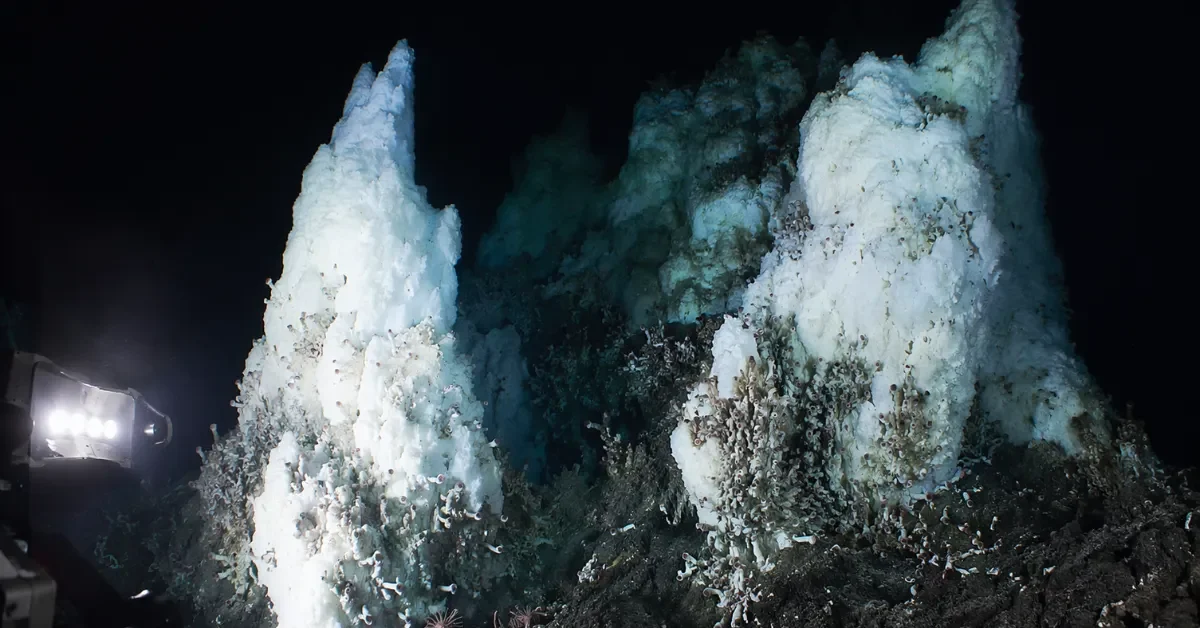
Deep beneath the surface of the Greenland Sea, an astonishing biological world thrives in complete darkness. In December 2025, scientists exploring the remote Molloy Ridge discovered massive mounds of methane ice rising dramatically from the ocean floor. Located at an immense depth of 3,640 meters, or roughly 3.6 kilometers, these unique formations represent the deepest methane cold seep ever recorded in the Arctic Ocean.
These icy towers, scientifically known as methane hydrates, develop when methane gas slowly escapes from deep underground cracks driven by continuous tectonic activity. As the gas rises and meets near-freezing seawater under extreme environmental pressure, it crystallizes into solid structures resembling frozen reefs. Scientific tests indicate this gas originates from intense geological heat and pressure deep within the earth’s crust, rather than from decaying marine organic matter settling near the seafloor.
What shocked researchers most was not just the presence of these geological structures, but the abundant life surrounding them. Because human divers cannot survive depths of 3,640 meters, the scientific team utilized remote-controlled robots equipped with specialized cameras and mechanical tools. These robots captured close-up footage of diverse biological communities clinging to the icy mounds and brought mud and water samples to the surface for chemical analysis. The discovered ecosystem includes siboglinid and maldanid tubeworms, tiny skeneid and rissoid snails, and scavenging amphipods scurrying across the seafloor.
Surviving Through Chemosynthesis
Because sunlight cannot penetrate to these immense depths, plants and traditional photosynthesis cannot exist. Instead, the survival of these deep-sea creatures relies entirely on a process called chemosynthesis. Microscopic organisms form thick mats on the frozen mounds, converting the seeping methane and surrounding chemical compounds into usable cellular energy.
These methane-consuming microbes form the foundation of a highly localized food web, allowing larger crustaceans and tubeworms to flourish in a habitat that is otherwise nearly freezing, utterly dark, and subjected to crushing ocean pressure.
Scientists noted that the creatures at the Molloy Ridge closely resemble species found near Arctic hot water vents, such as the Jotul vent field on the Knipovich Ridge. This striking biological overlap suggests that cold methane seeps and hot hydrothermal vents might be interconnected. These linked habitats could create a vital pathway for deep-sea organisms to migrate, survive, and adapt across the otherwise barren Arctic seafloor.
Surface Waters Hide a Warming Feedback Loop
While deep-sea methane sustains hidden ecosystems, surface-level ocean methane presents a growing climate concern. A major study published in the Proceedings of the National Academy of Sciences by researchers at the University of Rochester has solved a long-standing scientific paradox regarding why oxygen-rich open ocean waters consistently release methane into the Earth’s atmosphere.
Through extensive computer modeling and global datasets, the research team discovered that specific marine bacteria produce methane as a biological byproduct when breaking down organic matter. However, this microscopic process only occurs when the ocean waters lack phosphate. The scarcity of this vital marine nutrient acts as the primary control knob for open-ocean methane production.
Climate Change and Future Emissions
This microscopic mechanism introduces a troubling feedback loop for global warming. As climate change continues to heat the planet, the ocean warms from the surface downward. This top-down heating increases the density differences between the warm ocean surface layer and the freezing depths, which significantly slows down the vertical mixing of ocean waters.
Without healthy vertical mixing, essential nutrients like phosphate cannot travel up from the deep ocean to the surface. As surface waters become increasingly starved of phosphate, methane-producing bacteria face the ideal conditions to multiply and thrive.
Consequently, these nutrient-deprived oceans will release greater volumes of methane — a highly potent greenhouse gas — into the atmosphere. This creates an accelerating cycle where atmospheric warming increases marine methane emissions, which in turn drives further global heating.
Currently, major climate projection models do not account for this specific ocean methane feedback loop. Researchers stress that understanding both the deep-sea methane reservoirs in the Greenland Sea and the microbial methane production in surface waters is absolutely essential for accurately forecasting the future pace of global climate change.
