

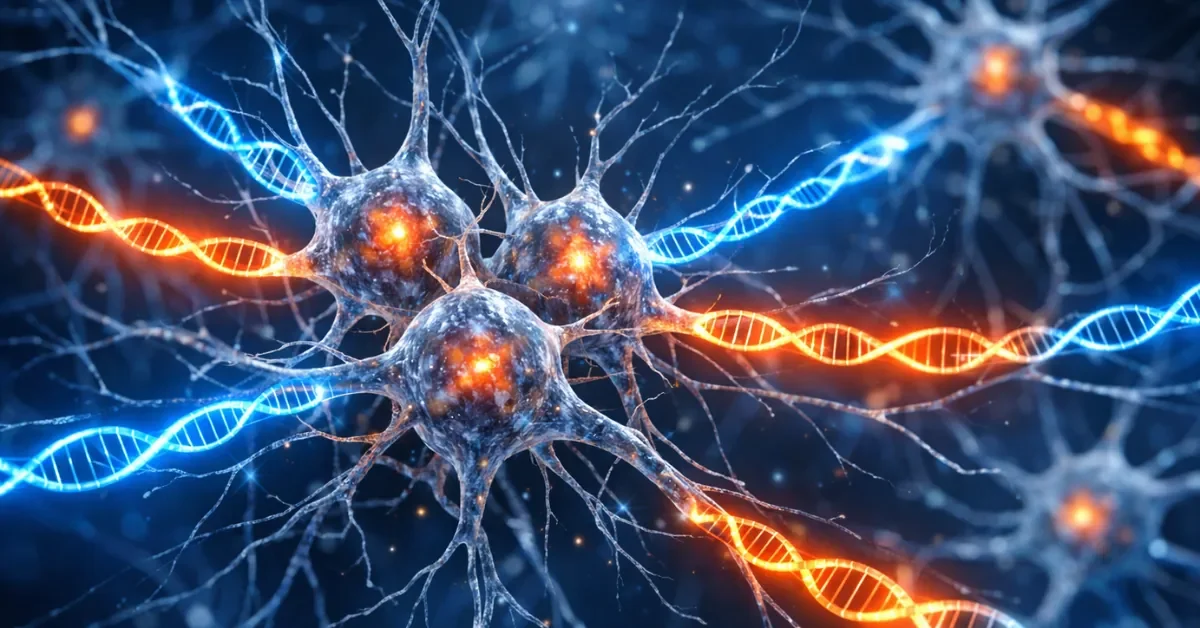
Researchers at the University of California, Irvine have created the most detailed genetic maps ever produced for Alzheimer’s disease, revealing how genes control each other inside brain cells affected by the condition. The breakthrough study identifies hundreds of influential genes that could become targets for new treatments aimed at slowing or preventing memory loss and brain degeneration.
Using a newly developed artificial intelligence system called SIGNET, the research team examined brain tissue from 272 people who participated in long-term aging studies. The machine learning platform goes beyond traditional genetic research by uncovering true cause-and-effect relationships between genes, rather than simply identifying patterns where genes appear connected.
Major Brain Cell Disruption Found
The study found that excitatory neurons experience the most severe genetic disruption in Alzheimer’s disease. These nerve cells, which send activating signals throughout the brain, showed nearly 6,000 cause-and-effect interactions that indicate extensive rewiring as the disease advances. Excitatory neurons play essential roles in memory and cognition, both of which decline significantly in people with Alzheimer’s.
The researchers examined six major types of brain cells: excitatory neurons, inhibitory neurons, astrocytes, microglia, oligodendrocytes, and oligodendrocyte progenitor cells. Each cell type showed distinct patterns of genetic activity, but excitatory neurons displayed the most dramatic changes.
Hub Genes Identified as Control Centers
The team identified hundreds of hub genes that function as major control centers in the brain. These genes influence many other genes and likely drive harmful changes associated with Alzheimer’s. Hub genes could serve as valuable targets for earlier diagnosis and future therapeutic interventions.
The research also uncovered new regulatory roles for well-known genes previously linked to Alzheimer’s. The amyloid precursor protein gene, commonly known as APP, was shown to strongly control other genes specifically in inhibitory neurons. This finding provides fresh insight into how familiar genetic players contribute to the disease through previously unknown pathways.
How SIGNET Works Differently
SIGNET stands for Statistical Inference on Gene Regulatory Networks. The platform integrates single-cell RNA sequencing with whole-genome sequencing data, allowing researchers to detect cause-and-effect relationships among genes across the entire genome. Traditional gene-mapping tools can only show which genes appear to move together, but cannot determine which genes actively drive changes in other genes.
The research team designed SIGNET to overcome limitations found in conventional methods. Many existing approaches make unrealistic assumptions, such as ignoring feedback loops between genes. SIGNET takes advantage of information encoded in DNA to identify true causal relationships between genes in the brain.
Validation Strengthens Findings
To confirm their results, the researchers tested their findings using an independent set of human brain samples. This additional validation strengthens confidence that the observed gene relationships represent genuine biological mechanisms involved in Alzheimer’s disease, rather than statistical artifacts.
The research team plans to conduct deeper investigations into networks involved in Alzheimer’s-specific pathologies across different cell types. Future work will compare brain tissue affected by Alzheimer’s with healthy samples to distinguish regulatory changes caused by the disease from normal cellular activities during aging.
Broader Applications Beyond Alzheimer’s
SIGNET’s analytical capabilities extend beyond Alzheimer’s research. The platform can be applied to study other complex diseases, including cancer, autoimmune disorders, and mental health conditions. The method enables integration of multi-omics data for constructing cell-type-specific causal gene regulatory networks across diverse biological contexts.
Alzheimer’s disease is the leading cause of dementia and is projected to affect nearly 14 million Americans over age 65 by 2060. Scientists have linked genes such as apolipoprotein E and amyloid precursor protein to the disease, but have not fully understood how these genes disrupt healthy brain function until now.
The study represents a shift in Alzheimer’s research from observing correlations to uncovering causal mechanisms that actively drive disease progression. The findings were published in Alzheimer’s & Dementia: The Journal of the Alzheimer’s Association, with funding support from the National Institute on Aging and the National Cancer Institute.
