

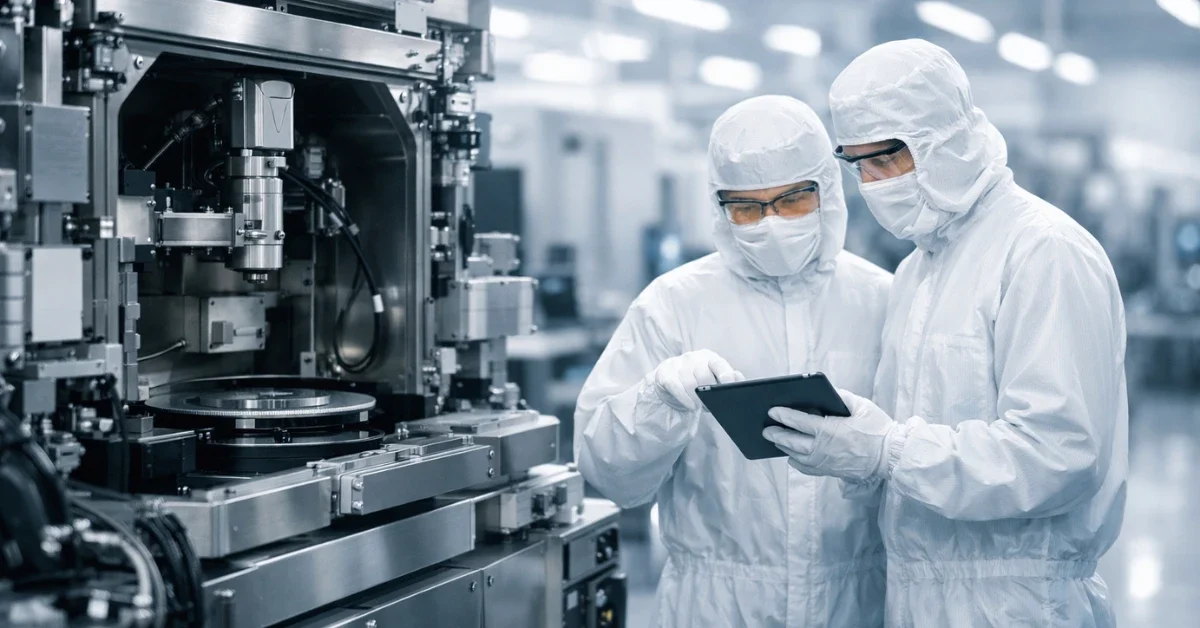
Applied Materials forecast second-quarter revenue and adjusted profit above market estimates, pointing to strong demand tied to artificial intelligence and a tight memory market that is driving chipmakers to expand capacity and buy more equipment.
The company’s shares rose sharply after the outlook, with one report noting the stock was up more than 12% in extended trading and another reporting an 11% jump on Friday.
Upbeat outlook beats estimates
Applied Materials said it expects second-quarter sales of about $7.65 billion, plus or minus $500 million, compared with analysts’ average estimate of $7.01 billion, according to LSEG data cited in the reports.
The company also forecast second-quarter adjusted profit of about $2.64 per share, plus or minus 20 cents, versus estimates of $2.28.
Chief Executive Gary Dickerson said the outlook was “fueled by the acceleration of industry investments in AI computing,” and he added that AI workloads are increasing demand for higher-performance, more energy-efficient chips.
Memory shortage adds momentum
The company and analysts tied the demand story to memory, saying the rapid build-out of AI infrastructure has absorbed a large share of the world’s memory supply and is pushing manufacturers to increase production capacity.
In the Feb. 12 report, Applied Materials said it is benefiting from a worldwide memory shortage, and it described high-bandwidth memory as a key part of the AI supply chain.
High-bandwidth memory (HBM) was described as advanced memory made by stacking layers of dynamic random access memory (DRAM), and it is used alongside AI processors such as those sold by Nvidia.
Dickerson said on the post-earnings call that Applied expects DRAM to be its fastest-growing segment in 2026, along with 3D chiplet stacking, a technique he said is used extensively in producing AI processors.
Results and sector ripple effect
Applied Materials reported first-quarter revenue of $7.01 billion, above estimates of $6.87 billion, for the quarter ended Jan. 25.
It posted first-quarter profit of $2.38 per share excluding items, while analysts had expected $2.20 per share.
On the earnings call, finance chief Brice Hill said revenue included record DRAM sales on a year-on-year basis.
The upbeat outlook also lifted other chip-equipment stocks, with one report saying Lam Research and KLA rose nearly 3% each after the bell, while another said Lam gained 2.7% and KLA rose more than 1%.
What analysts highlighted
One analyst, Timm Schulze-Melander of Rothschild & Co. Redburn, said “Memory and logic-foundry capex growth are two sides of the same coin,” and added that both are rising significantly, with memory a bigger near-term growth driver.
Another report said Applied Materials is positioned to benefit as AI chip demand consumes global memory supplies and pushes chipmakers to expand capacity, which analysts said could support multi-year growth.
William Kerwin, a senior equity analyst at Morningstar, said, “We expect a massive wafer fabrication equipment growth cycle over the next three years,” adding, “Artificial intelligence infrastructure demand is immense, and supply is scarce.”
The same report said that if the stock’s gains hold, Applied Materials would be on track to add more than $33 billion to its market valuation of $260.65 billion.
It also said at least 22 brokerages raised their price targets on Applied Materials following the results.
Separately, the report cited a December forecast from industry group SEMI projecting that sales of equipment used to make computer chip wafers will rise about 9% to $126 billion in 2026 and then increase a further 7.3% to $135 billion in 2027.
