

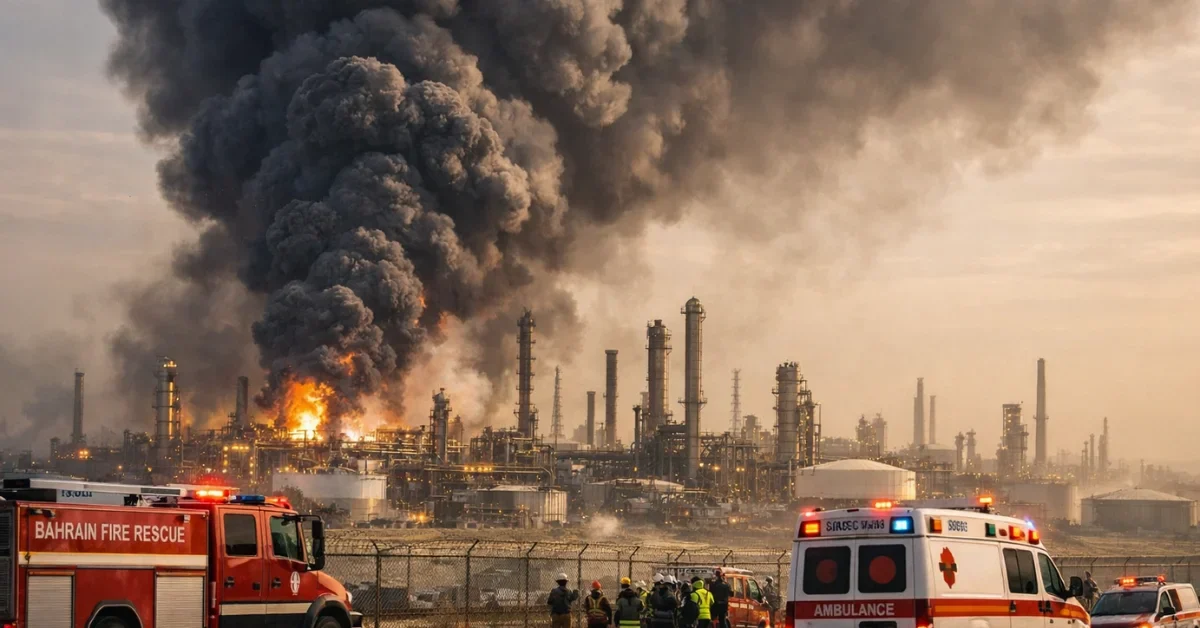
Bahrain’s state-linked energy company Bapco declared force majeure on its group operations on March 9 after an attack on its refinery complex triggered a fire and caused damage, according to a company statement carried by news reports. Thick smoke was seen rising over the Sitra area as emergency teams moved to contain the blaze, while separate official statements said an Iranian drone strike on Sitra wounded dozens of civilians.
The developments came as multiple Gulf states reported fresh Iranian missile and drone activity on Monday, with officials in Qatar, Saudi Arabia, the United Arab Emirates, and Kuwait describing interceptions or incoming threats. The new incidents have heightened concerns about the security of energy infrastructure and the risk of wider disruption across the region’s supply chains and markets.
Smoke over Sitra after reported strikes
Videos circulating online showed dark plumes of smoke rising near Bahrain’s Bapco refinery in the Sitra area, as witnesses described smoke spreading across the surrounding industrial zone. Authorities said the Sitra area suffered damage and injuries after what was described as an Iranian drone attack, while emergency services and security teams were deployed as officials assessed the situation. Officials had not confirmed whether the refinery itself was directly hit, but reports noted the facility sits close to the reported impact zone.
In a separate official update, Bahrain’s health ministry said an Iranian drone attack targeting Sitra wounded 32 civilians, all Bahraini citizens. The ministry said there were four serious cases, including children.
Refinery fire and force majeure declaration
Bahraini authorities said an attack hit the Al Ma’ameer petroleum complex operated by Bapco Energies, after which a fire broke out and damaged refinery infrastructure. Reports described thick smoke rising from the site on Sitra island, south of the capital, as emergency teams worked to contain the fire.
Following the incident, Bapco issued a force majeure notice affecting its group operations, citing disruption linked to the regional conflict and the recent attack on its refinery complex. In the statement carried in reports, the company said: “Bapco hereby serves notice of force majeure on its group operations which have been affected by the ongoing regional conflict in the Middle East and the recent attack on its refinery complex.”
Wider Gulf alerts and interceptions
Beyond Bahrain, Gulf states reported additional threats and interceptions on Monday amid what was described as fresh Iranian missile and drone strikes across the region. In Qatar, reports said explosions were heard in Doha, and Qatar’s defence ministry said its forces intercepted a missile targeting the country.
In Saudi Arabia, the defence ministry said air defences intercepted and destroyed two waves of drones heading toward the Shaybah oil field in the kingdom’s southeast. Authorities in the United Arab Emirates said air defence systems responded to a “missile threat,” while Kuwait reported another missile and drone attack after seven missiles and five drones were launched toward the country a day earlier, according to the same reporting.
A separate account of events said Qatar intercepted six ballistic missiles and two cruise missiles launched toward the country, with no casualties reported, and said some missiles fell in uninhabited areas or in territorial waters. That account also said the Kuwaiti Ministry of Defense reported 14 ballistic missiles and 23 drones traversing the region’s airspace within 48 hours, with many intercepted and some falling harmlessly.
Market worries as energy sites targeted
Reports said the widening attacks on energy infrastructure rattled global markets, with oil prices surging to their highest levels since the 2022 Ukraine war and Asian stock markets falling as investors reacted to fears of supply disruption. The same reporting said analysts warned that continued strikes on Gulf oil facilities could tighten global energy markets.
Another account said Qatar’s prime minister and foreign minister warned that continued escalation could bring severe consequences for the region and described a sense of betrayal over the attacks. The same account also said Iran’s president issued a statement apologizing for harm to neighbors while warning regional governments to prevent their territory from being used to threaten Iran’s security.
