

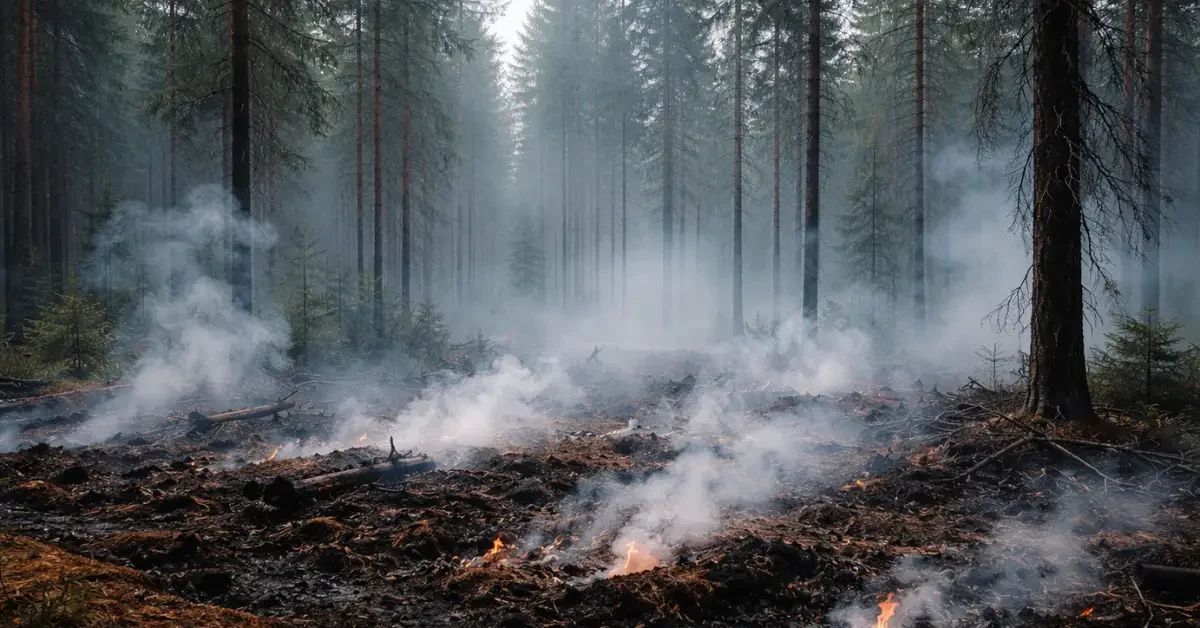
A new study published in the journal Science Advances warns that climate models may be dramatically undercounting the carbon released by wildfires in the world’s northern forests — and the culprit is hiding underground.
Researchers led by UC Berkeley, in collaboration with Lund University and the Brandenburg University of Technology, found that fires burning through boreal forests in Alaska, Canada, Scandinavia, and Russia can dig deep into carbon-rich peat soils beneath the forest floor. These slow-burning underground fires rarely show up clearly on satellite images, which means the tools scientists rely on to measure wildfire emissions may be missing a massive portion of the climate impact.
The Problem With Looking Down From Space
Most widely used global fire emissions models estimate carbon output by analyzing satellite images of visible flames. These models were largely built around data from wildfires at lower latitudes — regions where fires tend to burn fast and hot, staying above ground and remaining easily visible from space.
That approach breaks down when applied to boreal forests. Many fires in these northern regions smolder quietly through layers of peat — partially decayed plant material that has been accumulating in cold, wet soils for hundreds, or even thousands, of years. Boreal forests store more carbon in their soils than currently exists in the entire atmosphere.
“Many of the fires that matter most for the climate don’t look dramatic from space,” said lead author Johan Eckdahl, a postdoctoral scholar in UC Berkeley’s Energy and Resources Group and a forest fire researcher at Lund University. “Peatlands and organic soils can smolder for weeks to years, releasing enormous amounts of ancient carbon.”
Sweden’s 2018 Fires Put Models to the Test
To put the models under scrutiny, Eckdahl and his co-authors reconstructed the carbon emissions from 324 wildfires that swept through Sweden during the extremely hot summer of 2018. The team combined detailed national forest records from the Swedish Forest Agency, the Swedish Environmental Protection Agency, and the Swedish Meteorological and Hydrological Institute with direct field measurements to build what they describe as the most detailed map of carbon emissions from Swedish forest fires to date.
The researchers then compared their findings against six of the most widely used global fire emissions models — and found striking differences. The models overestimated carbon emissions in the county of Gävleborg, where intense, high-visibility fires burned through drier forests and were clearly captured by satellite. But in the neighboring county of Dalarna, where quieter fires crept into thick layers of organic soil, those same models underestimated carbon emissions by as much as 14 times. Overall, the study found that underground fire emissions from the 2018 fire season were underestimated by as much as 50 percent.
One Fire Outweighed Hundreds
One of the study’s most striking findings involves the 2014 Sala forest fire. Despite 2018 seeing a total burned area far larger than what was destroyed in Sala, the researchers determined that the Sala fire alone released roughly as much carbon as all 324 fires from 2018 combined. The difference came down to where the fire burned — the Sala fire reached deep into carbon-dense peat soils, while many of the 2018 fires burned across land with thinner soil layers.
“What matters is where it burns,” Eckdahl said. “A fire in deep peat soils can have a greater climate impact than hundreds of more intense fires on land with thin soil layers.”
To validate their calculations, the team visited 50 fire sites from 2018 — 19 from high-intensity fires and 31 from lower-intensity burns. At each location, researchers dug into the soil, measured the depth of the organic layer, and collected samples. By comparing carbon levels in burned soil against samples from nearby unburned forests, the team estimated how much carbon each fire had released.
Implications Beyond Sweden
The researchers are clear that Sweden is just the starting point. If current models are this far off for a well-documented Swedish fire season, they argue, the error margins for far larger fire events in Siberia, Canada, and North America could be considerably worse. Data from these remote regions is sparse, making it even harder to calibrate satellites and refine model estimates.
The study also highlights a land-use concern. The high-resolution maps suggest that recently clear-felled forest areas may act as corridors, helping fires spread from managed land into older, carbon-rich forests and wetlands. The researchers also note that population density plays a role — denser areas tend to enable faster firefighting responses, which can limit damage from high-intensity fires.
What Comes Next
Eckdahl is now extending this line of research to the western United States through the Western Fire & Forest Collaborative, working with colleagues at UC Berkeley and other institutions. Western forests generally lack the thick peat soils of the boreal north, but regional climate, vegetation types, and soil conditions still significantly shape how much carbon a wildfire releases. His next focus will be on the bacteria and fungi that live in forest soils and how these microbes support forest recovery after fire.
“By improving our understanding of how this element flows between the land and the atmosphere,” Eckdahl said, “we can better anticipate the impact of future fire regimes in a warming world and design smarter strategies to reduce climate risks on society.”
