

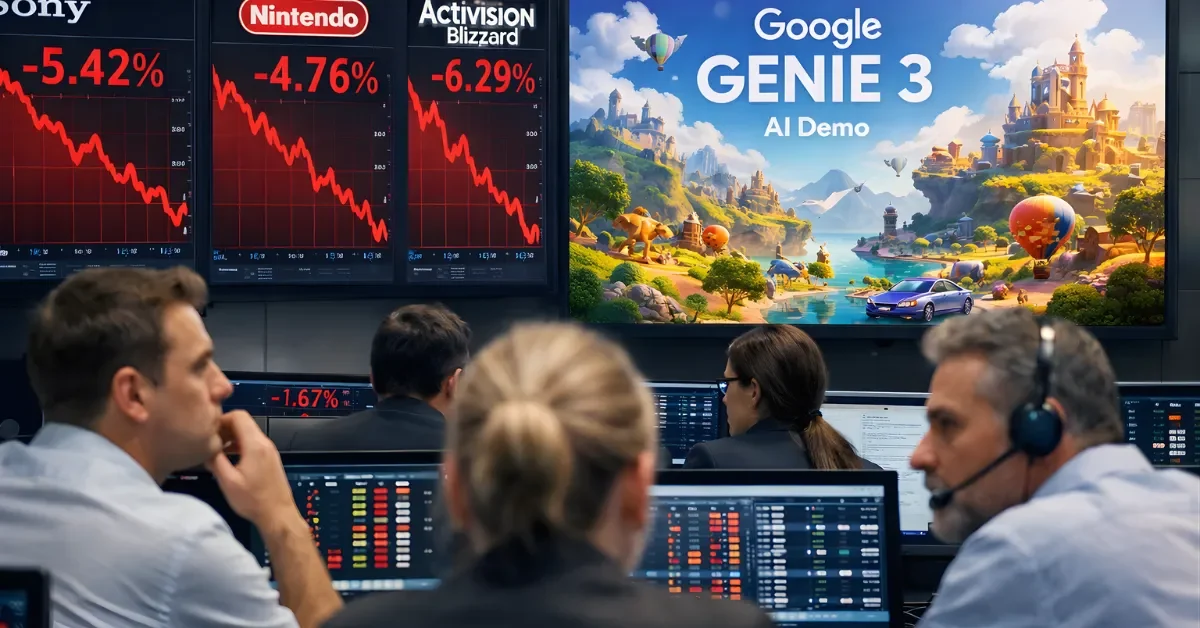
Google Genie 3 AI has ignited a sharp sell-off in major gaming stocks, as investors rushed to dump shares on fears that AI-generated games could upend the industry. The slide hit companies like Take-Two Interactive, Roblox, Unity, and Tencent, even as some analysts and executives argued the new technology is more limited experiment than looming replacement for traditional game development.
The turmoil followed Google’s latest AI push, including Project Genie and the Genie 3.0 model, which can turn a simple text prompt into a small, interactive game-like world in real time. Within hours of the reveal, gaming stocks across the board were under pressure, reflecting what many observers described as panic about the long-term impact of AI on game creation rather than a measured assessment of the tool’s actual capabilities.
Stocks slide on AI game fears
The market reaction to Google Genie 3 AI was immediate and severe for several high-profile publishers and platforms. Take-Two Interactive, the parent company of Rockstar Games, saw its share price drop by more than 9% in one account, wiping out billions of dollars in market value, while another report put the decline at nearly 8% and more than $3.5 billion in lost valuation. Roblox Corporation, known for its user-created game platform, fell by more than 12% in a single day, and Unity Technologies, maker of one of the most widely used game engines, tumbled around 30%.
The sell-off was not limited to those names. Tencent and other major publishers also saw declines, even as some companies such as Sega ended the day slightly higher, suggesting that at least part of the move reflected a wave of nervous selling rather than a uniform reassessment of the sector’s future. Commentators described retail investors “who know little to nothing about actual game development” rushing to sell shares as they imagined AI-generated titles quickly replacing big-budget projects from established studios.
What Google’s Genie 3 can actually do
At the center of the storm is Genie 3.0, which Google describes as a system that can take a text prompt and generate a dynamic, navigable world in real time at 24 frames per second, at 720p resolution, for a few minutes. Earlier demonstrations under the Project Genie banner have already shown users creating interactive scenes that closely resemble popular games like Mario, sparking worries about copyright risks if people continue to build lookalike worlds.
Despite its flashy presentation, the technology has clear limits that critics were quick to highlight. Commentators pointed out that Genie 3’s short duration, modest resolution, and latency issues make it more of a “cool to look at” showcase than a production-ready tool for building long, polished games, with one widely shared comment mocking the idea of paying high prices for RAM and SSDs just to generate seconds of “playable AI slop” with about a one-second delay. Others noted that running advanced AI models at scale would demand huge computing power and memory at a time when the world is already wrestling with component shortages and rising hardware costs.
Industry leaders urge caution, not panic
Some financial analysts see generative AI as a long-term tailwind for game makers rather than an existential threat. A report from research firm Wells Fargo stated that nothing observed from Project Genie changed its view that game studios will ultimately adopt AI tools to speed up development, calling the trend a broad secular positive for the industry. The firm argued that even if consumers interact directly with code to create virtual spaces, they will still rely on platforms that host online experiences, and demand for high-quality games will remain.
Take-Two’s chief executive Strauss Zelnick expressed a similar, if measured, optimism about AI. He described the technology as interesting for game development but said its abilities are often overstated, adding that it is unrealistic to expect an AI system to produce a game better than Grand Theft Auto just by typing a simple prompt like “Please create a game better than Grand Theft Auto.” In his view, human creativity is essential to making engaging art, and while AI can support creators, it cannot fully replace them.
Developers and gamers split on AI
Inside game studios, feelings about generative AI are mixed and often tense. A recent survey of developers found that more than half of respondents see generative AI as a threat to the gaming industry, even though over 35% said they already use such tools in their work. That split reflects both excitement about faster workflows and deep concern about job security, originality, and the quality of AI-assisted content.
On the player side, commentators noted that many gamers are loudly pushing back against AI in games, even for relatively modest uses. Writers described a growing gap where investors are frightened that tools like Google Genie 3 AI might cheaply replace traditional development, while gamers resist the idea of AI-produced experiences at all, leaving companies stuck between an angry audience and a skittish market. Some critics argued that people are not rushing to abandon human-made videos, movies, or games despite advances in AI content, suggesting that demand for human-crafted entertainment remains strong.
AI hype, hardware limits, and the road ahead
The latest sell-off is unfolding against a broader backdrop of AI hype and anxiety. Major tech firms have seen their valuations soar on promises that AI will reshape industries, leading some observers to warn of a growing bubble, even as others insist this moment differs from earlier crashes like the dot-com bust. Commentators described gaming itself as a kind of bubble that can be inflated or punctured from inside the industry or by outside shocks like sudden AI announcements.
Technical and economic constraints may slow any rush toward fully AI-generated games. Analysts and writers pointed to rising memory and storage prices, power-hungry models, and global RAM shortages as hard limits on how many people can run intensive AI experiences at once, which helps explain why Google’s own tools remain tightly scoped. For now, many in the industry argue that Genie 3 is a powerful experiment that has rattled investors more than it has changed what game development actually looks like, and that the true test will be how developers, publishers, and players decide to use—or reject—AI in the years ahead.
