

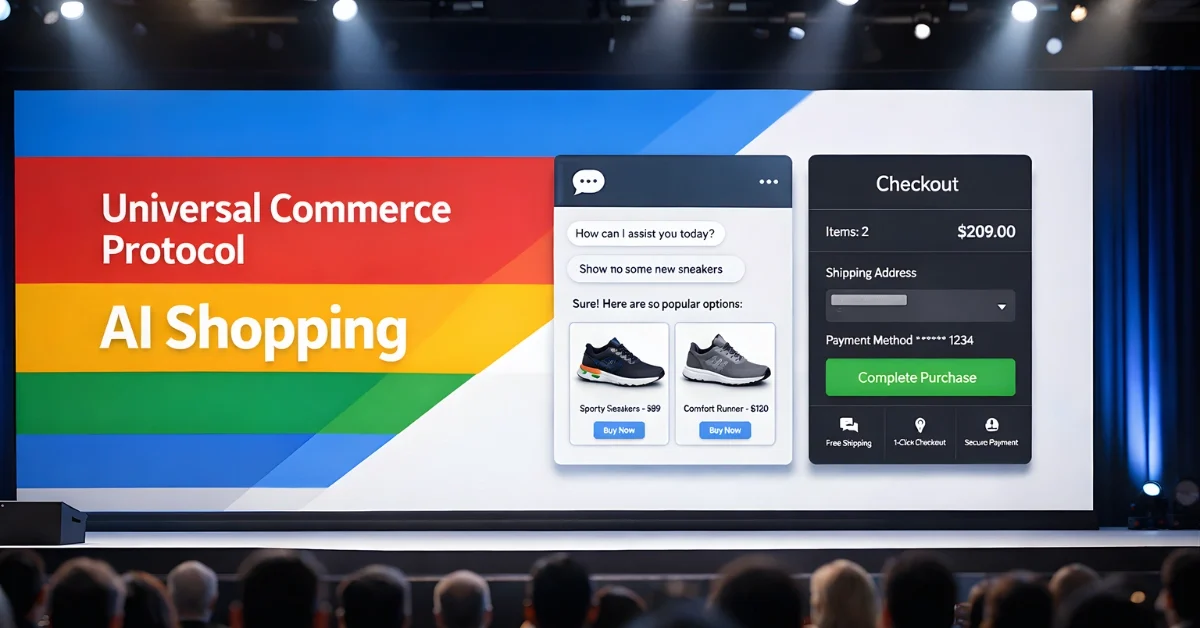
Google has announced a new open standard called the Universal Commerce Protocol (UCP) aimed at making it easier for AI agents to support shopping tasks across the customer buying process. The company introduced UCP at the National Retail Federation (NRF) conference and said the protocol is designed to help “agent-based shopping” work more smoothly across discovery, checkout, and post-purchase support.
UCP is being developed with companies including Shopify, Etsy, Wayfair, Target, and Walmart. Google’s central pitch is that a shared protocol can reduce the need to build separate connections for different agents and different steps of commerce, by offering a standard approach that can cover multiple parts of the workflow.
What Google says UCP does
Google describes UCP as an open standard that helps AI agents work across key parts of a customer’s buying journey, including product discovery and post-purchase support. The company’s framing is that shopping often breaks into many separate systems, and that a protocol could help tie actions together so agents can complete tasks more consistently across different services.
Google also said UCP works alongside other “agentic protocols,” naming Agent Payments Protocol (AP2), Agent2Agent (A2A), and Model Context Protocol (MCP). The company said agents and businesses can “pick and choose” extensions of the protocol that fit what they need, rather than using every part of it.
Shopping inside AI mode and Gemini
Google said it plans to use UCP for eligible Google product listings in AI mode in Search and in the Gemini apps. The goal, according to the company, is to let shoppers check out directly from U.S.-based retailers while they research a product.
For payments, Google said users will be able to pay with Google Pay and use shipping information saved in Google Wallet. Google also said it will soon add PayPal as a payment option.
Discounts and new merchant tools
Google said brands will be able to offer “a special discount” to users while they are searching for product recommendations using AI mode. In the example Google gave, a shopper might enter a detailed request—such as looking for a modern, stylish rug suitable for a high-traffic dining room—and a brand could be set up to present a discount at that moment.
The company also said it is adding new data attributes in Merchant Center so sellers can better feature their items within AI-powered search surfaces. In addition, Google said it is now allowing merchants to integrate a branded, AI-powered “Business Agent” within Google Search to answer customer questions, and it noted that Lowe’s, Michaels, Poshmark, and Reebok are already using the product.
Google also announced Gemini Enterprise for Customer Experience (CX), which it described as a suite for retailers and restaurants focused on shopping and customer service.
How Shopify framed “agentic” shopping
Shopify CEO and founder Tobi Lütke, speaking in connection with the announcement, emphasized the potential for AI-driven shopping to surface products a customer may not have thought to search for. “It’s really good at finding people who have specific interests and finding the product that is just perfect for them,” Lütke said, adding that “serendipity is where the best of commerce happens.”
TechCrunch also noted that Shopify unveiled a separate shopping integration with Microsoft Copilot on the same day, designed to let customers check out within the conversational flow.
A broader push toward AI-driven commerce
The announcement arrives amid broader efforts across the industry to bring generative AI into shopping experiences for both consumers and merchants. TechCrunch pointed to companies such as Google, Amazon, Walmart, and OpenAI as releasing standards and products meant to infuse AI into more parts of the shopping process.
The report also cited Adobe as saying that traffic driven to seller sites by generative AI grew by 693.4% during the holiday season, while noting that the report did not specify how much of that traffic became sales. Against that backdrop, Google’s new protocol and commerce features reflect a push to make AI tools not only answer questions, but also support transactions and customer support actions within the same experience.
