

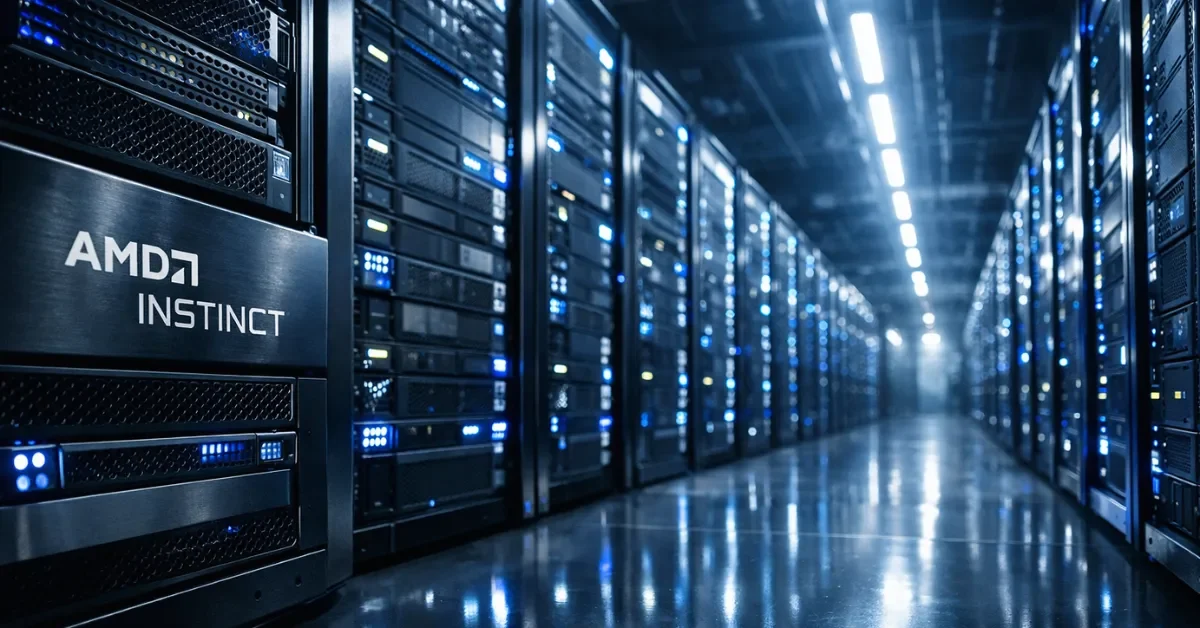
Meta Platforms has agreed to a landmark AI chip supply partnership with Advanced Micro Devices (AMD) in a deal that could exceed $100 billion in value — and comes with an option for Meta to acquire up to a 10% stake in the chipmaker.
The agreement centers on Meta purchasing AMD’s latest MI450 GPUs to power its expanding AI data centers. The multi-year, multi-generation commitment covers up to 6 gigawatts of AMD Instinct GPU hardware, with the first phase — an initial 1-gigawatt deployment — scheduled to begin in the second half of 2026.
A Deal Built for Unprecedented Scale
The first shipment phase will rely on a custom GPU derived from AMD’s MI450 architecture and integrated within AMD’s Helios rack-scale platform. The systems will also run on sixth-generation EPYC processors, code-named Venice, alongside AMD’s ROCm software stack. The two companies are co-engineering the chip design specifically to handle Meta’s AI workloads, which span large-scale AI training, inference tasks, and the recommendation systems that serve billions of users across platforms like Facebook and Instagram.
This new partnership builds on an already established relationship. Meta has previously deployed AMD’s EPYC CPUs and earlier-generation Instinct GPUs across its global data center footprint, making this expansion a natural progression of that existing infrastructure investment.
Equity Warrants Sweeten the Agreement
Beyond the hardware supply arrangement, the deal includes a notable equity component. AMD issued Meta a performance-based warrant covering up to 160 million shares of AMD common stock, priced at just $0.01 per share. The first tranche of shares vests after Meta receives its initial 1-gigawatt shipment, with additional batches unlocking as purchases scale toward the full 6-gigawatt commitment. If fully exercised, the warrants would give Meta a stake of up to 10% in AMD.
This structure ties commercial milestones directly to equity participation, giving both companies a shared incentive to execute the deployment efficiently and on schedule.
What the CEOs Are Saying
Meta founder and CEO Mark Zuckerberg framed the partnership as a strategic move toward diversifying the company’s computing stack. “We’re excited to form a long-term partnership with AMD to deploy efficient inference compute and deliver personal superintelligence,” he said. “This is an important step for Meta as we diversify our compute. I expect AMD to be an important partner for many years to come.”
AMD chair and CEO Dr. Lisa Su underscored the scope of the collaboration. “This multi-year, multi-generation collaboration across Instinct GPUs, EPYC CPUs, and rack-scale AI systems aligns our roadmaps to deliver high-performance, energy-efficient infrastructure optimized for Meta’s workloads, accelerating one of the industry’s largest AI deployments and placing AMD at the center of the global AI buildout,” she said.
AMD’s CFO Jean Hu added that the company expects the partnership to drive substantial multi-year revenue growth and be accretive to its non-GAAP earnings per share, while the performance-based structure tightly aligns both companies around long-term execution.
AMD Stock Surges After Announcement
Investors responded with enthusiasm. AMD shares jumped more than 9% in pre-market trading following the announcement, a signal that the market views the deal as a major validation of AMD’s position in the AI chip race.
The announcement arrived just days after Meta revealed a separate long-term partnership with Nvidia, under which it will deploy millions of Nvidia chips and related equipment across its AI data centers. Together, the two deals reflect Meta’s determination to lock in the massive computing capacity it believes will be essential for competing in an increasingly intensive AI landscape.
Meta’s Broader AI Ambitions
Meta has been accelerating its AI investments on multiple fronts. In June, the company committed $14.3 billion to AI data company Scale AI and brought on its CEO, Alexandr Wang, to help lead an internal team working toward what Meta describes as “superintelligence.” In December, Meta also acquired AI startup Manus, further deepening its capabilities across its platforms.
For AMD, landing Meta as a flagship customer marks a significant advance in its effort to close the competitive gap with Nvidia. Nvidia built its dominance by repurposing graphics processing units — originally designed for gaming — for AI model training, and it captured early market leadership as demand from tech companies surged. AMD is now making a credible push into that space, and securing a deal of this magnitude with one of the world’s largest technology companies gives it both the revenue stream and the industry validation it needs to compete at the highest level.
