

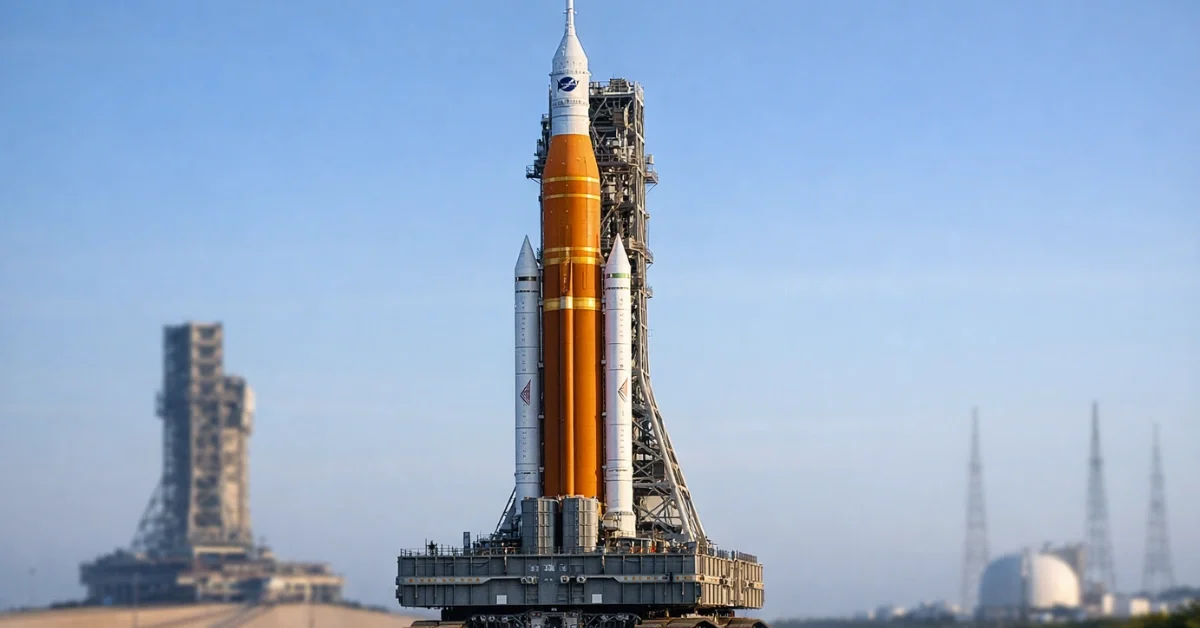
NASA is moving forward with the Artemis II rollback, officially targeting Wednesday, February 25, to transport its massive moon rocket off the launch pad. The agency will move the Space Launch System rocket and the Orion spacecraft from Launch Pad 39B at the Kennedy Space Center in Florida back to the Vehicle Assembly Building.
The Artemis II rollback is necessary after engineers detected an issue with helium flow to the rocket’s upper stage. Returning the spacecraft to the hangar is required to properly diagnose and repair the problem, forcing a launch delay. Originally scheduled for early March, the mission is now targeting April at the earliest.
Helium Flow Problem Halts Pad Preparations
The technical issue involves the Interim Cryogenic Propulsion Stage, the rocket’s upper stage. Overnight between February 20 and 21, the team was unable to achieve proper helium flow through the vehicle.
NASA relies on helium to pressurize the liquid hydrogen and liquid oxygen propellant tanks. The gas is also essential for purging the rocket’s engines and controlling environmental conditions necessary for operation.
The helium blockage came as a surprise because the systems performed correctly just days prior. During the mission’s wet dress rehearsal tests, which concluded on Thursday, February 19, the team successfully demonstrated the ability to safely load more than 700,000 gallons of super-cold liquid hydrogen and liquid oxygen into the rocket.
The Trek to the Vehicle Assembly Building
Weather permitting, the move begins around 9 a.m. EST on Wednesday. Initially planned for Tuesday, February 24, windy forecasts forced NASA to adjust the timeline. Managers previously opted to remove contingency pad access trusses from the mobile launch tower before high winds reached the Space Coast.
The four-mile journey from the launch pad to the Vehicle Assembly Building is a slow, delicate process. Moving the 322-foot rocket is expected to take up to 12 hours.
Necessary Repairs and Investigations
Once secured inside the Vehicle Assembly Building, teams will immediately install platforms to access the area where the helium flow issue originated.
NASA is currently investigating several potential causes for the blockage. The troubleshooting process includes examining the interface between the ground lines and the rocket lines used to route the helium. Engineers will also inspect a filter located between the ground equipment and the rocket, as well as a specific valve inside the upper stage. Additionally, the agency plans to review flight data from the uncrewed Artemis I mission, which experienced a helium-related pressurization issue prior to its 2022 launch.
While the primary focus is resolving the helium flow problem, teams will take advantage of the downtime in the hangar to complete other maintenance tasks. Workers will replace and retest batteries in the rocket’s flight termination system. They will also swap out additional batteries located in the upper stage.
Launch Window Shifts to April
The rollback will completely remove the possibility of launching during the upcoming March window, which featured opportunities between March 6 and March 9, as well as on March 11. Following the discovery of the helium blockage, NASA Administrator Jared Isaacman stated on X that the problem “will almost assuredly impact the March launch window.”
NASA has officially confirmed that the launch is delayed to April at the earliest. The next available launch windows fall on April 1, between April 3 and April 6, and on April 30. The agency noted that the quick decision to begin preparations for the rollback potentially preserves the April launch window, pending the outcome of the repair efforts, data findings, and the overall schedule.
Crew Status and Mission Context
With the launch delayed, the four Artemis II crew members were officially released from quarantine on the evening of February 21. The crew, consisting of three NASA astronauts and one Canadian astronaut, currently remains in Houston. The historic crew features the first woman and the first Black man assigned to a lunar mission.
Artemis II will be the first crewed mission to travel beyond low Earth orbit since the end of the Apollo era. The astronauts will embark on a roughly 10-day journey around the moon and back to Earth inside the Orion capsule.
The mission is a crucial stepping stone for the broader Artemis program, which is designed to establish a long-term human presence on the moon. NASA will use the flight to test vital life support and navigation systems ahead of Artemis III, a mission aimed at landing astronauts on the lunar surface in 2028. Ultimately, the agency plans to use the moon as a foundational testing ground for sending astronauts to Mars in the future.
