

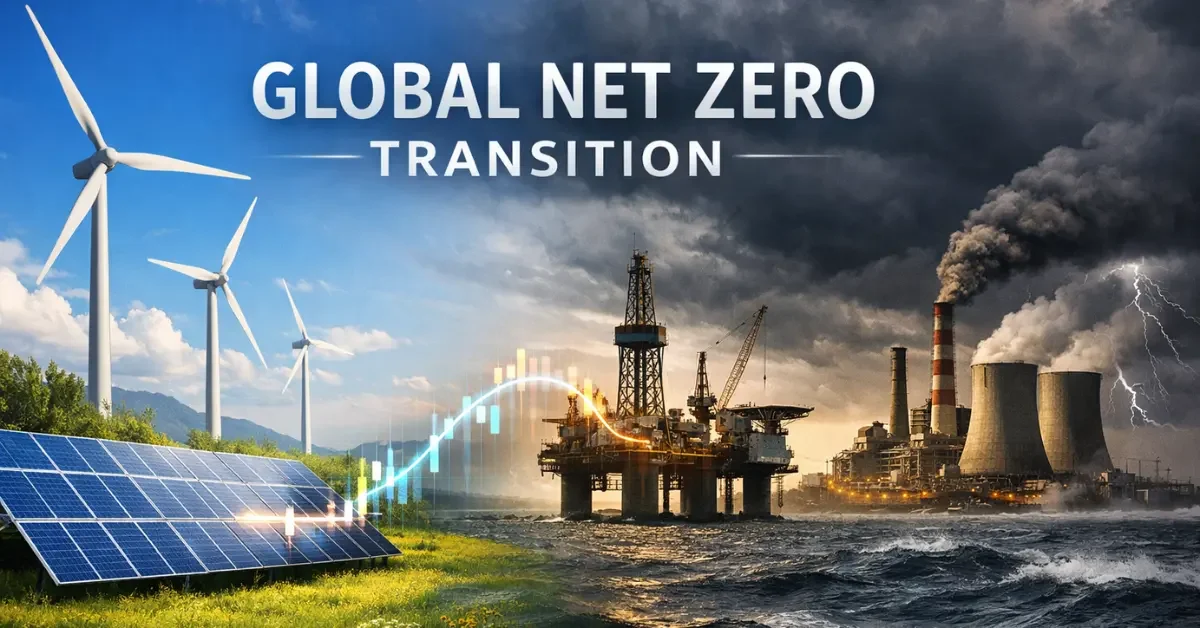
Global leaders, scientists, and financial experts are issuing a stark warning: the costs of ignoring climate change far outweigh the price of decarbonization. A recent report from the United Kingdom’s Climate Change Committee reveals that achieving a net zero transition by 2050 will cost less than enduring a single major fossil fuel price shock. This finding comes as Europe braces for a long-lasting energy crisis driven by the ongoing Iran war, which recently pushed oil prices above $110 a barrel.
Transitioning to a low-carbon economy is no longer just an environmental imperative; it is a financial necessity. Researchers stress that current economic models severely underestimate the financial damages of a warmer world, leaving businesses, governments, and taxpayers exposed to massive systemic risks. Delaying action not only increases the threat of catastrophic climate impacts but also threatens to wipe out substantial business revenue.
The High Cost of Fossil Fuel Reliance
The economic argument for rapid decarbonization is becoming clearer. According to the Climate Change Committee, each pound invested in achieving net zero yields a return of 2.2 to 4.1 times in broader societal and economic value. Avoiding physical climate damages stands out as the most significant financial advantage, with estimated savings ranging from £40 billion to £130 billion by 2050. Transitioning to clean energy also halves energy system waste, saving an estimated £30 billion annually compared to the £60 billion lost in today’s fossil fuel-heavy setup.
Despite these clear financial benefits, the global economy remains tethered to volatile fossil fuel markets. The Middle East conflict has triggered widespread energy shocks, prompting European Union officials to consider fuel rationing and tapping into emergency reserves. Several European finance ministers have even called for an EU-wide windfall tax on energy companies profiting from the geopolitical crisis.
Meanwhile, political shifts threaten to complicate the global energy transition. In the United States, President Donald Trump’s proposed 2027 budget seeks to eliminate $15 billion from clean energy programs. The proposal redirects funds toward building fossil fuel infrastructure and a record $1.5 trillion military budget, while cutting the Environmental Protection Agency’s funding by roughly half.
Flawed Economic Models Hide True Climate Risks
As the world approaches higher temperature thresholds, experts warn that financial planners are flying blind. A joint report by the University of Exeter and the Carbon Tracker Initiative, which surveyed 68 climate scientists, concluded that current economic models systematically downplay physical climate risks. These models often fail to account for interconnected system failures, critical tipping points, and multiplying financial shocks that occur as the planet warms beyond 2 degrees Celsius.
The report notes that relying on standard metrics like gross domestic product masks the full scale of environmental harms. This dynamic gives policymakers and financial institutions a false sense of security. Financial models often assume the future will behave much like the past, but climate scientists argue that beyond 2 degrees Celsius, societies will no longer face manageable economic adjustments.
The physical reality of these risks is alarming. Johan Rockström, director of the Potsdam Institute, has warned that a 2.5-degree Celsius temperature rise would trigger a 10-meter rise in sea levels and the total breakdown of essential marine ecosystems. Despite these warnings, a recent European Scientific Advisory Board on Climate Change report suggested using a baseline of 2.8 to 3.3 degrees Celsius of warming by 2100 for adaptation planning. Climate experts strongly criticize this approach, noting that normalizing a 3-degree warmer world ignores the severe global chaos and potential 50 percent drop in key crop yields that would inevitably follow.
Building the Business Case for Sustainability
For businesses and investors, the net zero transition is increasingly viewed as an opportunity for revenue growth rather than a mere compliance burden. Research from EY indicates that delaying climate initiatives could reduce a company’s annual revenue by 15 percent. While supply chain emissions often account for around 90 percent of a corporate carbon footprint and remain notoriously difficult to address, tackling these areas is crucial for long-term operational resilience. Organizations that fail to secure supply chain buy-in face poor operational data, reduced leverage in negotiations, and weakened defenses against market disruptions.
In emerging markets, the shift toward clean energy presents massive financial opportunities. India’s new climate plan aims to generate 60 percent of its electricity from cleaner sources by 2035, while reducing its emissions intensity by 47 percent compared to 2005 levels. Jayant Sinha, president of Eversource Capital, notes this goal will require billions of dollars in investments for grid upgrades and battery storage. Looking further ahead, India may need to deploy as much as $21 trillion to reach its ultimate goal of net zero by 2070.
Ultimately, early steps toward decarbonization deliver meaningful progress. Prioritizing action allows companies to build momentum, protect long-term profits, and stay ahead of shifting regulations, proving that the cost of acting on climate change is far lower than the price of ignoring it.
