

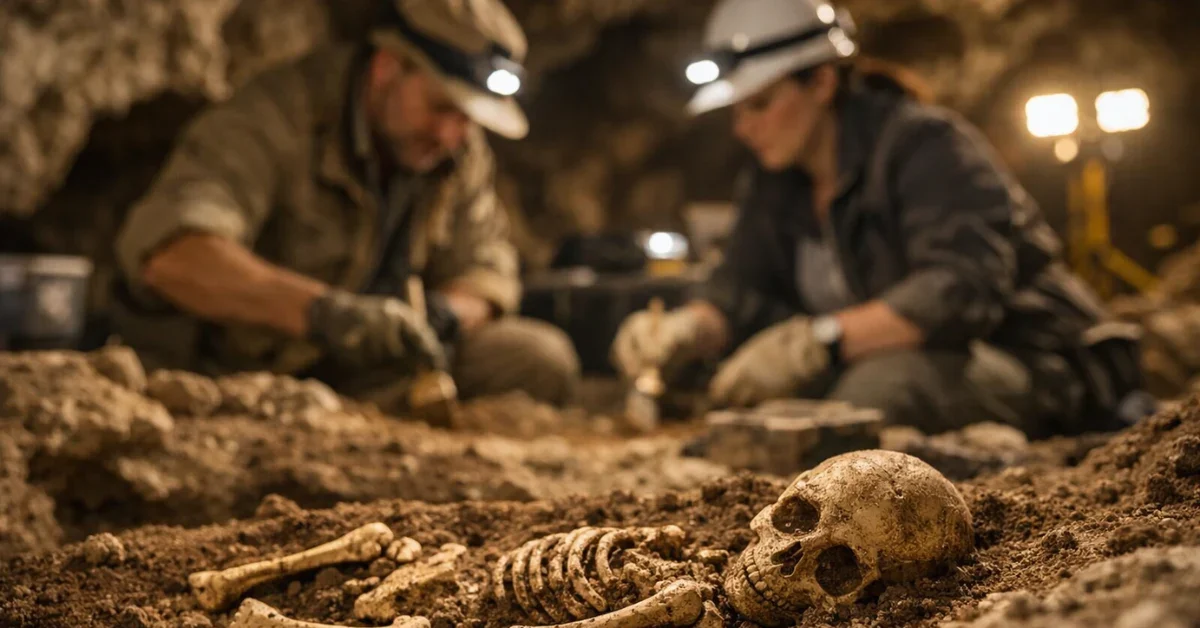
A groundbreaking genetic study has identified the oldest known case of a rare growth disorder in humans, solving a prehistoric medical mystery. Researchers analyzing 12,000-year-old skeletal remains from a cave in southern Italy discovered that a teenage girl buried there suffered from a severe form of dwarfism.
The study, led by teams from the University of Vienna and the University Hospital of Liège, focused on two skeletons unearthed in the Romito Cave. The remains, known as Romito 2 and Romito 1, were buried together in an embrace. Advanced DNA analysis revealed that the younger individual, a teenage female, carried a specific genetic mutation responsible for acromesomelic dysplasia, Maroteaux type. This extremely rare inherited condition causes severe short stature and significantly shortened limbs.
Genetic Diagnosis Solves Stone Age Mystery
The research marks a significant milestone in paleogenomics, providing the earliest DNA-based diagnosis of a genetic disease in modern humans. While anthropologists had previously noted the unusual physical characteristics of the Romito 2 skeleton, only modern sequencing technology could confirm the specific cause.
Scientists identified a mutation in the NPR2 gene, which is critical for bone growth. The teenage girl inherited two mutated copies of this gene—one from each parent—resulting in the severe form of the disorder. Her companion in the grave, an adult woman identified as Romito 1, was found to be a first-degree relative, likely her mother. The older woman carried only one copy of the mutated gene, which likely resulted in a shorter stature but not the full manifestation of the disease.
Evidence of Prehistoric Care and Compassion
Beyond the medical diagnosis, the findings offer a touching glimpse into the social dynamics of the Upper Paleolithic period. Despite the severe physical limitations imposed by her condition, the teenage girl survived well into adolescence. This survival would have been impossible without the sustained care, support, and assistance of her community.
The fact that she was buried with the same rites and alongside a close family member suggests she was a fully integrated and valued member of her group. This challenges the notion that prehistoric societies might have marginalized individuals with physical differences. Instead, the Romito discovery indicates a culture of compassion where vulnerable members were supported by their tribe.
Rare Diseases in Human History
The identification of this specific mutation pushes back the known history of rare genetic diseases by thousands of years. It demonstrates that such conditions have been part of the human experience for millennia. By successfully diagnosing a specific syndrome in remains dating back to the Ice Age, researchers have opened new possibilities for studying the history and evolution of genetic disorders.
The study confirms that the individuals belonged to the Villabruna genetic cluster, a group of hunter-gatherers that spread across Europe around 14,000 years ago. While the population in the region was likely small, the genetic data did not show evidence of close inbreeding, making the presence of this rare dual-carrier scenario a remarkable coincidental finding for geneticists.
