

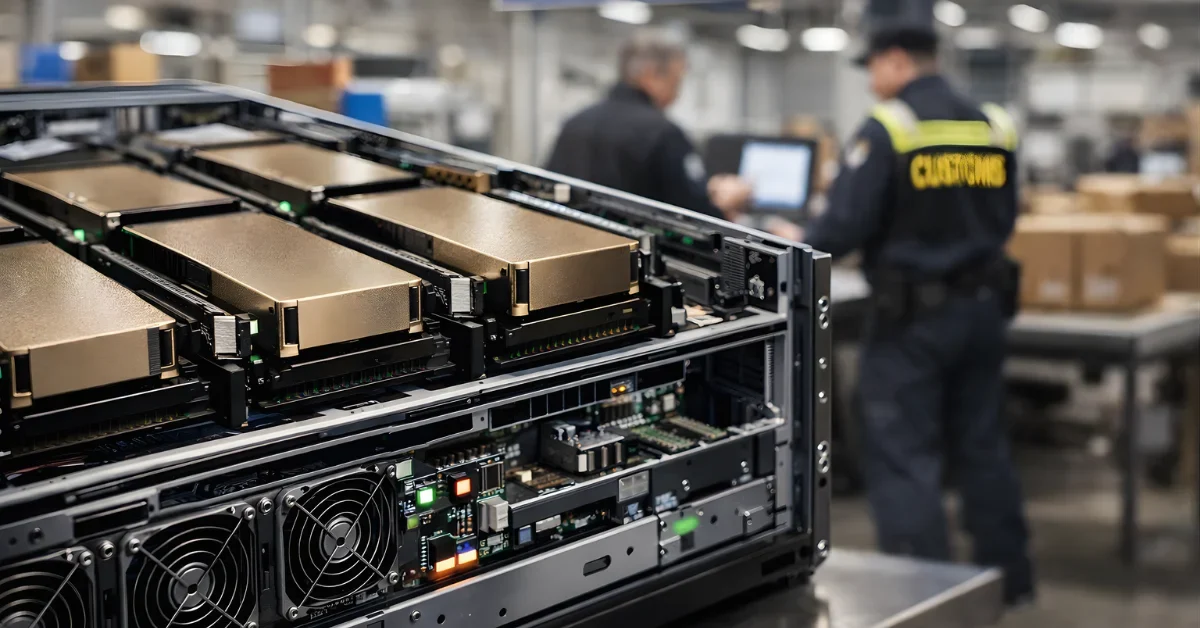
Suppliers making parts for Nvidia’s H200 artificial intelligence chips have paused production after Chinese customs officials blocked shipments of the processors from entering China, according to a Financial Times report. The Financial Times report said the pause followed instructions that prevented clearance applications, creating uncertainty for Nvidia and its partners just after the chip was cleared for export to China.
The Financial Times report said manufacturers of key H200 components, including printed circuit boards designed specifically for the chip, halted output after being told shipments could not clear Chinese customs. The report described a directive in which customs officials summoned logistics companies in Shenzhen and said they could not submit clearance applications for the processors, while it remained unclear if the restriction was temporary or part of a broader shift.
What the report says happened at customs
The Financial Times report said initial batches of H200 chips arrived in Hong Kong this week, but the intervention by Chinese customs caught Nvidia and its partners off guard. It also said suppliers paused manufacturing to avoid being left with inventory they could not sell if shipments stay blocked.
A Reuters item said suppliers of parts for Nvidia’s H200 chips paused production after Chinese customs officials blocked shipments of the newly approved processors from entering China, and Reuters said it could not immediately verify the Financial Times report. Nvidia and China’s General Administration of Customs did not immediately respond to requests for comment, the Financial Times report said.
Why parts suppliers are pausing production
The Financial Times report highlighted that the risk is especially high for printed circuit boards tailored only for the H200, because those parts cannot be easily repurposed if shipments remain blocked. SemiAnalysis analyst Chu Wei-Chia said the inability to repurpose those components increases suppliers’ financial exposure if the customs restriction continues.
The Business Times, citing Reuters, reported that Chinese authorities had not provided reasons for the directives and had not indicated whether the move is a formal ban or a temporary measure. The same report said sources also described government officials summoning domestic tech firms to warn them against buying the chips unless necessary.
US approval, then a reported China block
NetworkWorld reported that the US Commerce Department’s Bureau of Industry and Security announced a regulation clearing the way for Nvidia to sell H200 AI processors to Chinese companies on a case-by-case basis. NetworkWorld said the agency described it as a revision to licensing policy for semiconductor exports to China.
NetworkWorld reported the policy would allow reviews of license applications for Nvidia H200 and similar chips if certain security requirements are met, including a condition that exports to China will not reduce global semiconductor production capacity available to US customers. Nvidia welcomed the ruling, and a spokesperson told NetworkWorld: “we applaud President Trump’s decision to allow America’s chip industry to compete to support high paying jobs and manufacturing in America. Offering H200 to approved commercial customers, vetted by the Department of Commerce, strikes a thoughtful balance that is great for America.”
NetworkWorld also reported that Reuters later said Chinese customs authorities told customs agents this week that the chips are not permitted to enter China. The Business Times similarly reported that Chinese customs authorities told customs agents that Nvidia’s H200 chips are not permitted to enter the country.
Demand expectations and shipping plans
The Financial Times report said Nvidia ramped up production in anticipation of strong demand after US President Donald Trump signaled last month that sales would be permitted. The report said Nvidia expected more than one million orders from Chinese customers and that suppliers were operating around the clock to prepare for shipments as early as March.
The Business Times, citing Reuters, also reported Nvidia expected more than one million orders from Chinese clients and that suppliers had been preparing to ship as early as March. The Financial Times report said the H200 is an older-generation AI chip that falls below the most restrictive US export thresholds.
Signals inside China on next steps
The Financial Times report said Chinese regulators had been exploring mechanisms to allow limited access to the H200, while implementation has been complicated by differing priorities among government agencies. The report said George Chen of The Asia Group told the Financial Times that mixed signals have emerged from bodies including the National Development and Reform Commission, the Ministry of Industry and Information Technology, and the Cyberspace Administration of China.
People familiar with discussions told the Financial Times that possible approaches being considered included a licensing system limiting access to companies with advanced AI training needs and requirements tying imports to a ratio of domestic to imported chips. The report added that uncertainty has already pushed some Chinese customers to rethink procurement plans.
How customers and the market may react
The Financial Times report said the H200 is favored by major technology groups such as Alibaba, ByteDance and Tencent for performance and relatively straightforward maintenance. It also said a Chinese seller of Nvidia AI servers reported that many local clients canceled H200 orders and instead sought the more powerful B200 and B300 chips, which the report said are banned from export to China under US rules.
The same Financial Times report said that demand for the banned B200 and B300 chips has fueled a black market. It also said this is not the first time Nvidia has faced pushback from Chinese authorities, noting that Beijing halted purchases of the H20 last summer, a chip designed to comply with US export restrictions.
NetworkWorld included differing takes from analysts on what the shifting policies might mean for enterprises and supply. Info-Tech Research Group’s Scott Bickley told NetworkWorld the flip-flop policies are “more a symbol of the ongoing trade war between the US and China,” and he said volumes involved are not material to Nvidia allocation from TSMC.
NetworkWorld also reported Forrester analyst Charlie Dai said renewed H200 access would likely have only a modest impact on global supply as China prioritizes domestic AI chips and the H200 is inferior to Nvidia’s latest Blackwell-class systems in performance and appeal. Greyhound Research’s Sanchit Vir Gogia told NetworkWorld the bigger issue is “policy volatility,” calling the situation a case study in how infrastructure availability assumptions can be invalidated by shifting rules rather than product lifecycle.
