

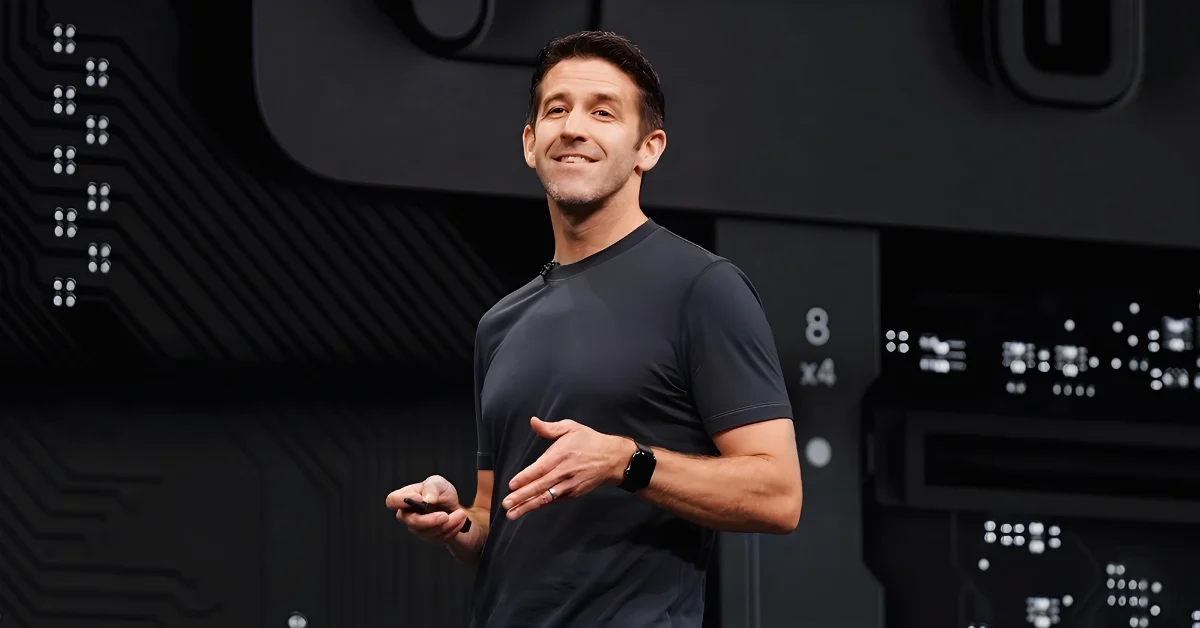
Tim Cook recently confirmed that he is not leaving his post immediately, but Apple is actively preparing for his eventual retirement. After leading the technology giant for nearly 15 years, the 65-year-old executive is laying the groundwork for the company’s future leadership. Among the potential candidates, John Ternus, Apple’s Senior Vice President of Hardware Engineering, has surfaced as the most likely internal successor to become the next Apple CEO.
Current and former colleagues note that the 50-year-old executive is highly regarded among senior leadership. Multiple members of Cook’s team and external analysts view him as the obvious heir apparent. With recent high-profile retirements shaking up Apple’s management tier, Ternus has steadily accumulated more responsibility across the organization, positioning him to guide the $4 trillion company into its next era.
A Meticulous Engineer with Deep Product Roots
Ternus brings a vastly different background to the leadership table compared to Cook, who is known for his focus on supply chains, financial strategy, and business operations rather than product development. Ternus is described by coworkers as a highly technical and meticulous engineer who prefers to drill into the finest details during internal meetings.
His journey at Apple began in 2001, following a brief stint working on virtual reality headsets and accessories as a mechanical engineer at Virtual Research Systems. Armed with a mechanical engineering degree from the University of Pennsylvania—where he also competed on the varsity swim team and built a mechanical feeding arm for individuals with limited mobility—Ternus initially joined Apple’s product design team to work on computer monitors like the Apple Cinema Display.
Over the past two decades, he has been instrumental in building the products that generate roughly 80% of Apple’s revenue. He oversaw hardware development for the original iPad, managed the Mac lineup, and played a crucial role in integrating LiDAR technology into premium iPhone models. In 2021, he was promoted to his current role as the head of hardware engineering when Dan Riccio stepped down. Since then, Ternus has reversed a previous company trend that prioritized sleekness over device performance.
His collaborative nature has also been a significant asset. Ternus successfully partnered with software chief Craig Federighi to execute the complex transition from Intel processors to Apple Silicon. Furthermore, he pushed Federighi internally to develop a dedicated operating system for the iPad, arguing that the tablet’s powerful hardware was being limited by running the same software as the iPhone.
Stepping Into the Public Eye
Historically, Cook has handled major product announcements and media appearances, but Ternus is increasingly taking on these public-facing duties. During a launch event in New York on March 4, Ternus took the stage to reveal the new $599 MacBook Neo. The following morning, he appeared on national television to promote the laptop, a responsibility typically reserved for the chief executive.
Internally, his influence continues to expand. Following the retirement of Cook’s longtime second-in-command, Jeff Williams, in 2025, Ternus was appointed as the executive sponsor for design in January 2026. This move made him the primary bridge connecting Apple’s design organization with senior management, even though he does not hold a formal design title.
Ternus has also become the public voice for Apple’s hardware philosophy. He has defended the company’s decision to keep MacBooks without touchscreens, maintained Apple’s stance against removable back panels despite new European Union battery regulations, and championed a balanced approach to the company’s self-repair programs.
Navigating the Artificial Intelligence Challenge
While Ternus has a proven track record in hardware, whoever succeeds Cook will inherit significant challenges in the software and services sector. Apple has faced intense scrutiny regarding its position in the rapidly evolving artificial intelligence landscape. The company’s initial Apple Intelligence launch in 2024 was widely criticized, and a more capable version of its virtual assistant has faced multiple delays.
Some industry observers question whether a hardware-first executive is the ideal choice for a market increasingly driven by cloud computing and generative AI. In a 2023 interview, Ternus laughed off concerns about Apple being late to the AI race, a stance that has been tested by aggressive competition from rival tech companies who are rolling out advanced tools.
However, Ternus is already adapting to these shifting demands. After a challenging software rollout in early 2025, he was tasked with overseeing the reorganization of Apple’s artificial intelligence and machine learning divisions. Additionally, he has taken control of a secretive robotics unit developing an AI-powered tabletop device with a swiveling screen for video calls.
As Apple navigates ongoing leadership changes—including the planned spring 2026 retirement of its machine learning and AI strategy chief, John Giannandrea—Ternus remains the standout candidate. Former procurement chief Tony Blevins has called him an outstanding and obvious choice for the top job, while another longtime executive noted that those who appreciate Cook’s leadership will likely feel the same about Ternus. For now, Cook maintains that he cannot imagine life without Apple, giving his likely successor ample time to prepare for the transition.
