
By using this site, you agree to our Privacy Policy and Terms of Use.
Accept
VellaTimesVellaTimesVellaTimes
  • News
    NewsShow More
    NVIDIA CEO Jensen Huang announces Rubin AI platform on CES 2026 stage with holographic rack-scale system display.
    NVIDIA Launches Rubin AI Platform at CES 2026
    February 3, 2026
    Microsoft headquarters building in Redmond, Washington, symbolizing strong Q2 2026 earnings driven by cloud and AI growth.
    Microsoft Q2 2026 Earnings Beat Expectations with Strong Cloud Growth
    February 3, 2026
    Iranian official announces US diplomacy updates at press conference with flags visible.
    Iran Examines US Diplomacy, Hopes for Results Soon
    February 3, 2026
    Deep-sea mining tracks on Clarion-Clipperton Zone seafloor with reduced animal abundance, including worms and crustaceans, illuminated by ROV lights.
    Deep-Sea Mining Trial Causes 37% Drop in Seabed Animals
    February 3, 2026
    A modern conference room with laptops and papers on a table, with a city skyline visible through glass windows.
    Meta hires OpenAI researchers as AI talent war heats up
    February 3, 2026
  • Technology
    TechnologyShow More
    Microsoft headquarters building in Redmond, Washington, symbolizing strong Q2 2026 earnings driven by cloud and AI growth.
    Microsoft Q2 2026 Earnings Beat Expectations with Strong Cloud Growth
    February 3, 2026
    Advanced AI chips representing OpenAI's exploration of Nvidia alternatives amid performance concerns in a professional news style.
    OpenAI Seeks Nvidia AI Chip Alternatives
    February 3, 2026
    MacBook screen showing OpenAI Codex app with multi-agent coding threads and project management interface.
    OpenAI Launches Codex App for Mac Multi-Agent Coding
    February 3, 2026
    A smartphone displaying the Snapchat app logo held by a teenager in an outdoor Australian park setting.
    Snapchat Blocks 415,000 Underage Accounts as Australia Social Media Ban Takes Effect
    February 2, 2026
    Hyper-realistic illustration of Nvidia H200 AI server racks in a Chinese data center, symbolising Beijing’s conditional approval for DeepSeek to buy the chips.
    Nvidia H200 China approval: DeepSeek gets conditional nod
    February 2, 2026
  • AI
    AIShow More
    NVIDIA CEO Jensen Huang announces Rubin AI platform on CES 2026 stage with holographic rack-scale system display.
    NVIDIA Launches Rubin AI Platform at CES 2026
    February 3, 2026
    A modern conference room with laptops and papers on a table, with a city skyline visible through glass windows.
    Meta hires OpenAI researchers as AI talent war heats up
    February 3, 2026
    MacBook screen running OpenAI Codex app with multi-agent coding threads and project management features.
    OpenAI Launches Codex App for macOS Developers
    February 3, 2026
    A Starlink satellite dish positioned outdoors at dusk with a starry night sky and satellite light trails in the background.
    Starlink Privacy Policy Update Allows AI Training on Customer Data
    February 2, 2026
    Traders watch large screens showing falling gaming stock prices next to a Google Genie 3 AI demo display on a busy trading floor.
    Google Genie 3 AI Triggers Sharp Sell-Off in Gaming Stocks
    February 2, 2026
  • Science
    ScienceShow More
    Deep-sea mining tracks on Clarion-Clipperton Zone seafloor with reduced animal abundance, including worms and crustaceans, illuminated by ROV lights.
    Deep-Sea Mining Trial Causes 37% Drop in Seabed Animals
    February 3, 2026
    Massive sunspot AR4366 on the sun's surface with bright solar flares erupting from its edges, shown in high-contrast hydrogen-alpha telescope view.
    Sun Unleashes 27 Solar Flares in 24 Hours as Monster Sunspot Races Toward Earth
    February 3, 2026
    Illustration of NASA’s Juno spacecraft observing a large bright volcanic hotspot near the south pole of Jupiter’s moon Io from space.
    Io volcanic eruption: Juno spots most powerful blast
    February 2, 2026
    Scientist in a modern genomics lab examining a large digital display of a DNA double helix with AI-generated data overlays, illustrating Google DeepMind’s AlphaGenome model.
    AlphaGenome: Google DeepMind Open-Sources Powerful DNA AI
    February 2, 2026
    NASA's Perseverance rover driving along the rocky rim of Jezero Crater on Mars during its historic first AI-planned autonomous drive.
    NASA’s Perseverance Rover Completes Historic First AI-Planned Drive on Mars
    February 2, 2026
  • World
    WorldShow More
    Iranian official announces US diplomacy updates at press conference with flags visible.
    Iran Examines US Diplomacy, Hopes for Results Soon
    February 3, 2026
    Families and professionals protest outside New York federal courthouse against Trump administration's 75-country green card freeze.
    Lawsuit Challenges Trump’s 75-Country Green Card Freeze
    February 3, 2026
    US President Donald Trump announcing US-India trade deal with reduced tariffs at White House podium.
    Trump Cuts Tariffs to 18% in US-India Trade Deal
    February 3, 2026
    Starlink dish and terminal operating near a military command post with soldiers monitoring drone footage on screens.
    Starlink blocks Russia use after Ukraine drone alerts
    February 2, 2026
    Ukrainian, Russian, and American flags displayed in a conference room with the Abu Dhabi skyline visible through large windows, representing upcoming trilateral peace talks.
    Ukraine-Russia-US Peace Talks Delayed to February 4-5 in Abu Dhabi
    February 2, 2026
  • Bookmarks
Search
Category
  • News
  • Technology
  • AI
  • Science
  • World
Company
  • About Us
  • Contact Us
  • Fact Checking Policy
  • Terms & Conditions
  • Privacy Policy
  • Copyright Policy
Resources
  • Home
  • Web Stories
  • Bookmarks
  • Interests
  • Disclaimer
  • Sitemap
© 2022 VellaTimes • All Rights Reserved.
Reading: Stanford Optical Cavity Arrays Unlock Million-Qubit Quantum Computers
Share
Notification Show More
Font ResizerAa
VellaTimesVellaTimes
Font ResizerAa
  • News
  • Technology
  • AI
  • Science
  • World
Search
  • Explore
    • News
    • Technology
    • AI
    • Science
    • World
  • Useful Links
    • About Us
    • Contact Us
    • Fact Checking Policy
    • Terms & Conditions
    • Privacy Policy
    • Copyright Policy
  • Home
  • Web Stories
  • Bookmarks
  • Interests
  • Disclaimer
  • Sitemap
© 2022 VellaTimes • All Rights Reserved.
News

Stanford Optical Cavity Arrays Unlock Million-Qubit Quantum Computers

Nisha Pradhan
Last updated: 03/02/2026
Nisha Pradhan
Share
5 Min Read
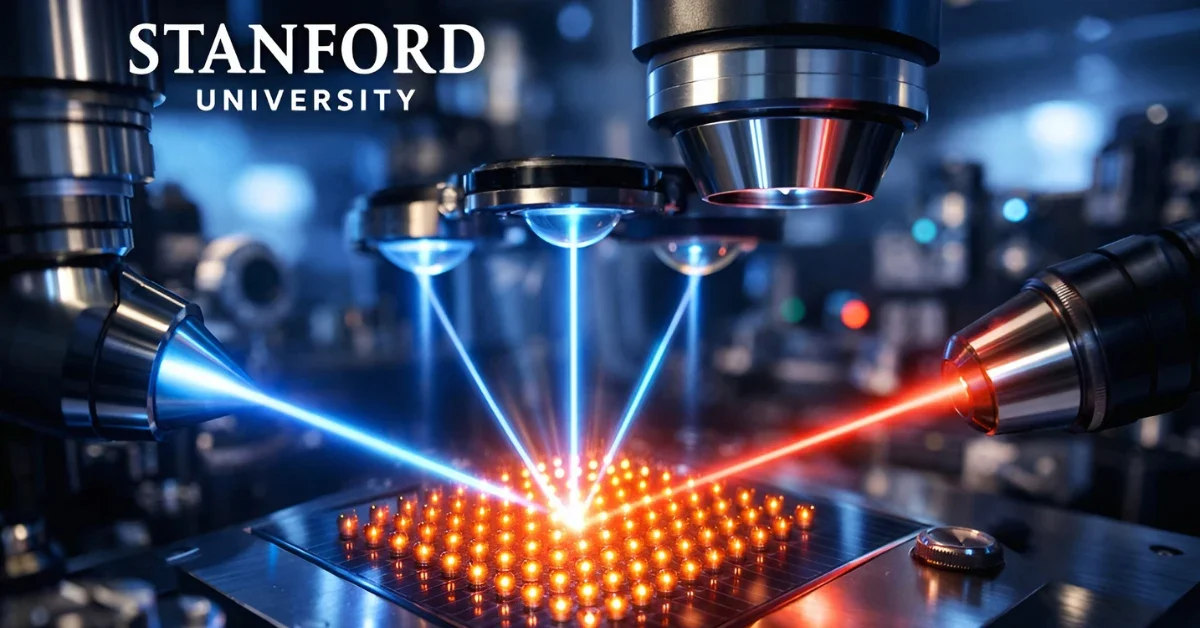
Stanford lab optical cavity array system interfacing light with atom qubits for quantum computing advancement.

Stanford physicists have introduced a novel optical cavity array system that speeds up qubit readout in quantum computers. This breakthrough tackles a key scaling challenge by linking each atom qubit to its own dedicated cavity for parallel light collection. A new study in Nature details a 40-cavity array with individual atoms and a prototype surpassing 500 cavities, pointing toward systems with millions of qubits.

Contents
Qubit Readout Challenge SolvedInnovative Cavity DesignScalability DemonstratedBroad Applications Ahead

The platform, called a cavity-array microscope, merges neutral-atom arrays with optical cavity quantum electrodynamics. It enables fast, non-destructive measurement of single atoms across a two-dimensional setup. Researchers demonstrated parallel readout on millisecond timescales, including via a fiber array for networking tests.

Qubit Readout Challenge Solved

Quantum computers rely on qubits from atom quantum states, which can hold zero, one, or both values simultaneously. This superposition promises to slash computation times for tough problems from millennia to hours. Yet reading qubit states quickly has proven tricky.

Atoms emit photons slowly and scatter them everywhere. Past efforts paired whole atom arrays with one shared cavity mode, limiting addressability and growth. The Stanford design changes that. Each atom now sits in its own cavity, achieving strong light-matter coupling without nanophotonics.

Jonathan Simon, senior author and associate professor of physics and applied physics at Stanford, explained the issue clearly. Atoms fail to emit light fast enough at scale, and it spreads in all directions. Optical cavities direct that light efficiently, and this setup gives every atom its personal cavity.

Innovative Cavity Design

Optical cavities trap light between reflective surfaces, bouncing it repeatedly for stronger atom interactions. The team added microlenses inside each cavity. These focus beams tightly on single atoms at micrometer scales, matching optical tweezer spacings.

The macro-scale resonator spans about 34 centimeters. An microlens array stabilizes beams and demagnifies them at the atom plane. This yields peak cooperativity above unity, with low crosstalk under 1% between neighboring modes.

Atoms stay distant from dielectric surfaces, easing engineering. The result: homogeneous coupling across the array. Adam Shaw, first author and Stanford Science Fellow, described the shift. The architecture goes beyond basic mirrors, promising quicker distributed quantum machines with high data rates.

Scalability Demonstrated

The study showcased a working 40-mode array. A next-generation version boasts over 500 cavities and nearly ten times better finesse. Goals include tens of thousands of cavities soon.

This supports linking quantum processors into networks. Imagine quantum data centers where machines connect via cavity interfaces, forming supercomputers. Fiber-coupled readout proves the modular approach works.

Simon likened classical computing to sequential searches. Quantum systems compare answer combos like noise-canceling headphones, boosting correct ones while damping errors.

Broad Applications Ahead

Millions of qubits will outpace top supercomputers. Fields like materials design, chemical synthesis for drugs, and cryptography stand to gain. Cavity arrays also boost biosensing and microscopy for medical advances.

In astronomy, they could sharpen optical telescopes to spot exoplanets directly. Shaw sees single-particle light control reshaping how we view the world.

Co-authors include David Schuster from Stanford, plus experts from Stony Brook University, University of Chicago, Harvard University, and Montana State University. Doctoral students Anna Soper, Danial Shadmany, and Da-Yeon Koh contributed from Stanford.

Support came from the National Science Foundation, Air Force Office of Scientific Research, Army Research Office, Hertz Foundation, and U.S. Department of Energy. Some researchers consult for Atom Computing and hold stock options there. Shadmany, Jaffe, Schuster, Simon, and Stony Brook’s Aishwarya Kumar share a patent on the resonator geometry.

This platform unlocks many-cavity quantum electrodynamics. It pioneers large-scale quantum networks with atom arrays, blending high-fidelity logic from arrays and strong coupling from cavities.

The work promises hybrid atom-photon systems for faster measurements and engineered Hamiltonians. Engineering hurdles linger, but the foundation feels solid for quantum leaps forward.

TAGGED: atom qubits, Nature study, quantum computing, quantum networks, Stanford University
Share This Article
Facebook Twitter Whatsapp Whatsapp Telegram Copy Link
By Nisha Pradhan
I am a passionate content creator with a deep love for travel, music, and food. Using my unique blend of these interests, I genuinely enjoy crafting high-quality travel, lifestyle, and entertainment-related news content.
Leave a comment

Leave a Reply Cancel reply

Your email address will not be published. Required fields are marked *


Most Read

OpenAI Nonprofit AI Jam scales AI for India nonprofits

January 17, 2026

US controls Venezuelan oil sales under Trump plan

January 8, 2026

Quantum magnetic levitation: How nanomagnets hover

January 27, 2026

Chinese fishing boats Taiwan blockade test stirs concern

January 28, 2026

NASA’s Perseverance Rover Completes Historic First AI-Planned Drive on Mars

February 2, 2026

Nvidia DLSS 4.5 adds dynamic 6X frame generation as CES 2026

January 7, 2026

Related News

NVIDIA CEO Jensen Huang announces Rubin AI platform on CES 2026 stage with holographic rack-scale system display.
News

NVIDIA Launches Rubin AI Platform at CES 2026

Sameer Katoch Sameer Katoch February 3, 2026
Microsoft headquarters building in Redmond, Washington, symbolizing strong Q2 2026 earnings driven by cloud and AI growth.
News

Microsoft Q2 2026 Earnings Beat Expectations with Strong Cloud Growth

Rakesh Paul Rakesh Paul February 3, 2026
Iranian official announces US diplomacy updates at press conference with flags visible.
News

Iran Examines US Diplomacy, Hopes for Results Soon

Editorial Staff Editorial Staff February 3, 2026

About Us

VellaTimesVellaTimesVellaTimes

VellaTimes is a leading news portal that covers the latest trending news in technology, lifestyle, entertainment, automobiles, travel, and sports.

Explore

  • News
  • Technology
  • AI
  • Science
  • World

Useful Links

  • About Us
  • Contact Us
  • Fact Checking Policy
  • Terms & Conditions
  • Privacy Policy
  • Copyright Policy

Subscribe Us

Subscribe to our newsletter for the Latest News and Top Stories!

© 2022 VellaTimes • All Rights Reserved.
  • Home
  • Web Stories
  • Bookmarks
  • Interests
  • Disclaimer
  • Sitemap
adbanner
AdBlocker Detected
Our site is an advertising supported site. Please whitelist us to support our work.
Okay, I'll Whitelist