

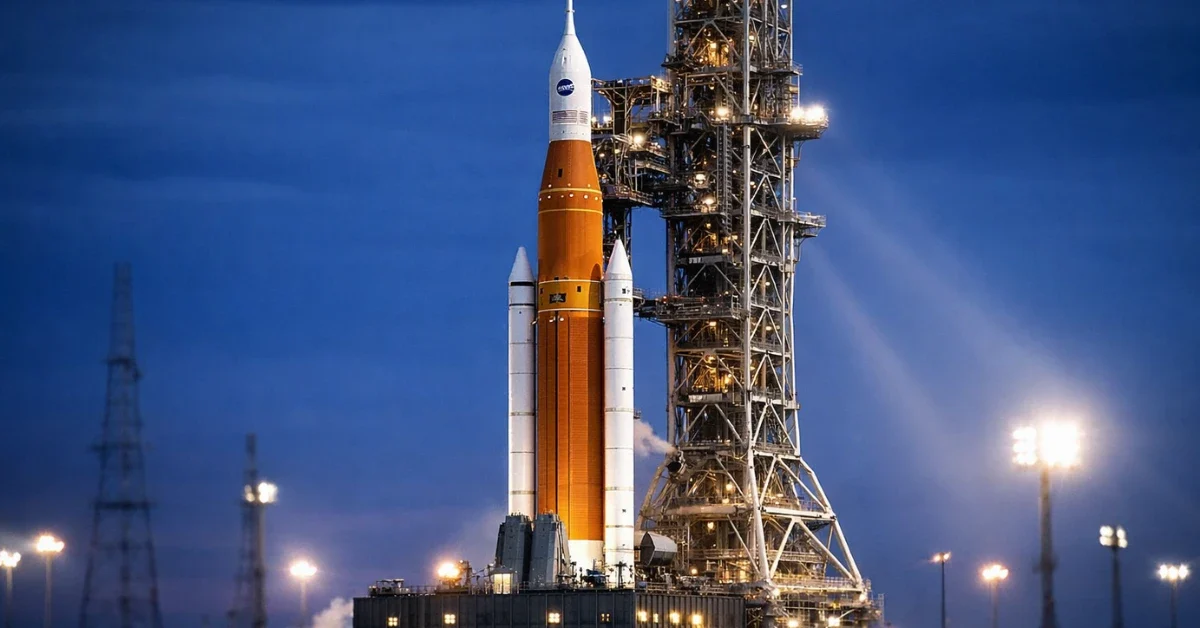
NASA has announced a major restructuring of its plan to return astronauts to the moon. Under a newly updated timeline, the space agency will delay its first crewed lunar landing to 2028 and add a new low-Earth orbit test flight in 2027 as part of a sweeping NASA Artemis program overhaul. NASA Administrator Jared Isaacman revealed the revised strategy on Friday, outlining a shift that prioritizes mission safety, simplified rocket designs, and an eventual goal of launching annual moon missions to maintain an edge over international competitors.
The most significant change affects the upcoming Artemis III mission. Originally slated to be the first human moon landing in over 50 years, Artemis III will now launch in mid-2027 as an Earth-orbit rendezvous flight. During this mission, astronauts will practice docking the Orion spacecraft with commercial lunar landers built by private partners SpaceX and Blue Origin.
The first astronaut lunar landing will now take place during the Artemis IV mission in early 2028. If that mission is successful, a second lunar landing, Artemis V, could follow later that same year. Isaacman explained that attempting a direct return to the moon without additional orbital testing was too risky. “This is just not the right pathway forward,” Isaacman said. “Going right to the moon … is not a pathway to success.”
Safety Concerns and Lander Delays
The decision to alter the mission sequence stems largely from safety concerns and technological delays. A recent report from NASA’s Aerospace Safety Advisory Panel cast serious doubts on the previous timeline. The panel highlighted significant risks regarding overall mission safety and the readiness of the private Human Landing System vehicles.
Neither SpaceX nor Blue Origin has completed the critical milestones required to safely carry a crew to the lunar surface. While SpaceX’s Starship has flown 11 suborbital test flights, and Blue Origin’s Blue Moon pathfinder is currently undergoing tests in Houston, both vehicles must still prove they can transfer cryogenic fuels in space and execute uncrewed lunar landings. The newly retooled Artemis III mission will serve as a safe proving ground to test these landers, alongside life support systems, communications, and new spacesuits, in low-Earth orbit.
Standardizing the Space Launch System
To safely increase the frequency of future flights, NASA is simplifying its rocket architecture. The agency plans to standardize the Space Launch System rocket and the Orion spacecraft to a “Block 1” configuration. This shift involves scrapping the previously planned, Boeing-developed Exploration Upper Stage in favor of sticking with the current Interim Cryogenic Propulsion Stage.
According to NASA Associate Administrator Amit Kshatriya, changing the rocket’s design between missions is needlessly complicated and adds unnecessary production risks. By keeping the hardware consistent, space agency officials hope to shorten the wait time between launches from once every three years to approximately once every 10 months. Isaacman compared this step-by-step approach to the Apollo program, noting that a logical, phased buildup is essential for ensuring crew safety and system reliability.
Overcoming Recent Technical Setbacks
The programmatic overhaul arrives as NASA works to resolve immediate technical challenges with the Artemis II mission. Following a February 19 countdown rehearsal, engineers discovered a helium flow pressurization issue on the rocket’s upper stage. As a result, the rocket was rolled back to the Vehicle Assembly Building at the Kennedy Space Center on February 25.
Crews are currently replacing batteries in the flight termination system and removing the suspected faulty component to diagnose the helium leak. Lori Glaze, acting associate administrator for NASA’s Exploration Systems Development Mission Directorate, said the team hopes to find the root cause and update operational procedures to prevent the issue from happening again. Despite these repairs, NASA is still targeting launch windows in April for Artemis II.
When it launches, Artemis II will send a quartet of astronauts—Reid Wiseman, Victor Glover, Christina Koch, and Jeremy Hansen—on a 10-day flight around the moon and back. This flight follows the successful uncrewed Artemis I mission that orbited the moon in late 2022.
Looking ahead, NASA plans to rebuild its civil servant workforce to support a faster launch cadence. Ultimately, the revised roadmap aims to establish an enduring human presence on the moon with at least one surface landing every year after 2028, ensuring the United States remains ahead of geopolitical adversaries like China in the modern space race.
