

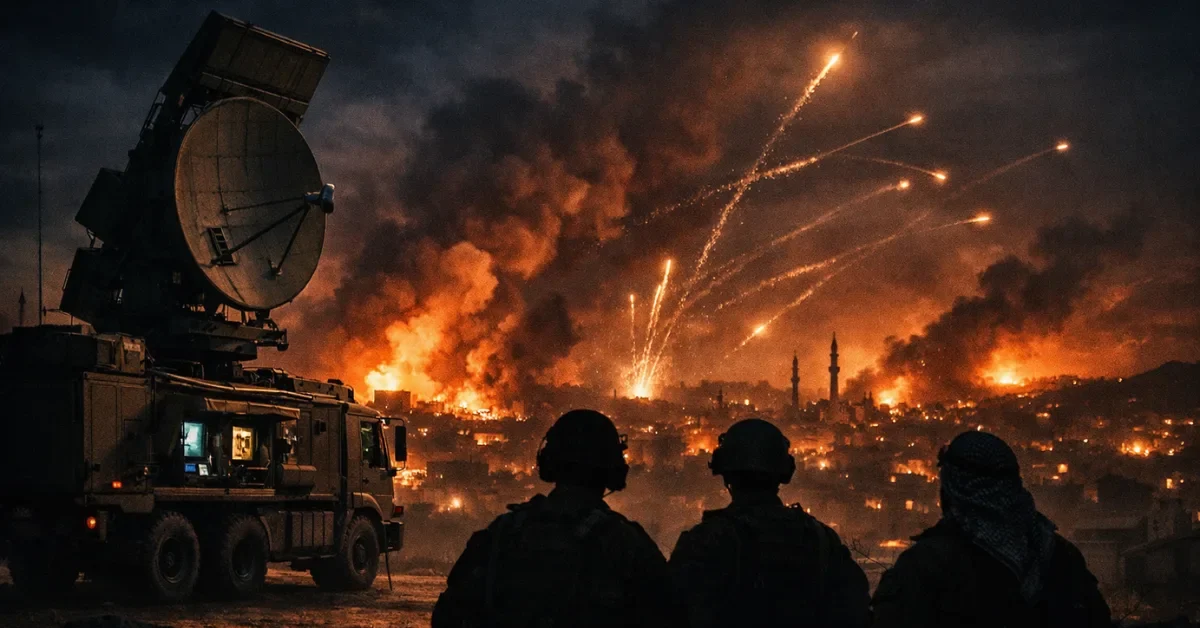
The US Israel Iran conflict has expanded dramatically as the United States and Israel launched extensive, coordinated military operations against Iran. In response to the intensifying airstrikes, Tehran and its regional allies have initiated retaliatory attacks. These counterstrikes have targeted Israel, neighboring Gulf nations, and critical facilities vital to global oil and natural gas production. The rapidly widening war has prompted the United States State Department to issue a stark advisory, urging American citizens to immediately exit more than a dozen Middle Eastern countries due to severe safety concerns.
As rockets continue to cross the region, military operations have intensified on multiple fronts. American and Israeli forces have specifically targeted Iranian missile sites and naval infrastructure. United States and Israeli officials claim these joint strikes have successfully obliterated an Iranian command center and destroyed multiple naval vessels. Early Tuesday morning, the Israeli armed forces announced they were actively intercepting a fresh barrage of missiles launched from Iran, subsequently advising residents in various areas to seek immediate shelter.
Regional Retaliation and Defense
Military engagements have simultaneously spilled into neighboring territories. Israel recently bombed Hezbollah targets in Beirut following missile launches directed at Israel by the Lebanon-based militant group. Across the Persian Gulf, explosions have been reported in Bahrain, Dubai, and Doha, leading Gulf nations to publicly vow they will defend their sovereign territories. Amid the regional chaos, Iranian state media claimed that a United States F-15 fighter jet was shot down in Kuwait, broadcasting a video purportedly showing the aircraft engulfed in flames as the pilots ejected.
Differing Timelines for the Military Campaign
United States and Israeli leaders have offered slightly varying perspectives on the expected duration of the military campaign. President Donald Trump has stated that the conflict will not be bound by a strict deadline. Speaking at the White House, he remarked that the military will take whatever time is required. He noted that while initial projections estimated a four-to-five-week operation, the United States possesses the capability to sustain the campaign for far longer.
Offering a different timeline, Israeli Prime Minister Benjamin Netanyahu told Fox News that the offensive is designed to be a quick and decisive action. He emphasized that while the operation may take some time, it is not intended to evolve into an endless war. This position has been publicly supported by United States Defense Secretary Pete Hegseth, who outright rejected the concept of an endless war.
Strategic Objectives and Regime Change
President Trump outlined four core objectives for the military campaign: destroying Iran’s missile capabilities, annihilating its naval capacity, ensuring the nation never obtains a nuclear weapon, and preventing the Iranian regime from directing militant proxy groups beyond its borders. The President also addressed historical grievances stemming from the 1979 Islamic Revolution and urged the Iranian public to overthrow their current government. Despite these calls for regime change, there have been no observable indications of a popular uprising within Iran.
Pre-emptive Action and Political Fallout
The strategic motivations behind the military involvement have been characterized as pre-emptive. United States Secretary of State Marco Rubio explained that the military intervened alongside Israel after receiving intelligence regarding Israel’s planned operations. American officials assessed that Tehran was actively preparing to launch attacks against United States forces in the region. Rubio noted that the current American military buildup in the Middle East has reached levels not seen since the 2003 invasion of Iraq, warning that the United States military should brace for incoming attacks.
Following a classified intelligence briefing, Senator Mark Warner expressed concern to the New York Times, observing that if a danger to Israel is now being treated as comparable to an immediate threat to the United States, the current administration is navigating completely unexplored territory. President Trump took to his Truth Social platform to defend the operation, arguing that if he had not previously annulled the Iran nuclear deal, Tehran would have already possessed a nuclear weapon. He placed blame on former Presidents Barack Obama and Joe Biden for their roles in the historic agreement.
Diplomatic resolutions appear highly unlikely in the near term. As airstrikes continue to pound Tehran, Iran’s top security official, Ali Larijani, issued a definitive statement of defiance on the social media platform X, declaring that the Iranian government will absolutely not negotiate with the United States.
