

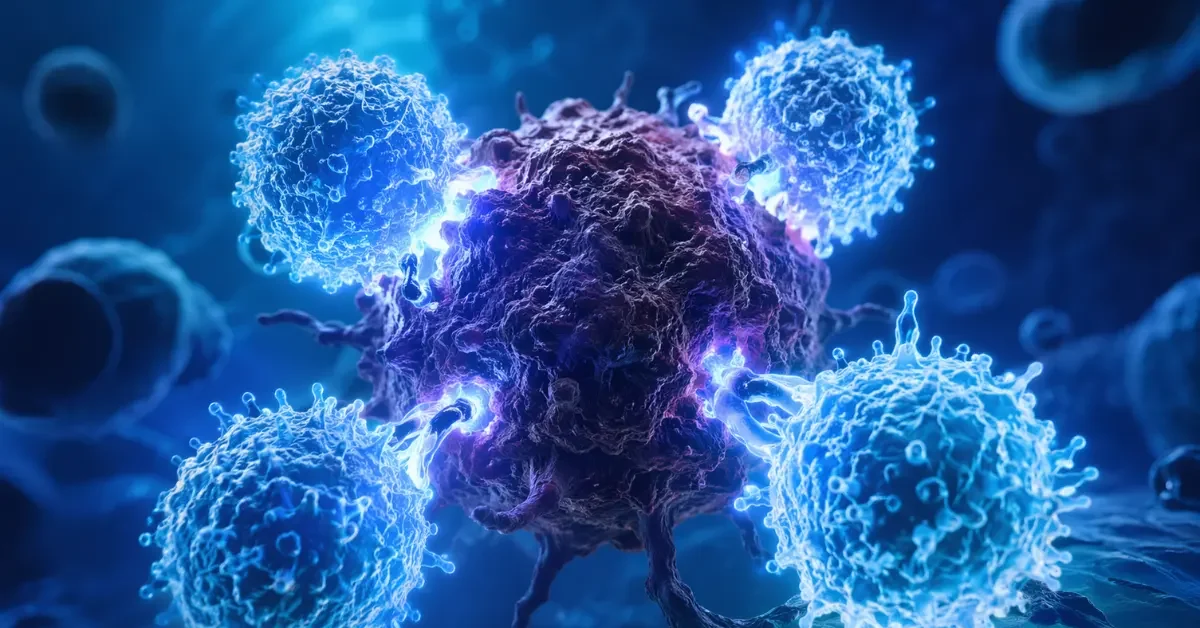
Cancer treatment is entering a remarkable new era. Across labs on multiple continents, researchers are finding creative ways to turn the body’s own immune system into a more powerful and precise weapon against tumors — and the pace of discovery in 2026 has been striking.
Making Cancer Cells Easier to See
One of the most persistent challenges in cancer immunotherapy is that many tumors simply don’t show enough warning signals for the immune system to detect them. Researchers at University College London have found a potential fix. Their study, published in the journal Immunity, focuses on a process inside cells called Nonsense-Mediated mRNA Decay, or NMD. This biological quality-control system normally destroys faulty genetic messages before they can cause trouble.
The UCL team discovered that cancer cells exploit this same process to stay hidden. When NMD clears away damaged RNA, it also prevents the production of abnormal proteins — and those proteins, if present, would be broken down into small fragments displayed on the cancer cell’s surface as molecular “flags” called antigens. Without those flags, the immune system can’t see the tumor.
By blocking the NMD process, the researchers allowed faulty RNA to survive long enough to produce those abnormal proteins, dramatically increasing the number of antigens visible on the cancer cell surface. Dr. Roberto Vendramin, who led the research, noted that this approach could be especially valuable for patients whose tumors have few genetic mutations — a group that makes up the majority of cancer cases and often responds poorly to existing immunotherapies. Scientists believe drug candidates targeting this pathway could enter early clinical trials within roughly five years.
Immune Cells That Track Tumors Like Bloodhounds
Stanford Medicine researchers have tackled a different problem: getting immune cells to physically reach solid tumors. Their March 2026 study, published in Nature Immunology, describes engineering immune cells with special surface proteins — called tumor-homing G-protein coupled receptors, or thGPRs — that allow them to sniff out the chemical waste products that cancer cells release as they rapidly multiply.
“We found that when we equip immune cells with receptors that sense metabolites released by cancer cells, they can sense the tumor, migrate toward it, infiltrate it, and control tumor growth,” said Dr. Livnat Jerby, assistant professor of genetics at Stanford and senior author of the study.
The engineered cells, including natural killer (NK) cells and CAR-T cells, more than doubled the rate of complete tumor elimination in laboratory mice with aggressive breast cancer tumors. Because cancer’s unusual metabolism is a feature shared across many tumor types, the approach could eventually apply to a wide range of cancers. Stanford University has filed a patent on the research.
An Implantable “Charging Station” for Immune Cells
Even when immune cells successfully reach a tumor, they often burn out quickly in the hostile environment that tumors create. UCLA researchers have designed an implantable device that acts like a biological charging station, keeping cancer-fighting immune cells energized and active for longer.
The device, developed for a type of engineered immune cell called CAR-iNKT cells, uses tiny biomimetic microparticles that mimic the natural activation signals these cells need to stay switched on. “Instead of delivering a one-time boost, the device provides sustained signals that help the cells stay active, multiply and form long-term memory,” said Song Li, chancellor’s professor of bioengineering at UCLA.
In preclinical experiments using human melanoma and lymphoma samples, the recharged immune cells didn’t just fight the local tumor — they circulated through the bloodstream and attacked cancer cells throughout the body. The system also concentrates its immune-activating signals in a small area near the tumor, reducing the risk of harmful side effects that can occur when powerful immune stimulants flood the entire body.
Mass-Producing Tumor Killers From a Single Stem Cell
Getting enough cancer-fighting immune cells has long been a practical bottleneck. Chinese Academy of Sciences researchers reported in February 2026 that a single stem cell from cord blood can now generate as many as 14 million tumor-killing NK cells using a new three-step laboratory process. One-fifth of a typical cord blood unit, they estimate, could theoretically produce enough cells for thousands — or even tens of thousands — of treatment doses.
Four-Armed Antibodies and Smarter Chemotherapy
Scientists at the University of Southampton have engineered a new class of four-pronged antibodies that simultaneously grab and cluster multiple immune cell receptors, amplifying the signal that tells T cells to launch a full attack on cancer. In laboratory tests with mice and human immune cells, these four-armed antibodies significantly outperformed conventional two-armed versions at activating CD8+ T cells — the immune system’s front-line cancer killers.
Meanwhile, researchers at the University of Texas at Austin and UT MD Anderson Cancer Center have found that an experimental chemotherapy compound can make cancer cells mimic a viral infection, tricking the immune system into attacking them. The phenomenon, called viral mimicry, may explain why some patients respond far better to chemotherapy than others — and suggests that lower doses of chemo, paired with immunotherapy, could one day produce better outcomes with fewer side effects.
A Hidden Immune Army in the Prostate
Adding to the momentum, a study from the La Jolla Institute for Immunology has identified a population of specialized immune cells called tissue-resident memory T cells, or TRMs, living permanently inside the prostate. These cells develop unique biological markers that distinguish them from ordinary blood immune cells and remain on high alert, ready to respond if a threat returns. Researchers believe these cells could be activated to create new immunotherapy strategies for prostate cancer, a disease that claims around 35,000 lives in the United States each year.
Taken together, these advances paint a picture of immunotherapy rapidly maturing — from a promising idea into a field delivering concrete, testable solutions for some of the most stubborn cancers in existence.
