

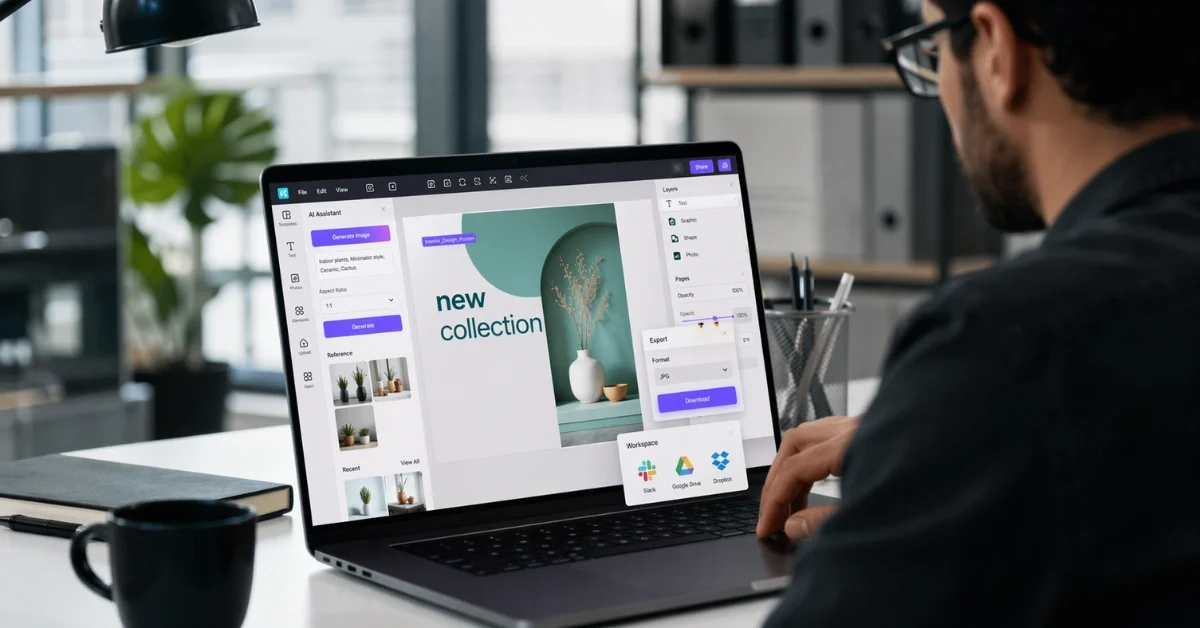
Canva AI 2.0 has launched as the company pushes beyond basic design tools and toward a broader AI-powered workspace. Unveiled at Canva Create in Los Angeles, the update introduces conversational design features that let users create and refine fully editable content from text or voice prompts, while Canva’s system handles more of the work behind the scenes.
The release marks what Canva has described as its biggest evolution since the platform launched in 2013. Instead of treating AI as a set of add-on features, Canva is repositioning the platform so users can move from an idea to a finished output in one place. The rollout begins as a research preview, with early access limited to up to one million users and wider availability expected in the coming weeks.
Four core changes
At the center of Canva AI 2.0 are four main capabilities. The first is conversational design, which allows people to describe an idea, goal, or structure and receive a design they can edit right away. That is a notable shift from older AI workflows that often produce a flat result that then needs to be rebuilt.
The second feature is agentic orchestration. Canva says the system can understand a user’s intent and coordinate several tools across the platform to complete more complex jobs, such as building content for different channels from one brief. In practical terms, that means the AI is meant to act less like a single-purpose generator and more like a working assistant inside the platform.
The third capability focuses on editable layers. Canva says its new object-based or layered intelligence lets users change specific elements, such as an image, headline, or font, without remaking the entire design. That addresses one of the common frustrations with generative design systems, where a small requested change can force a full restart.
The fourth feature is persistent memory. Called either a Memory Library or Living Memory in different reports, it is designed to remember user preferences, brand styles, and past work across sessions. Canva says that this should help the platform produce more consistent outputs over time, especially for teams that need branded materials across multiple projects.
Workflow tools expand
Canva is also connecting the new AI system to workplace apps and recurring tasks. Reports on the launch say the platform now includes connectors for services such as Gmail, Google Drive, Google Calendar, Slack, and Zoom, allowing Canva AI to pull in context from messages, files, and meetings. The goal is to help users generate more relevant designs and content without manually moving information between tools.
The update also adds scheduling and web research features. Canva says users can set repeatable tasks so the system runs them in the background, and web research can be gathered and added directly into designs as editable content. Alongside that, the company introduced brand intelligence tools that apply brand fonts, colors, and styles from the start, or update older designs to match revised branding.
Other additions widen the platform beyond classic design work. Canva Code 2.0 now supports HTML import and is aimed at building interactive experiences from prompts, while Sheets AI can generate structured spreadsheets such as budgets, timelines, or content calendars from natural-language descriptions. Together, those features show Canva trying to become a broader work platform, not just a graphic design app.
Automation details vary
One part of the launch is described differently across reports. Fortune said the new Canva can crawl the web for breaking tech news, identify what is trending, create content, and even schedule social media posts on its own. CMSWire, however, reported that Canva’s scheduling feature creates drafts for user review rather than publishing autonomously.
That difference matters because Canva AI 2.0 is being presented as an agentic system that can take on more multi-step work. Even with that disagreement, the reports point in the same direction: Canva is giving AI a bigger role in planning, drafting, and organizing creative work while still keeping editing and refinement inside the platform.
A bigger platform bet
The launch also reflects a larger business shift. Fortune reported that Canva now has 265 million users and is rolling out multiple pricing tiers, with free access for basic AI features and plans that rise to $100 a month. Cliff Obrecht, Canva’s co-founder and chief operating officer, said the company had to rearchitect the whole platform to support the new system.
Other reports say Canva’s AI push is backed by its own models and research operation. Constellation Research said the company has more than 100 researchers in its CORE unit and has been building a vertically integrated AI stack focused on design. That helps explain why Canva is now presenting AI 2.0 not as a simple feature launch, but as a platform-level reset aimed at making Canva the place where design, collaboration, and publishing come together.
