

For decades, scientists have assumed that organisms require a brain and a complex nervous system to learn, retain memories, or make deductions. However, a recent publication in the journal Cognitive Science challenges this fundamental belief, suggesting non-neuronal organisms possess the ability to process complex information.
A study led by William & Mary Professor of Psychology Peter Vishton and his former student Paige Bartosh indicates that certain plants can actually count. While this does not look exactly like human mathematics, evidence demonstrates that the Mimosa pudica plant can keep track of the number of events in its environment.
The researchers believe this represents the first documented proof that flora can enumerate, meaning they can identify and track distinctly separate events as they occur.
Uncovering the Secrets of Mimosa Pudica
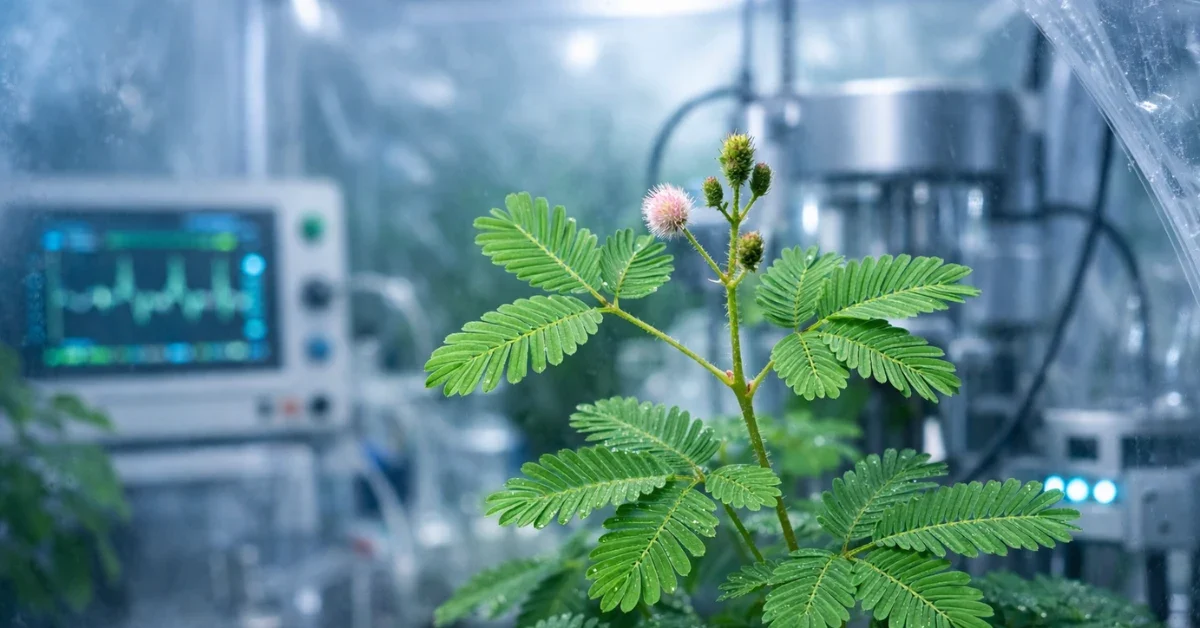
The subject of this study is the Mimosa pudica, frequently referred to as the shy plant or touch-me-not. This species is famous for delicate, frond-like leaves that fold inward when shaken or touched. The plant also exhibits nyctinasty, meaning the foliage closes during the night and reopens when the sun rises.
Vishton initiated this research during the COVID-19 pandemic inside a humidified tent in a windowless room at William & Mary’s Integrated Science Center. The research team exposed these plants to specific cycles of light and darkness to monitor resulting behavioral changes.
During the initial phase, the team implemented a standard 24-hour cycle. On the first two days, the plants experienced exactly 12 hours of light followed by 12 hours of darkness. On the third day, the lights were kept completely off.
After repeating this cycle approximately five times, the team observed a fascinating behavioral shift. During the pre-dawn hours of the days when light was anticipated, the flora displayed significantly increased movement. Conversely, on the third day of complete darkness, this anticipatory movement did not occur.
According to Vishton, this indicates the subjects managed to “learn” the unique three-day routine and shift their physical responses. Mapped out, these adjustments formed a logarithmic curve, showing rapid changes in the beginning before leveling into a consistent routine. Vishton noted this exact pattern frequently appears in traditional animal learning models, such as when rats gradually master a physical sequence.
Testing Time Versus Event Tracking
To eliminate alternative explanations, the team needed to prove the plants were not simply monitoring the passage of time.
While many plants operate on a standard 24-hour circadian rhythm, previous literature never suggested vegetation could track a 72-hour cycle. To test the time-tracking hypothesis directly, Vishton and Bartosh artificially reduced the day length from 24 hours to 20 hours. Almost instantly, the plants adjusted their movement to match the newly established routine.
To solidify the enumeration theory, the researchers conducted a final test generating three-day cycles with totally randomized durations spanning from 10 to 32 hours.
Whenever the assigned cycle fell outside the 12 to 24-hour range, the established behavioral pattern deteriorated completely. Vishton theorizes this highlights distinct cognitive limits: a minimum exposure window required to process the pattern, alongside a maximum memory capacity where the subject eventually forgets the sequence.
As long as the assigned lengths remained within the 12 to 24-hour window, the subjects successfully anticipated the light periods. Vishton concluded that the simplest explanation is the subjects are tracking the exact number of occurrences, rather than merely responding to time.
The Future of Non-Neuronal Intelligence
If future experiments validate these findings, the scientific community may need to recognize a new category of information processing. Vishton pointed out that memory theories rely exclusively on neurons. Yet, without a nervous system, vegetation appears capable of performing cognitive-like actions.
This revelation opens the door to profound biological questions. If a simple touch-me-not can encode advanced functions, other non-neuronal tissues might share the same potential. Vishton suggested that non-neuronal cells found within human and animal bodies could also be involved in complex learning, a possibility modern science has largely ignored.
Understanding how this intelligence is stored and accessed remains a primary goal. While Vishton approaches the phenomenon as a developmental psychologist, he hopes chemists and biologists will investigate the underlying physical mechanisms.
Potential applications are vast. This foundational knowledge could lead to biologically driven computational devices and plant-based environmental sensors. On a medical level, understanding cellular memory might even help scientists develop treatments to help human cells “unlearn” addictive behaviors.
Ultimately, these findings blur the strict boundaries between biological kingdoms. As Vishton noted, humans generally view vegetation as simple, reflexive objects rather than thinking creatures. This groundbreaking enumeration research suggests the dividing line between the animal and plant worlds may be far more porous than previously believed.
