

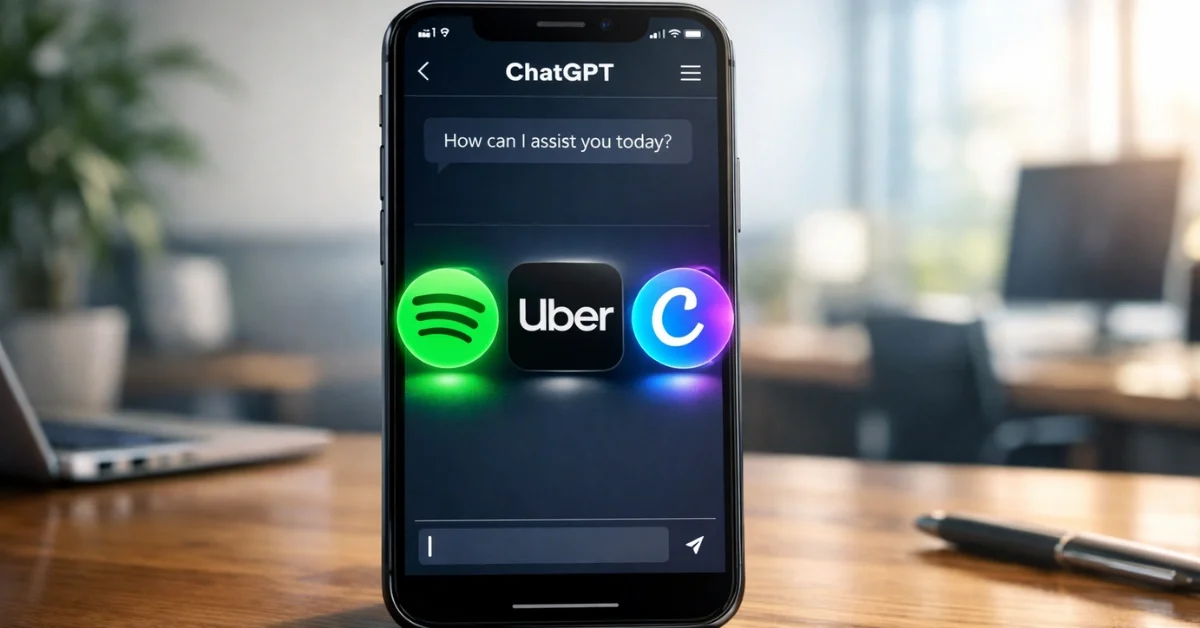
OpenAI has officially launched ChatGPT app integrations, transforming the artificial intelligence chatbot into a central hub for daily digital tasks. With this new feature, users can connect third-party accounts directly to the AI assistant. This allows people to use natural language prompts to perform actions across platforms like Spotify, Uber, Canva, and DoorDash without leaving the chat interface.
By introducing these ChatGPT app integrations, OpenAI is shifting from a simple search replacement to a commercial action layer. The initial launch includes 14 third-party partners and reaches an audience of 800 million users. While OpenAI handles the discovery and intent through user prompts, all final transactions and bookings are completed securely within the partner applications.
How to Connect and Manage Third-Party Apps
Activating these new features is a straightforward process. Users can simply type the name of the desired application at the beginning of a prompt, and the assistant will guide them through the official sign-in process. Alternatively, users can navigate to the Apps and Connectors section within their settings to browse the available gallery of services and link their accounts directly.
Connecting external accounts does require sharing specific user data with the AI to enable personalized experiences. For example, linking a Spotify profile grants the assistant access to listening history and music preferences to generate custom playlists. Users are encouraged to review all requested permissions before authorizing a connection. If privacy becomes a concern, any linked service can be easily disconnected at any time through the same settings menu.
Streamlining Food Delivery and Travel Planning
The new ecosystem significantly simplifies travel and meal planning. The DoorDash connection, which originally launched in December 2025, allows users to request weekly meal plans and instantly populate a shopping cart with ingredients from participating grocers like Kroger, Safeway, and Wegmans. Meanwhile, Uber and Uber Eats allow users to browse local restaurants or arrange on-demand rides, including options like UberX, Comfort, and Uber Black.
For travel planning, Expedia and Booking.com allow users to search for flights and hotels based on specific budgets, dates, and locations. A traveler can request a four-star hotel near public transit, and the AI will filter the best options before handing the user off to the partner site to finalize the reservation.
Enhancing Productivity, Design, and Education
Professionals and students can also leverage these tools for creative and educational workflows. The Canva and Figma connections allow users to quickly generate visual content, presentation slide decks, flowcharts, and product roadmaps based on simple text descriptions. In March 2026, Wix introduced an integration that lets users generate fully functional websites and manage business operations like scheduling and payments directly through voice or text prompts.
On the educational front, Coursera helps users discover online classes by comparing course ratings, duration, and costs. Students can also connect Quizlet to convert their uploaded notes or ongoing AI conversations into active flashcard sets for studying.
Expanding Retail and Home Services
Retail and real estate platforms are also participating in the initial rollout. Target launched a beta version of its service just before Black Friday, enabling shoppers to ask for gift suggestions and build a digital basket for same-day store pickup or shipping. Zillow makes house hunting more efficient by letting users filter home listings by exact price ranges, bedroom counts, and neighborhood preferences. Additionally, the Angi connection allows homeowners to ask repair questions and request quotes from local service professionals.
Geographic Limits and Future Expansions
These integrations are built on the Model Context Protocol, an open standard that gives developers a software development kit to surface their services inside the chat window. This approach follows OpenAI’s recent decision to shut down its in-chat purchasing experiment, which struggled with low conversion rates. By letting partners handle the payment processing, data records, and liability, OpenAI offers a smoother transaction experience that benefits both developers and users.
Currently, the rollout is limited strictly to users in the United States and Canada. European and United Kingdom markets are excluded from the initial release due to complex data regulations like the General Data Protection Regulation. However, OpenAI plans to expand its ecosystem further throughout 2026, with upcoming partners expected to include Walmart, PayPal, OpenTable, Instacart, and Peloton.
