
By using this site, you agree to our Privacy Policy and Terms of Use.
Accept
VellaTimesVellaTimesVellaTimes
  • News
    NewsShow More
    Close-up of a silver espresso machine extracting a fresh shot of coffee into a glass cup in a softly lit cafe setting.
    Espresso Extraction Science: The Finer Grind Flaw
    May 18, 2026
    A smartphone resting on a wooden desk displaying an AI-powered Amazon search bar in a modern home office setting.
    Amazon Alexa for Shopping Replaces Rufus AI Assistant
    May 18, 2026
    Wide news-style image showing an OpenAI office scene with screens displaying audio waveforms and voice technology graphics
    OpenAI acquires Weights.gg to boost voice AI tools
    May 18, 2026
    Federal agents standing outside a modern university biology laboratory building at dusk during an active investigation.
    US Arrests Chinese Scientists for Smuggling Biological Materials
    May 18, 2026
    A dramatically lit modern corporate courtroom with futuristic technology elements, representing a high-stakes artificial intelligence legal trial.
    Elon Musk OpenAI Lawsuit Exposes Clashes Over AI Safety
    May 18, 2026
  • Technology
    TechnologyShow More
    Wide news-style image showing an OpenAI office scene with screens displaying audio waveforms and voice technology graphics
    OpenAI acquires Weights.gg to boost voice AI tools
    May 18, 2026
    A polished silicon wafer rests on a surface inside a modern semiconductor manufacturing facility.
    Samsung Strike Threatens Global AI Chip Production
    May 18, 2026
    A glowing computer screen displaying the text GPT-5.5 Instant in a modern, high-tech office environment with soft blue and purple lighting.
    GPT-5.5 Instant: OpenAI’s New Default ChatGPT Model
    May 10, 2026
    Wide view of a modern AI data center with server racks, glowing fiber-optic cables, and semiconductor hardware in the foreground.
    AI Infrastructure Spending Drives Nvidia, AMD Shares
    May 10, 2026
    A glowing computer monitor displaying lines of code and digital network graphics in a modern tech office setting.
    Airbnb AI Coding: 60% of New Software Now Generated by AI
    May 9, 2026
  • AI
    AIShow More
    A smartphone resting on a wooden desk displaying an AI-powered Amazon search bar in a modern home office setting.
    Amazon Alexa for Shopping Replaces Rufus AI Assistant
    May 18, 2026
    A dramatically lit modern corporate courtroom with futuristic technology elements, representing a high-stakes artificial intelligence legal trial.
    Elon Musk OpenAI Lawsuit Exposes Clashes Over AI Safety
    May 18, 2026
    A high-tech global map visualization showing glowing digital connections across different continents, representing the worldwide adoption of artificial intelligence.
    Global AI Adoption in 2026: Trends and Growing Divide
    May 10, 2026
    A modern smartphone displaying an artificial intelligence chat interface used for online shopping and product comparison.
    Alibaba Qwen AI Taobao Integration Launches Agentic Shopping
    May 10, 2026
    A split-screen illustration showing a high-tech modern office using advanced AI tools contrasted against an older, dimly lit workspace.
    Global AI Adoption Surges But Rich-Poor Divide Widens
    May 9, 2026
  • Science
    ScienceShow More
    Close-up of a silver espresso machine extracting a fresh shot of coffee into a glass cup in a softly lit cafe setting.
    Espresso Extraction Science: The Finer Grind Flaw
    May 18, 2026
    Federal agents standing outside a modern university biology laboratory building at dusk during an active investigation.
    US Arrests Chinese Scientists for Smuggling Biological Materials
    May 18, 2026
    Header image of a quantum communication lab setup with fiber-optic equipment, a telecom quantum dot device, and interferometer components used for long-distance quantum key distribution.
    Quantum Key Distribution Reaches 120 km With Quantum Dots
    May 10, 2026
    Abstract geometric representation of glowing quantum paraparticles interacting within a three-dimensional mathematical grid in deep blue and gold tones.
    Quantum Paraparticles Exist: New Math Challenges Physics
    May 10, 2026
    A large expedition cruise ship is navigating rough ocean waters under a cloudy sky.
    Global Authorities Respond to Andes Hantavirus Outbreak on MV Hondius Cruise Ship
    May 9, 2026
  • World
    WorldShow More
    Allu Arjun Commitment to Ethical Brand Partnerships
    Exploring Allu Arjun’s Commitment to Ethical Brand Partnerships
    December 18, 2023
    Orry aka Orhan Awatramani
    Orhan Awatramani ‘Orry’ Biography, Lifestyle and Rise to Fame
    December 8, 2023
    Alia Bhatt Latest Deepake Video Victim
    Alia Bhatt becomes latest victim of Deepfake Videos, Obscene Video goes Viral
    November 28, 2023
    Napoleon Movie Review
    Napoleon Movie Review: A Historical Epic by Ridley Scott Reviewed
    November 25, 2023
  • Bookmarks
Search
Category
  • News
  • Technology
  • AI
  • Science
  • World
Company
  • About Us
  • Contact Us
  • Fact Checking Policy
  • Terms & Conditions
  • Privacy Policy
  • Copyright Policy
Resources
  • Home
  • Web Stories
  • Bookmarks
  • Interests
  • Disclaimer
  • Sitemap
© 2022 VellaTimes • All Rights Reserved.
Reading: Groundbreaking Study Reveals Plants Can Count Without a Brain
Share
Notification Show More
Font ResizerAa
VellaTimesVellaTimes
Font ResizerAa
  • News
  • Technology
  • AI
  • Science
  • World
Search
  • Explore
    • News
    • Technology
    • AI
    • Science
    • World
  • Useful Links
    • About Us
    • Contact Us
    • Fact Checking Policy
    • Terms & Conditions
    • Privacy Policy
    • Copyright Policy
  • Home
  • Web Stories
  • Bookmarks
  • Interests
  • Disclaimer
  • Sitemap
© 2022 VellaTimes • All Rights Reserved.
News

Groundbreaking Study Reveals Plants Can Count Without a Brain

Nisha Pradhan
Last updated: 16/03/2026
Nisha Pradhan
Share
6 Min Read
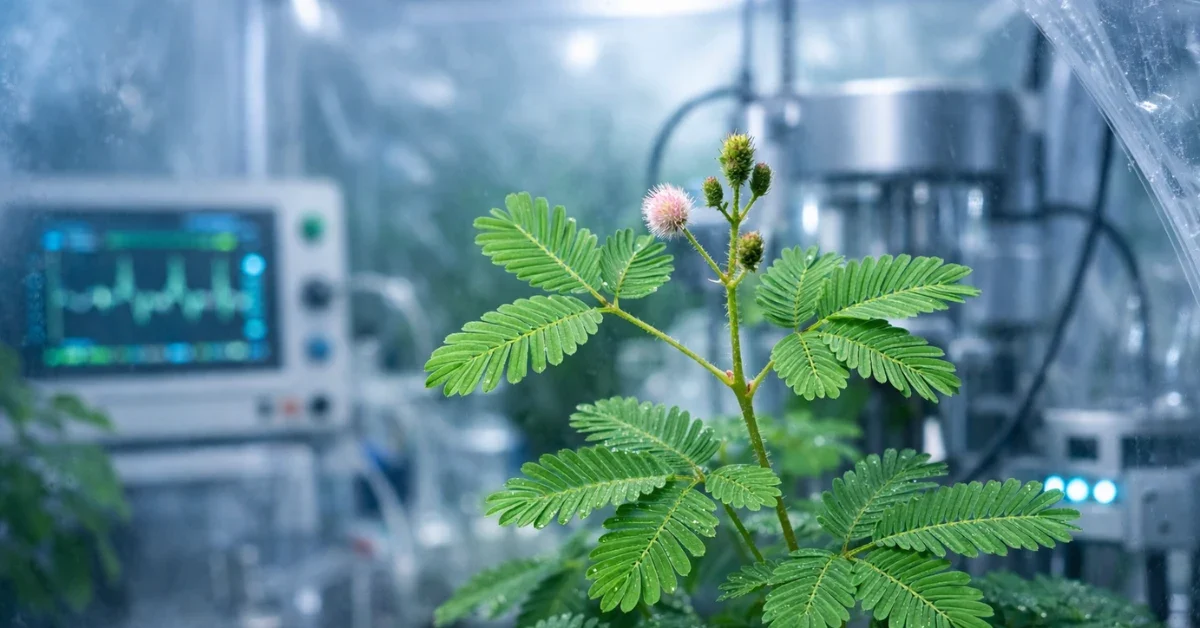
A highly detailed Mimosa pudica plant with delicate green leaves positioned under soft laboratory lighting inside a research tent.

For decades, scientists have assumed that organisms require a brain and a complex nervous system to learn, retain memories, or make deductions. However, a recent publication in the journal Cognitive Science challenges this fundamental belief, suggesting non-neuronal organisms possess the ability to process complex information.

A study led by William & Mary Professor of Psychology Peter Vishton and his former student Paige Bartosh indicates that certain plants can actually count. While this does not look exactly like human mathematics, evidence demonstrates that the Mimosa pudica plant can keep track of the number of events in its environment.

The researchers believe this represents the first documented proof that flora can enumerate, meaning they can identify and track distinctly separate events as they occur.

Uncovering the Secrets of Mimosa Pudica

The subject of this study is the Mimosa pudica, frequently referred to as the shy plant or touch-me-not. This species is famous for delicate, frond-like leaves that fold inward when shaken or touched. The plant also exhibits nyctinasty, meaning the foliage closes during the night and reopens when the sun rises.

Vishton initiated this research during the COVID-19 pandemic inside a humidified tent in a windowless room at William & Mary’s Integrated Science Center. The research team exposed these plants to specific cycles of light and darkness to monitor resulting behavioral changes.

During the initial phase, the team implemented a standard 24-hour cycle. On the first two days, the plants experienced exactly 12 hours of light followed by 12 hours of darkness. On the third day, the lights were kept completely off.

After repeating this cycle approximately five times, the team observed a fascinating behavioral shift. During the pre-dawn hours of the days when light was anticipated, the flora displayed significantly increased movement. Conversely, on the third day of complete darkness, this anticipatory movement did not occur.

According to Vishton, this indicates the subjects managed to “learn” the unique three-day routine and shift their physical responses. Mapped out, these adjustments formed a logarithmic curve, showing rapid changes in the beginning before leveling into a consistent routine. Vishton noted this exact pattern frequently appears in traditional animal learning models, such as when rats gradually master a physical sequence.

Testing Time Versus Event Tracking

To eliminate alternative explanations, the team needed to prove the plants were not simply monitoring the passage of time.

While many plants operate on a standard 24-hour circadian rhythm, previous literature never suggested vegetation could track a 72-hour cycle. To test the time-tracking hypothesis directly, Vishton and Bartosh artificially reduced the day length from 24 hours to 20 hours. Almost instantly, the plants adjusted their movement to match the newly established routine.

To solidify the enumeration theory, the researchers conducted a final test generating three-day cycles with totally randomized durations spanning from 10 to 32 hours.

Whenever the assigned cycle fell outside the 12 to 24-hour range, the established behavioral pattern deteriorated completely. Vishton theorizes this highlights distinct cognitive limits: a minimum exposure window required to process the pattern, alongside a maximum memory capacity where the subject eventually forgets the sequence.

As long as the assigned lengths remained within the 12 to 24-hour window, the subjects successfully anticipated the light periods. Vishton concluded that the simplest explanation is the subjects are tracking the exact number of occurrences, rather than merely responding to time.

The Future of Non-Neuronal Intelligence

If future experiments validate these findings, the scientific community may need to recognize a new category of information processing. Vishton pointed out that memory theories rely exclusively on neurons. Yet, without a nervous system, vegetation appears capable of performing cognitive-like actions.

This revelation opens the door to profound biological questions. If a simple touch-me-not can encode advanced functions, other non-neuronal tissues might share the same potential. Vishton suggested that non-neuronal cells found within human and animal bodies could also be involved in complex learning, a possibility modern science has largely ignored.

Understanding how this intelligence is stored and accessed remains a primary goal. While Vishton approaches the phenomenon as a developmental psychologist, he hopes chemists and biologists will investigate the underlying physical mechanisms.

Potential applications are vast. This foundational knowledge could lead to biologically driven computational devices and plant-based environmental sensors. On a medical level, understanding cellular memory might even help scientists develop treatments to help human cells “unlearn” addictive behaviors.

Ultimately, these findings blur the strict boundaries between biological kingdoms. As Vishton noted, humans generally view vegetation as simple, reflexive objects rather than thinking creatures. This groundbreaking enumeration research suggests the dividing line between the animal and plant worlds may be far more porous than previously believed.

TAGGED: cognitive science, Mimosa pudica, non-neuronal intelligence, Peter Vishton, plant intelligence, plants can count, William & Mary
Share This Article
Facebook Twitter Whatsapp Whatsapp Telegram Copy Link
By Nisha Pradhan
I am a passionate content creator with a deep love for travel, music, and food. Using my unique blend of these interests, I genuinely enjoy crafting high-quality travel, lifestyle, and entertainment-related news content.
Leave a comment

Leave a Reply Cancel reply

Your email address will not be published. Required fields are marked *


Most Read

Google Maps Rolls Out Massive AI Update With Gemini-Powered Ask Maps

March 13, 2026

Google Enterprise AI Updates: New TPUs and Workspace Tools

April 24, 2026

Nvidia GTC 2026: CEO Projects $1 Trillion AI Revenue

March 24, 2026

Scientists Break 50-Year Bottleneck in Doxorubicin Chemotherapy Drug Production

March 16, 2026

Samsung Q1 Profit Forecast Hits Record on AI Chip Demand

April 7, 2026

Samsung Chip Tech Leak to China: Arrests, Verdicts, and Billions at Stake

April 22, 2026

Related News

Close-up of a silver espresso machine extracting a fresh shot of coffee into a glass cup in a softly lit cafe setting.
News

Espresso Extraction Science: The Finer Grind Flaw

Nisha Pradhan Nisha Pradhan May 18, 2026
A smartphone resting on a wooden desk displaying an AI-powered Amazon search bar in a modern home office setting.
News

Amazon Alexa for Shopping Replaces Rufus AI Assistant

Sameer Katoch Sameer Katoch May 18, 2026
Wide news-style image showing an OpenAI office scene with screens displaying audio waveforms and voice technology graphics
News

OpenAI acquires Weights.gg to boost voice AI tools

Rakesh Paul Rakesh Paul May 18, 2026

About Us

VellaTimesVellaTimesVellaTimes

VellaTimes is a leading news portal that covers the latest trending news in technology, lifestyle, entertainment, automobiles, travel, and sports.

Explore

  • News
  • Technology
  • AI
  • Science
  • World

Useful Links

  • About Us
  • Contact Us
  • Fact Checking Policy
  • Terms & Conditions
  • Privacy Policy
  • Copyright Policy

Subscribe Us

Subscribe to our newsletter for the Latest News and Top Stories!

© 2022 VellaTimes • All Rights Reserved.
  • Home
  • Web Stories
  • Bookmarks
  • Interests
  • Disclaimer
  • Sitemap
adbanner
AdBlocker Detected
Our site is an advertising supported site. Please whitelist us to support our work.
Okay, I'll Whitelist