

In a massive leap forward for physics and energy technology, researchers have set a new temperature record for ambient pressure superconductivity. A team of scientists from the University of Houston’s Texas Center for Superconductivity successfully observed superconducting properties at 151 Kelvin (minus 122 degrees Celsius) without the need for extreme pressure. This milestone marks the highest transition temperature ever recorded under normal atmospheric conditions since superconductivity was first discovered in 1911.
Pushing this boundary closer to room temperature has been a central focus of materials science for decades. Because superconductors allow electrical currents to flow completely without resistance, creating materials that function outside of extreme environments could completely transform how the world generates and stores energy. By proving that advanced superconducting states can exist at ambient pressure, this breakthrough paves the way for a new era of highly efficient technologies.
Shattering a Thirty-Year Temperature Record
For more than half a century, the global scientific community has steadily searched for new materials with higher transition temperatures—the specific point where a material suddenly loses all electrical resistance. The modern race for high-temperature superconductors kicked off in 1987, when physicists discovered a material called YBCO that reached superconductivity at 93 Kelvin.
Years later, in 1993, scientists discovered a mercury-based, copper-oxide ceramic known as Hg1223. This material superconducted at 133 Kelvin (minus 140 degrees Celsius) and proudly held the ambient pressure record for more than three decades.
Now, University of Houston physicists Paul Ching-Wu Chu and Liangzi Deng have successfully increased that limit by 18 degrees Celsius. The team coaxed the Hg1223 ceramic to reach its superconducting state at 151 Kelvin under normal atmospheric conditions. Their groundbreaking research was officially published on March 9 in the Proceedings of the National Academy of Sciences.
The Science of Pressure Quenching
To achieve this milestone, the research team utilized a specialized technique known as pressure quenching. While this method is frequently used in other industrial applications like the creation of synthetic diamonds, it represents a highly innovative approach in the field of superconductivity.
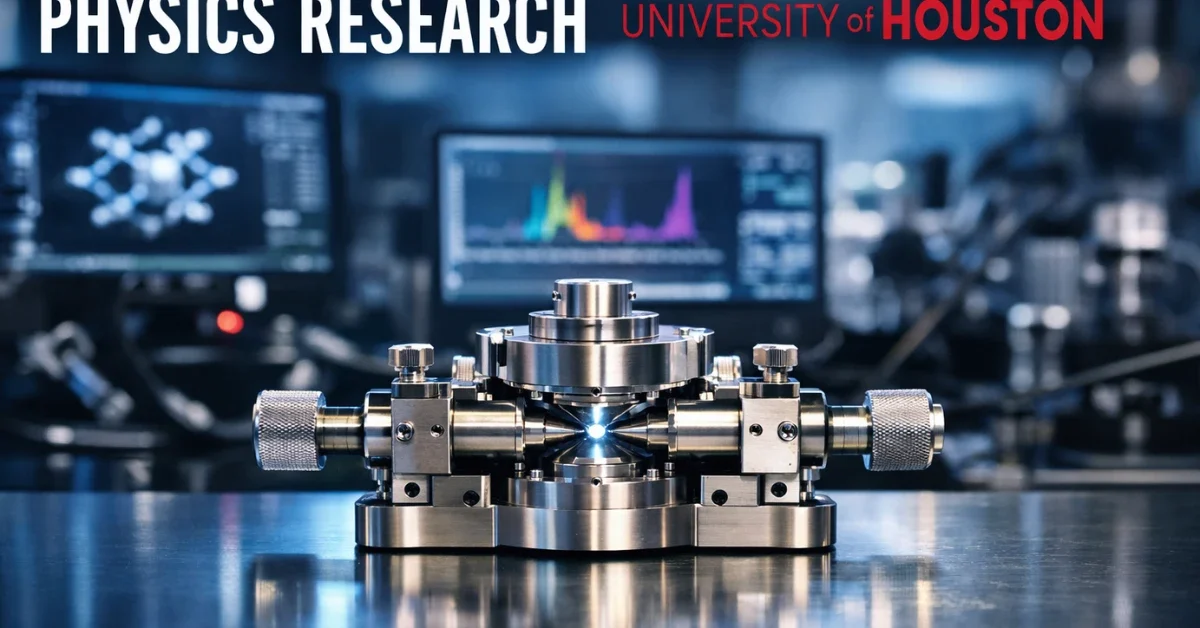
During the experiment, the team used a diamond anvil cell to apply intense, crushing pressure to the ceramic material. This extreme pressure fundamentally alters the material, enhancing its superconducting properties and driving its transition temperature higher. While the ceramic is confined under this immense pressure, it is cooled down to a very specific temperature.
Finally, the researchers rapidly release the pressure entirely. This sudden release effectively “locks in” the enhanced superconducting properties. By using this unique pressure-quench protocol, the physicists proved it is possible to maintain a highly elevated transition temperature even after the physical pressure is removed.
Assistant Professor Liangzi Deng noted that bringing the material back to ambient pressure allows scientists to use standard, well-developed laboratory instruments to investigate its properties. This accessibility is crucial for developing technologies that operate in everyday conditions.
Transforming Energy and Modern Technology
The practical implications of ambient pressure superconductivity are massive. Currently, the standard electrical grid loses about eight percent of the electricity it transmits. Eliminating that resistance would result in billions of dollars in economic savings and lower the environmental impact of global energy consumption.
Beyond the power grid, accessible superconductors could revolutionize advanced industries. They are vital components for building next-generation medical imaging systems, developing faster electronics, and enabling functional fusion energy technologies. Until now, cooling most superconductors to extremely low temperatures has made these technologies incredibly expensive. Raising the transition temperature makes these applications far more affordable and practical.
The Pursuit of the Ultimate Goal
While this new record is a monumental achievement, the ultimate objective for physicists remains true room-temperature superconductivity, which sits at approximately 300 Kelvin. The University of Houston study was supported by Intellectual Ventures, alongside the state of Texas and other foundations.
Rohit Prasankumar, the director of superconductivity research at Intellectual Ventures, referred to room-temperature superconductivity as a “holy grail” that scientists have chased for over a century. He noted that while the recent breakthrough proves this goal is closer than ever, there is still a daunting gap of about 140 degrees Celsius between the new record and actual room temperature.
Closing this gap will require immense dedication and collaboration. It will demand concerted, intentional efforts from a broad scientific community, relying on the combined expertise of materials scientists, chemists, engineers, and physicists to finally bring everyday superconductivity to life.
