

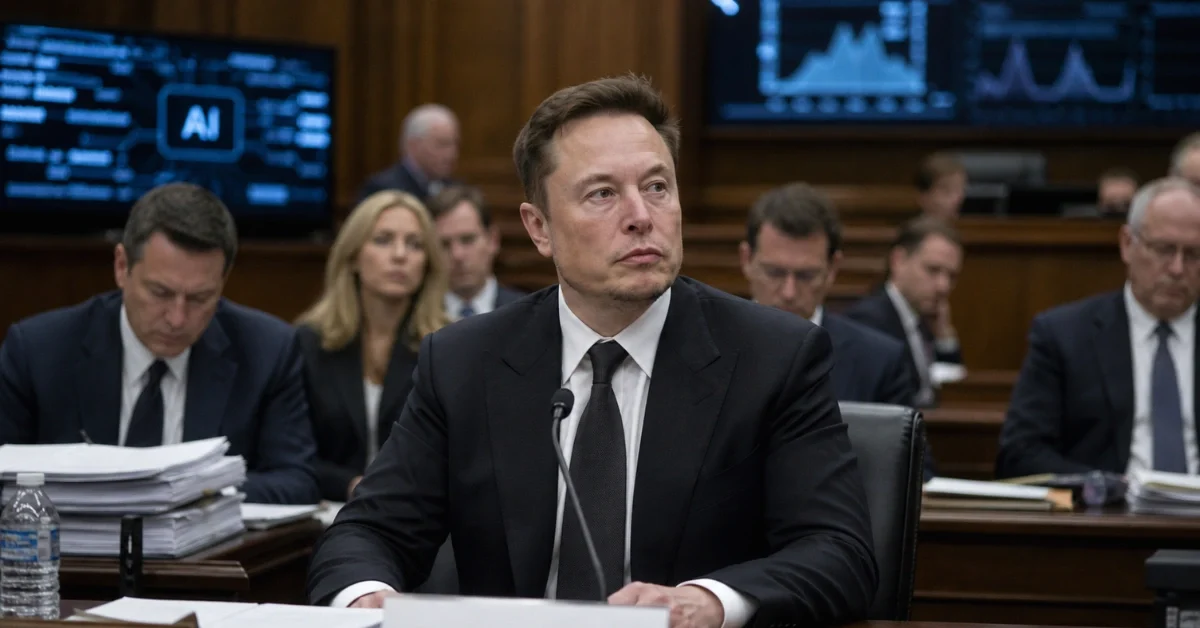
Elon Musk’s lawsuit against OpenAI and CEO Sam Altman has moved into a closely watched California trial over whether the company abandoned the nonprofit mission it promoted when it was founded in 2015. The case has become one of the biggest legal fights in artificial intelligence, arriving at a moment when OpenAI is also reshaping its business relationship with Microsoft as competition across the AI industry grows.
At the center of the Elon Musk OpenAI trial is a basic question with major business consequences: did OpenAI change course in a way that broke the understanding behind its founding, or did it adapt to the huge costs of building advanced AI systems? Musk claims he was deceived about OpenAI’s mission, while other accounts say he argues the company moved away from its original nonprofit purpose and toward profit.
How the Dispute Grew
Musk and Altman worked together to launch OpenAI in 2015 as a nonprofit meant to build artificial intelligence that benefits all people. Tensions grew over time, and Musk left the organization in 2018 after internal disagreements. Court filings describe Altman convincing Musk to back OpenAI as a nonprofit lab whose technology would belong to the world, and that Musk later put millions of dollars into the effort before leaving.
Musk now wants the court to require OpenAI to return to a pure nonprofit structure and to remove Altman and co-founder Greg Brockman from leadership. He had sought as much as $134 billion in damages but later gave up any personal benefit, saying any award should go to the OpenAI nonprofit instead. OpenAI now operates with a hybrid governance structure in which a nonprofit foundation controls a for-profit arm.
OpenAI’s Response
OpenAI rejects Musk’s claims and argues that its break with him was driven by his push for control, not by a broken commitment to nonprofit status. The company has described the lawsuit as a harassment campaign driven by ego, jealousy, and a desire to slow down a competitor. OpenAI says changes in its structure were necessary to support large-scale AI development and that Musk is now targeting a rival in the industry.
That rivalry is now part of the public story around the case. ChatGPT has become a direct rival to Grok, the chatbot made by Musk’s xAI lab, while Musk launched xAI after OpenAI became widely known through ChatGPT. Together, those details show why the legal battle is being watched not only as a dispute over OpenAI’s past, but also as a fight between major players in AI’s current market.
Trial Details
Jury selection began Monday in a courtroom across the bay from San Francisco, with Judge Yvonne Gonzalez Rogers overseeing the case. Public accounts differ, however, on the exact role of the jury. One report says a nine-member jury will decide the case under a judge, while another says the judge plans to decide by mid-May with guidance from an advisory jury’s findings.
Microsoft CEO Satya Nadella is among the expected witnesses. The trial is expected to continue for around a month. The feud has also spilled into public exchanges, including an offer by Musk and investors to buy OpenAI’s assets for about $97.4 billion, a rejection from OpenAI, and a fresh round of insults between Musk and Altman on X.
Microsoft Ties Shift
While the trial puts OpenAI’s founding mission under scrutiny, the company is also changing one of its most important business relationships. OpenAI and Microsoft have revised their agreement, so Microsoft is no longer the exclusive seller of OpenAI’s models, even as it remains OpenAI’s primary cloud provider. Under the updated deal, OpenAI can now make its products and services available across all clouds.
The updated arrangement is described as the next phase of the partnership, built around more flexibility, clearer financial terms, and long-term stability. Microsoft will keep access to OpenAI’s models and intellectual property through 2032 on a non-exclusive basis, and capped revenue sharing will continue through 2030. Microsoft will no longer share profits with OpenAI, and OpenAI will pay Microsoft 20% of its revenue through 2030, with those payments capped at an undisclosed amount.
The original partnership began in 2019, when Microsoft invested $1 billion in OpenAI as the lab shifted from a nonprofit to a for-profit company. The earlier exclusive setup eventually became limiting as OpenAI’s growth and computing needs expanded beyond what one provider could easily support. In that sense, the Elon Musk OpenAI trial is unfolding alongside a business reset that shows how far the company has moved from its early structure and how much is now at stake in the outcome.
