

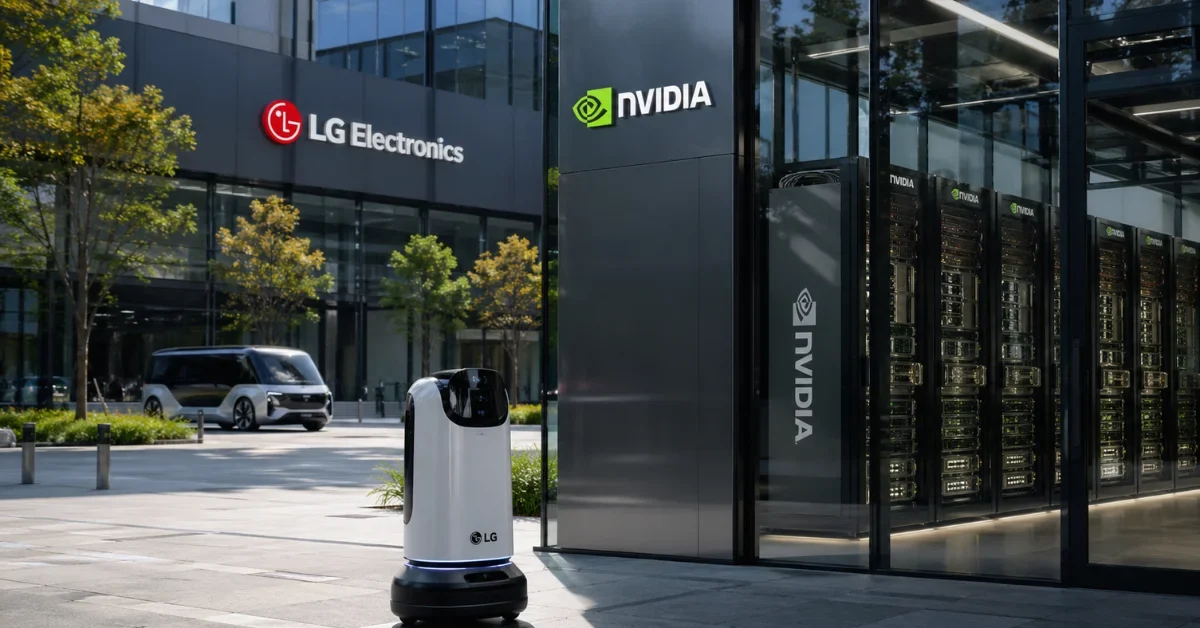
LG Electronics has confirmed talks with Nvidia over possible cooperation in robotics, AI data centres, and mobility, putting Nvidia-LG talks at the center of a fast-growing race to build out new artificial intelligence products and infrastructure. The discussions stand out because they connect one of the world’s best-known consumer electronics companies with a chip giant that is increasingly pushing beyond processors into broader AI systems.
The timing also fits Nvidia’s wider strategy. At its annual developer event, Chief Executive Jensen Huang said the company is moving beyond graphics processors and deeper into hardware, infrastructure, and software, while forecasting that Nvidia’s flagship AI processors could help generate $1 trillion in cumulative sales through 2027, driven by demand for its Blackwell and Rubin platforms.
LG’s AI Roadmap
The talks with Nvidia line up with the areas LG has already highlighted in its own AI plans. The Next Web reported that LG used its CES presentation to frame its AI strategy around three pillars: device excellence, an orchestrated smart home ecosystem, and expansion into AI-defined vehicles and AI data centre HVAC solutions.
LG’s robotics ambitions are already visible in its CLOiD robot. According to The Next Web, the robot runs on LG’s “Affectionate Intelligence” platform, which handles contextual awareness, natural interaction, and continuous learning from the home environment. That makes robotics more than a side project for LG and shows why this part of the Nvidia-LG talks is drawing attention.
The data centre side of the discussions may be just as important. The same report said LG has explicitly positioned itself as a provider of high-efficiency HVAC and thermal management solutions for AI data centres, a market gaining importance as AI computing systems demand more power and cooling support.
Nvidia’s System Push
NVIDIA is making a broader argument that AI demand now reaches far beyond standalone chips. Huang said computing demand has increased by 1 million times in the last two years, reflecting the scale of the AI buildout now underway across industries.
Gulf News reported that Nvidia is repositioning itself from a chipmaker into a full-scale AI systems company. That push includes new processors, complete computing systems, and a strategy aimed at controlling more of the AI stack from hardware to infrastructure and software. The report also said Nvidia is moving into complete computing systems that combine processors, networking, and software into integrated platforms.
NVIDIA is also expanding into adjacent markets as it looks for more ways to embed its technology into real-world applications. Gulf News said the company is deepening its presence in central processing units, exploring chips for data centres in space, and growing partnerships across technology, software, and mobility. In that context, talks with LG fit neatly into Nvidia’s effort to spread its AI capabilities across more industries and use cases.
India Footprint Grows
NVIDIA’s expansion is not limited to partnerships and product plans. The Economic Times reported that the company signed a 7.6 lakh sq ft office deal in Bengaluru that became effective on April 1, 2026, with rent set at Rs 113 per sq ft per month. The report said the monthly rent is Rs 8.59 crore, with a 15% escalation every three years and a security deposit of Rs 34.35 crore.
The same report said the full tenure value of the Bengaluru lease is well over Rs 1,200 crore. It also said the transaction nearly doubled Nvidia’s known India office footprint, taking its combined Bengaluru and Pune presence to more than 11.35 lakh sq ft. NVIDIA’s India footprint now spans six cities: Bengaluru, Pune, Hyderabad, Gurugram, Mumbai, and New Delhi.
The Economic Times also linked that office growth to Nvidia’s broader India strategy. The report said Nvidia is involved in India’s sovereign AI infrastructure push, with partners such as Yotta deploying more than 20,000 Nvidia Blackwell Ultra GPUs and L&T building gigawatt-scale AI factory infrastructure across Chennai and Mumbai. It added that Huang projected cumulative demand for Nvidia’s Blackwell and Vera Rubin chip architectures would reach at least $1 trillion through the end of 2027, doubling his earlier estimate of $500 billion through 2026.
What Is Confirmed Now
For now, what is confirmed is that LG Electronics and Nvidia are discussing possible cooperation rather than announcing a finalized deal. Even so, the scope of those talks, spanning robotics, AI data centres, and mobility, shows how Nvidia’s growth story is increasingly tied to full systems, infrastructure, and industry partnerships, while LG’s own AI roadmap already points toward those same areas.
