

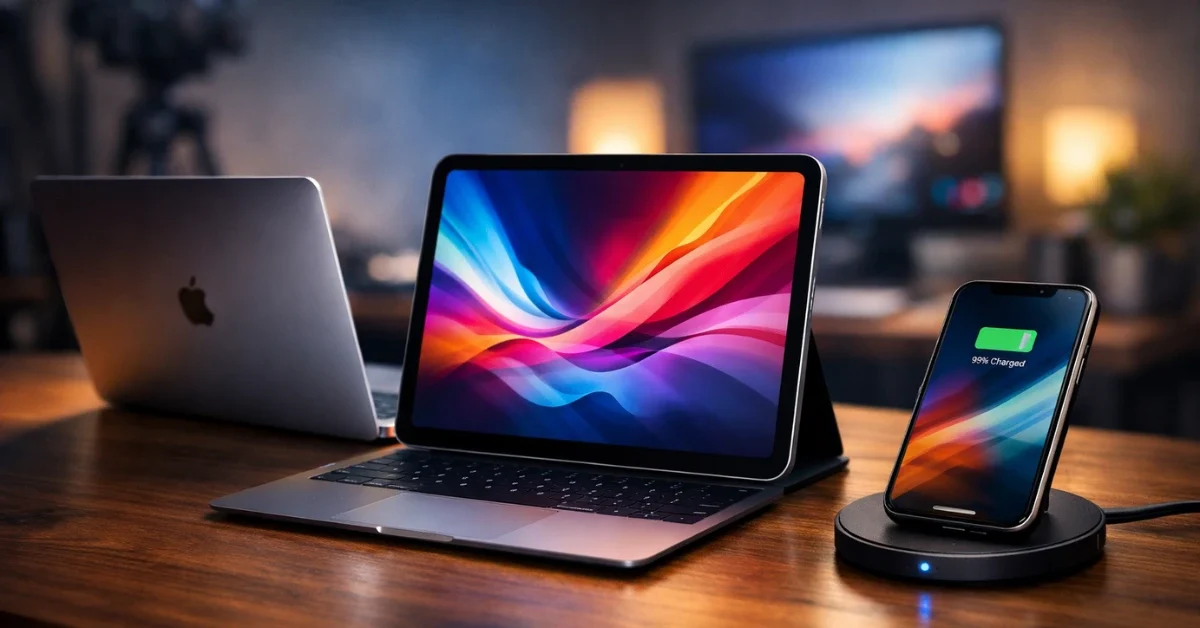
Apple has officially kicked off its highly anticipated Apple March 2026 product launches, revealing a sweeping wave of new hardware. Rather than hosting a traditional, single-day keynote presentation, CEO Tim Cook confirmed a sequential, multi-day rollout strategy.
The staggered announcements began on Monday, March 2, through press releases and product videos. This momentum is building toward exclusive, in-person media experiences scheduled for Wednesday, March 4, in three major cities: New York, London, and Shanghai. By spreading out the reveals, Apple ensures that every new device gets focused attention, showcasing a comprehensive strategy that targets everyone from budget-conscious students to high-end creative professionals.
The M5 MacBook Air and the Budget-Friendly MacBook Neo
Apple’s Mac lineup received significant attention this week, led by the refreshed MacBook Air. While the sleek aluminum design remains unchanged, the new ultrabook is now powered by the M5 chipset. This upgrade promises a noticeable jump in speed, efficiency, and artificial intelligence capabilities.
To offset rising hardware costs, Apple doubled the base storage of the MacBook Air to 512GB. The laptop can also be configured with up to 32GB of unified memory and a massive 4TB of solid-state storage. However, buyers in India are facing a steep price hike of Rs 20,000 across the board. The 13-inch MacBook Air M5 now starts at Rs 1,19,900, while the larger 15-inch model begins at Rs 1,44,900. Both models continue to feature a 12MP Centre Stage camera, a six-speaker sound system with spatial audio, and MagSafe 3 charging.
For users seeking macOS at a much lower price, Apple introduced a completely new entry-level laptop: the MacBook Neo. Starting at just $599, the MacBook Neo fills a long-standing gap in the company’s budget lineup. To achieve this aggressive price point, Apple equipped the laptop with the A18 Pro chip, a processor originally used in the iPhone 16 smartphone line. While it may not handle heavy creative workloads, the MacBook Neo is designed for students and office workers, offering an impressive 18 hours of battery life to rival top-tier Chromebooks on the market.
A Massive Leap for the iPad Air M4
The tablet family also saw a major upgrade with the introduction of the new iPad Air. Skipping the M3 generation entirely, the latest iPad Air is powered directly by the M4 chip. Apple notes this processor makes the tablet up to 30 percent faster than the previous M3 models and offers next-level power for everyday artificial intelligence tasks.
The new iPad Air is available in two sizes: an 11-inch model starting at INR 64,900 and a 13-inch version starting at INR 84,900. Under the hood, the device boasts 12GB of unified memory—a 50 percent increase from the previous generation—and heavily increased memory bandwidth.
Connectivity is another primary focus for the new tablets. Apple integrated its custom-designed N1 and C1X networking chips into the iPad Air series. These additions enable Wi-Fi 7 support, Bluetooth 6, and up to 50 percent faster cellular data performance on 5G models.
The tablets will run on the newly announced iPadOS 26, which introduces a fresh Liquid Glass design aesthetic and a completely revamped windowing system for better multitasking. For creative professionals, the new iPad Air also supports the high-end Apple Pencil Pro and the Magic Keyboard accessories.
The Affordable iPhone 17e and Premium Studio Display XDR
Apple’s smartphone strategy continues to evolve alongside its computers with the launch of the iPhone 17e. Replacing last year’s iPhone 16e, this budget-friendly model keeps its starting price safely anchored at $599. The arrival of the 17e suggests that Apple is permanently moving its more affordable smartphone tier to a reliable annual update cycle.
The iPhone 17e packs a surprising amount of processing power for its lower price tag. It utilizes the modern A19 chip, featuring a six-core CPU and a 16-core Neural Engine, though it has one less graphics core than the flagship iPhone 17. Notably, Apple has also added standard MagSafe and Qi2 fast wireless charging support to this entry-level model.
On the opposite end of the pricing spectrum, Apple unveiled a new monitor designed strictly for demanding creative professionals: the Studio Display XDR. Priced at a staggering $3,299, this 27-inch 5K Retina display features a mini-LED backlight. It delivers richer colors, higher brightness, and a refresh rate that doubles the standard Studio Display model, making it ideal for video production and intensive photo editing workflows.
Looking Ahead to the Rest of 2026
The launch week highlights Apple’s shifting approach to product reveals. The move away from a single live-streamed keynote toward multi-day announcements allows the company to dominate the technology news cycle for an entire week.
Industry rumors suggest that the hardware rollout might not be over just yet. Additional configurations for the MacBook Pro, including the highly anticipated M5 Pro and M5 Max chips, are heavily expected to drop soon. Furthermore, reports indicate that Apple is actively developing a revamped smart home device featuring a built-in screen. As the March events unfold, it is clear that Apple intends to offer a fresh product for nearly every budget and workflow this year.
