

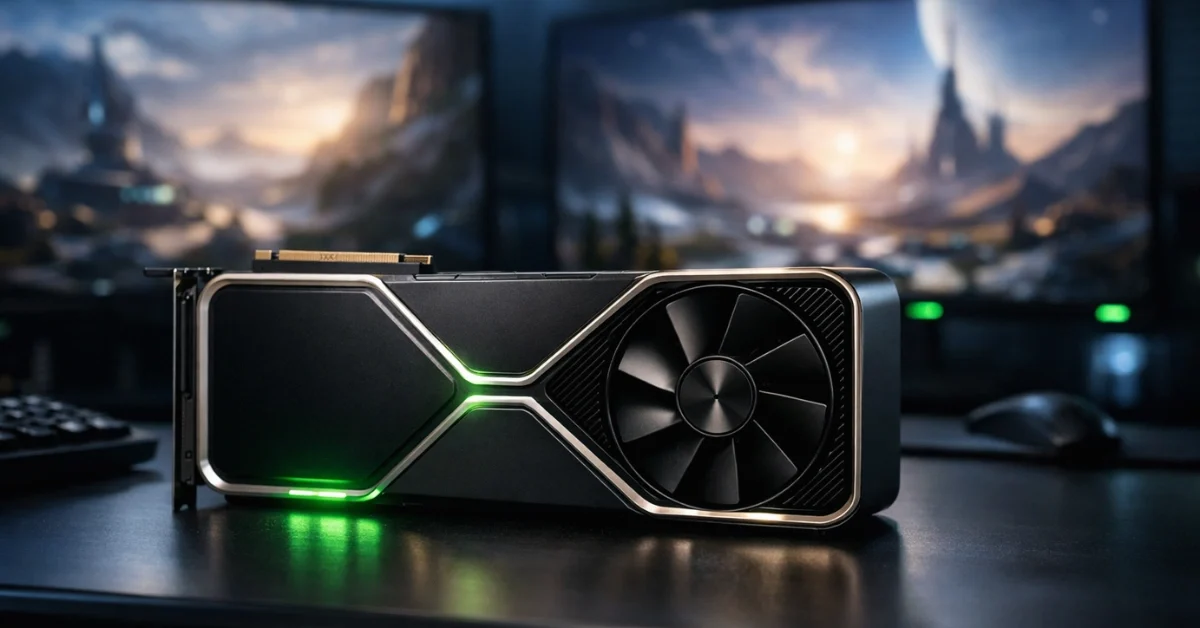
At the GTC 2026 megaconference, the company officially unveiled Nvidia DLSS 5, positioning the technology as a groundbreaking leap into a new level of photorealistic computer graphics. This latest iteration of Deep Learning Super Sampling introduces a real-time neural rendering model designed to completely overhaul lighting and materials in video games. Slated for a full release this fall, the update aims to shrink the long-standing gap between real-time game graphics and movie-quality visual effects by relying heavily on advanced generative AI.
Nvidia CEO Jensen Huang introduced the technology during his keynote address, calling Nvidia DLSS 5 a “GPT moment” for computer graphics. The system blends traditional handcrafted 3D graphics rendering with generative AI models. This hybrid approach allows Nvidia’s graphics processing units to produce highly detailed scenes without having to render every single element from scratch, ultimately saving massive amounts of compute power. According to Huang, this represents the biggest leap in visual realism since the introduction of real-time ray tracing in 2018.
How the Neural Rendering Model Works
Unlike previous iterations that primarily focused on upscaling resolution and generating extra frames, this new update fundamentally changes how frames are created. The AI model takes the game’s color and motion vectors as inputs for each individual frame. It then infuses the scene with realistic materials, understanding the semantics of complex elements like skin, hair, fabric, water, and metal.
The system also adapts to various lighting conditions, such as backlit environments or overcast skies, applying enhancements that remain consistent from frame to frame. According to Nvidia, this allows for effects like accurate skin translucency and realistic light bouncing off surfaces. All of this processing happens in real-time at resolutions up to 4K, an achievement that would typically take minutes or hours per frame in traditional film production.
Developer Support and Upcoming Titles
Nvidia has built its DLSS ecosystem over several years, initially starting in 2018 as a way to improve performance by upscaling lower-resolution images using machine learning. DLSS 4.5 recently pushed these boundaries further, allowing AI to generate a vast majority of the pixels seen on screen. Now, the technology expands the role of AI even further, allowing GPUs to generate a substantial portion of the final image through neural inference rather than pure native rendering.
The gaming industry is already beginning to adopt the new technology. Nvidia confirmed that major publishers, including Bethesda, Capcom, Ubisoft, and Warner Bros., are supporting the software. The update will be available in several highly anticipated and existing titles, such as Assassin’s Creed Shadows, Starfield, Hogwarts Legacy, EA Sports FC, and Resident Evil Requiem.
Early reactions from game developers have been highly positive. Bethesda studio head Todd Howard noted that it was amazing how the technology brought the universe of Starfield to life. Similarly, Jun Takeuchi, executive producer at Capcom, stated that the software helps push visual fidelity forward, allowing players to become deeply immersed in the world of Resident Evil.
Criticisms and the “Uncanny Valley”
Despite the technological advancements and developer enthusiasm, the gaming community remains sharply divided over the visual results. Some critics and players have expressed concern that the AI-driven changes are too dramatic, fundamentally altering the original art style, textures, and creative intent of the game’s developers.
Some media outlets have harshly criticized the early demonstrations. A report from Gizmodo described the updates as “slop-ification,” arguing that the AI makes characters look like uncanny internet stock images. Critics pointed out that a wizened witch in Hogwarts Legacy appeared unnaturally wrinkled, while Bethesda’s characters in Starfield sported pronounced eyebrows and cheekbones that pushed them dangerously close to the uncanny valley.
Furthermore, demonstrations of older remastered games have drawn mixed reactions. When running on The Elder Scrolls IV: Oblivion Remastered, some updated character models were described as looking like craggy skin adhered to a beaten pineapple. In Resident Evil Requiem, the faces of protagonists Grace Ashcroft and Leon Kennedy were significantly altered, with one critic comparing Leon’s new look to a ChatGPT prompt for a grizzled horror protagonist with a boy band haircut.
The Future of AI in PC Gaming
While character models have sparked debate, the technology’s handling of environments has received praise. Richard Leadbetter, founder of Digital Foundry, noted that the treatment of materials like metals, cloth, fruit skin, and foliage lighting is astonishingly realistic. He clarified that while it shares similarities with generative AI, the system remains consistent and coherent within the game world.
Nvidia acknowledges that the technology is still a work in progress, describing the current demonstrations as a snapshot of its capabilities. As the company fine-tunes the model ahead of its fall release, the gaming community will be watching closely. With additional updates expected to include 6x frame generation, this massive AI integration is poised to be a major selling point for Nvidia’s next generation of graphics cards.
