

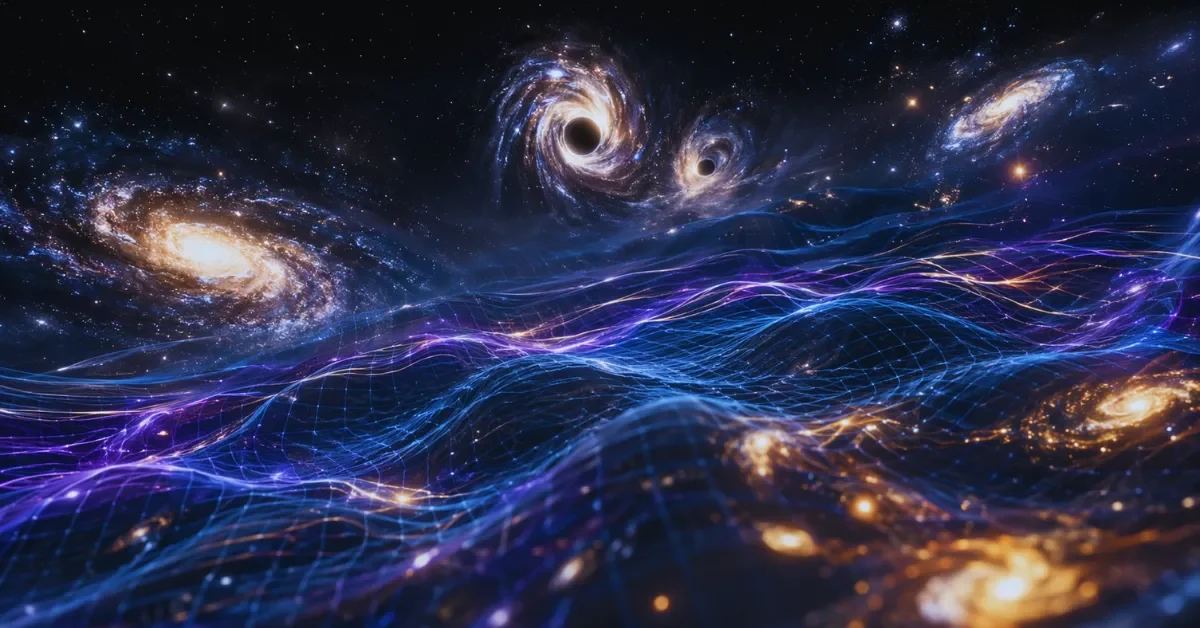
For decades, scientists have grappled with a central crisis in cosmology known as the Hubble tension. This conflict arises from two different methods of measuring the universe’s expansion rate, or the Hubble constant, which consistently yield conflicting results. Now, a comprehensive analysis combining years of independent measurements confirms that this discrepancy is not due to observational errors or statistical uncertainty. Instead, it points to a significant gap in the standard cosmological model, suggesting new physics may be required to explain cosmic expansion.
The recent findings stem from a community-wide effort launched at a breakthrough workshop in Bern, Switzerland. Astronomers developed a unified framework to measure the local universe’s expansion with unprecedented precision. By confirming that the Hubble tension is real, researchers are fundamentally challenging our understanding of cosmic evolution. Physicists are now exploring innovative concepts, ranging from primordial magnetic fields to the background hum of gravitational waves, to solve this profound mystery.
The Local Distance Network Achieves One Percent Precision
To determine the expansion rate of the nearby universe, astronomers historically relied on a cosmic distance ladder. This method uses increasingly distant celestial objects to calculate how light stretches as it travels through expanding space. Expanding on this concept, researchers have now established the Local Distance Network. This community-built framework integrates decades of independent distance measurements transparently, achieving a goal once considered unreachable.
The Local Distance Network relies on local anchor points with geometrically determined distances. These include the galaxy NGC 4258, the Magellanic Clouds, and variable stars within the Milky Way. Researchers also incorporated data from dying red giant stars, supermassive black hole accretion disks, and over 7,500 galaxies observed up to a billion light-years away. Through this massive synthesis, the team calculated the most precise direct measurement of the Hubble constant in the local universe to date: 73.50 kilometers per second per megaparsec, with a relative uncertainty of just 1.09 percent.
The Core of the Cosmological Crisis
The crisis in cosmology becomes apparent when comparing the local expansion rate to measurements from the ancient cosmos. When astronomers calculate the Hubble constant using the cosmic microwave background—the earliest light from just after the Big Bang—they get a significantly lower value of approximately 67 or 68 kilometers per second per megaparsec.
While the difference may seem small, it is far larger than what statistical anomalies can explain. The persistence of this gap, solidified by the recent one-percent precision measurement, indicates that the current standard model of cosmology is incomplete. The comparison between early and late-universe values effectively tests physics on a cosmological scale, revealing that a crucial piece is missing.
Exploring Primordial Magnetic Fields and Evolving Dark Energy
With the discrepancy confirmed, cosmologists are investigating alternative theories to bridge the gap. One proposed solution involves primordial magnetic fields generated in the early moments of the universe. If present, these magnetic fields could have influenced charged particles, altering the moment the universe became transparent. This effect would change the scale of the patterns observed in the cosmic microwave background, effectively shifting the early-universe measurements to align with local observations.
Simultaneously, researchers are examining the mysterious force known as dark energy, which drives the accelerated expansion of the cosmos. A newly proposed mathematical framework comparing various dark energy models reveals compelling evidence that its properties may have evolved since the early universe. The framework also suggests potential interactions between dark energy and dark matter. These findings highlight the necessity for advanced theoretical models and next-generation surveys to address the persistent tension.
Gravitational Waves as a New Measurement Tool
In the search for an independent way to measure the Hubble constant, scientists are turning to ripples in space and time known as gravitational waves. Predicted by general relativity, these waves are generated by massive cosmic collisions, such as merging black holes. Researchers have proposed a novel technique called the stochastic siren method, which utilizes the background hum of distant, unobservable black hole collisions across the universe.
By analyzing the density of these collisions and the resulting gravitational wave background, astronomers hope to determine an independent expansion rate. While current gravitational wave detectors need greater sensitivity to fully capture this background hum, initial proofs of concept indicate that this method could eventually provide a definitive measurement. As detectors improve, gravitational waves may serve as the ultimate tool to constrain the Hubble constant and finally resolve the cosmological crisis.
