

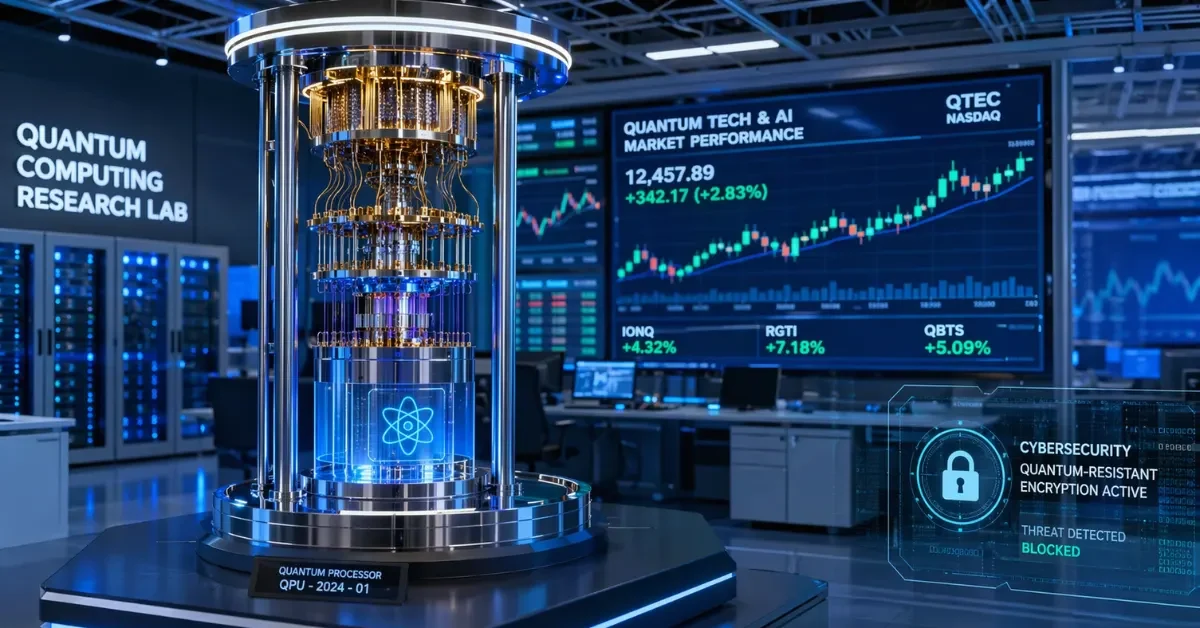
Quantum computing moved back to the center of the tech conversation this month as Nvidia’s new AI models lifted quantum computing stocks, fresh research raised new questions about online security, and India reported major progress in secure quantum communication. Together, these developments show how quantum computing is moving beyond theory and into a phase where markets, governments, and universities are paying closer attention.
The sharpest market reaction came after Nvidia introduced Ising, an open-source family of AI models built to help solve two difficult problems in quantum computing: processor calibration and real-time error correction. That announcement pushed several quantum names higher during Tuesday trading, with Xanadu Quantum Technologies, IonQ, D-Wave Quantum, and Rigetti Computing among the notable gainers.
Nvidia sparks stock rally
The market response was especially dramatic for Xanadu. The company’s stock, which had only recently started trading publicly after a merger with a special purpose acquisition company, jumped sharply in the days following Nvidia’s April 14 announcement. By Friday afternoon, shares were trading at $31.41 in New York, up 251% from the previous week’s close, after rising as high as $40 during the rally.
The move was strong enough to trigger multiple trading halts on the Toronto Stock Exchange. At one point, Xanadu’s market value briefly moved past $16 billion, making it one of Canada’s most valuable publicly traded technology companies just weeks after its Nasdaq and TSX debut.
NVIDIA said its Ising decoding models are up to 2.5 times faster and three times more accurate than pyMatching, an open-source decoder used by many quantum researchers. That helped investors focus on a key idea now gaining traction across the industry: AI may help make fragile quantum systems more reliable and easier to scale.
That theme also appeared in analyst commentary. Bernstein said quantum processor units, or QPUs, could become an important co-processor in data centers alongside CPUs and GPUs. The broader message from the rally was clear: even though the sector remains speculative, investors are reacting strongly to tools that may speed up practical progress.
AI raises the stakes
At the same time, a separate set of developments showed why the quantum race matters beyond stock prices. New research described by TIME said papers from Google and quantum startup Oratomic suggest that quantum computers capable of breaking widely used encryption protocols may arrive sooner than many expected.
That possibility has direct cybersecurity consequences. Cloudflare said it was accelerating its own deadline to prepare for quantum computers to 2029, ahead of the 2035 deadline set by the U.S. National Institute of Standards and Technology. Multiple experts cited in the report said the Google and Oranotica results could significantly shorten the timeline for a quantum computer that threatens encryption.
A major reason for that concern is the growing role of AI in research itself. According to the TIME report, Oratomic’s team said AI was instrumental in developing its algorithm. In atomic quantum computers, it can take between 100 and 1,000 atoms to encode a single qubit, but the algorithm described in the report requires just three atoms to encode a qubit, sharply reducing the resources needed for that approach.
The report also noted an important caution. The paper has not yet been peer-reviewed, and one expert quoted by TIME said some of the assumptions behind the work remain untested. Even so, the research added urgency to the global discussion about post-quantum cybersecurity and how quickly institutions need to prepare.
India builds momentum
India also added to the global quantum story with a major milestone in secure communications. Under the National Quantum Mission, the country developed a 1,000-km quantum communication network in less than two years from the mission’s launch, using indigenous technology developed by QNu Labs with support from the Department of Science and Technology.
The network uses Quantum Key Distribution, or QKD, a method designed to share encryption keys using quantum particles in a way that can reveal interception attempts. The development was described as one of the longest QKD deployments globally since the mission began, and it is aimed at strengthening secure communications across defence, financial systems, and critical national infrastructure.
India’s push is also reaching campuses. On April 16, Visvesvaraya Technological University said it is preparing to establish a dedicated quantum computing lab at its Bengaluru campus. The announcement came during the National Quantum Students’ Conference and Symposium-2026, which drew more than 200 students and included over 50 research papers scheduled for presentation across two days.
Taken together, these developments show a field moving on several fronts at once. Markets are responding to AI-driven quantum tools, researchers are warning that security timelines may be shrinking, and institutions are building the infrastructure needed to train talent and deploy new systems. Quantum computing is still an emerging technology, but the latest signals suggest the pace of change is getting harder to ignore.
